
 •
Rating:
•
Rating:
THE REVIEW
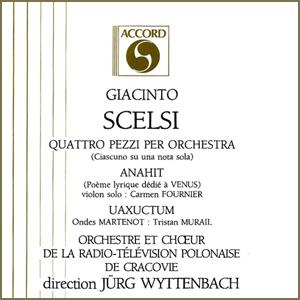
To get an idea of Giacinto Scelsi's sound world, just read the titles of the pieces on this CD: "Four Pieces on a Single Note" sounds like a joke. "Anahit" and "Uaxuctum," two enigmatic names... echoes of a remote exoticism.
Imagine then the surprise when listening: the "Four Pieces" from 1959 each assume one note (F, B, A flat, A) as a foundation on which the four brief compositions (16 minutes in total) rest, but there are continuous variations in pitch, intensity, timbres—as well as microtonal fluctuations in the sounds—such that the piece is never monotonous but perpetually differentiated in a highly refined sound kaleidoscope.
"Anahit" is the ancient Egyptian name for Venus, to which this 1965 piece is dedicated, in the subtitle: Scelsi's very personal contribution to the classical genre of the concerto for solo instrument and orchestra. In this case, the solo violin avoids any melodic phrasing and produces only long sustained notes, blending for 13 minutes into the sound bands produced by the orchestra, as if one were seeking shelter and peace in the other.
Giacinto Scelsi's case is a singular one (1905-1988). If ever the expression "cult" had a meaning, this is the right opportunity to use it in regard to this composer overlooked for many years (and decades) in Italy, whose name emerged little by little, especially abroad. Today, Scelsi, the aristocrat, the contrarian who did not want to bow to the oppressive rules of the serial school and who, out of spite, looked to the East and the esotericism of ancient civilizations, is considered one of the most original composers of the 20th century.
Try listening to "Uaxuctum," the last piece on the CD: you will be transported into the legend of the ancient Mayan city destroyed by its own inhabitants. A piece from 1966, 20 minutes long, with an ensemble of 8 percussionists and the enigmatic sounds of the ondes Martenot, favoring dark tones (in the strings, violins and violas are entirely absent, but there are 6 double basses). And above all the choir, which bursts in after a few minutes projecting the piece into an abstract, sidereal dimension. A choir that does not intone any text but produces pure sound, tainted here and there by microtonal smudges, nasal and guttural sounds, onomatopoeic imitations (breathing, etc.).
I wouldn't be surprised if some of you, upon first hearing this music, mistook it for electronic music, perhaps dark ambient. Premonitions of what was to come?... This CD collects three successful examples of Giacinto Scelsi's visionary personality: not all of his music sounds like this, but this is a good opportunity to begin engaging with the "Scelsi case".
Loading comments slowly
Summary by Bot
This review highlights Giacinto Scelsi's unique and visionary orchestral compositions featured on this CD, showcasing his pioneering use of microtonal variations and innovative sound textures. The works, influenced by Eastern mysticism and ancient legends, create an exotic and immersive listening experience. Pieces like 'Four Pieces on a Single Note,' 'Anahit,' and 'Uaxuctum' demonstrate Scelsi’s contribution to 20th-century avant-garde music. The review encourages exploring this distinct sound world as an introduction to Scelsi’s legacy.Tracklist
Giacinto Scelsi
Giacinto Scelsi (1905–1988) was an Italian composer known for intensely focused works centered on single pitches and microtonal inflections, forging a distinctive, meditative sound world. Long overlooked, he is now regarded as one of the 20th century’s most original voices.02 Reviews
