
 •
Rating:
•
Rating:
THE REVIEW
For Dhani Harrison, valuing the artistic and cultural heritage left by his father is a constant commitment.
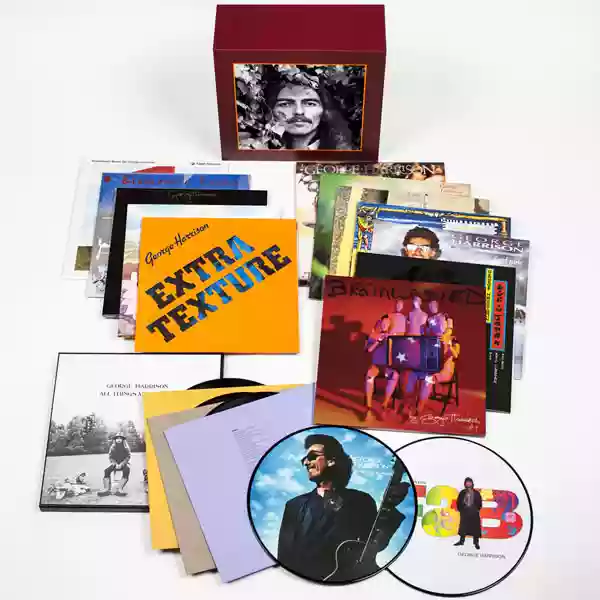
The work of the spiritual Beatle is precious, and over the years, some have somewhat forgotten it, relying on a superficial understanding of the legacy of a man who lived his short life constantly balancing between the material and spiritual worlds. So, the Apple of the Fab Four from Liverpool releases the entire remastered works of George Harrison on 180g vinyl for both old and new Beatles aficionados. The journey is complete, from his debut in '68 with the soundtrack "Wonderwall Music" to the posthumous "Brainwashed" in 2002, a year after his death. Harrison gave his musical production an extremely personal touch. If "All Things Must Pass" is the triple album of a grown talent now overshadowed by authors too great for anyone, "Living in the Material World" marks the full assertion of his spiritual consciousness. The period '74-'75 is the most difficult; the talent is always there, but the recording industry and an Apple about to close its doors push George towards the use of alcohol and cocaine, which do not benefit the decent "Dark Horse," despite the poor voice due to laryngitis, and the "flawed" "Extra Texture," which still places the big hit "You" but is the weak point, in terms of production and sound, of Harrison's work. The Dark Horse label period is once again prolific and fully inspired, at least until the early '80s; the death of John and the usual recording pressures, wanting him to fit the plastic era ("Blood From a Clone"), cause in Harrison a rejection of the music business, resulting in the weak "Somewhere in England" ('81) and "Gone Troppo" ('82). The comeback in 1987 thanks to Jeff Lynne with "Cloud Nine" has Harrison delivering the master stroke, a fresh and cohesive record that may not be at the level of the early '70s but is more than enough to clear out many "one-hit wonder" bands hated by good George that infest the charts of the period. It's a magical period; he forms the Travelling Wilburys with Dylan, Petty, Lynne, and Orbison, lends his guitar to Belinda Carlisle for "Runaway Horses," and then returns to a peaceful retreat at his Friar Park after the "Live in Japan" in '92.
This was George Harrison, the third arrow of a magic bow who managed to move forward alone with consistency and inspiration, the "mystical one" with the sweetly unmistakable guitar of rock music.
Loading comments slowly
Summary by Bot
This review praises the remastered vinyl collection of George Harrison, showcasing his deep spiritual and musical journey. It covers his career from the debut 'Wonderwall Music' to posthumous 'Brainwashed,' highlighting highs and lows. The collection reflects the balance he maintained between material and spiritual worlds. Key albums and collaborations are examined, celebrating Harrison's unique contribution to rock music.Tracklist Lyrics
01 Wonderwall Music (00:00)
02 Electronic Sound (00:00)
03 All Things Must Pass (00:00)
04 Living In The Material World (00:00)
06 Extra Texture (Read All About It) (00:00)
07 Thirty Three And 1/3 (00:00)
08 George Harrison (00:00)
09 Somewhere In England (00:00)
10 Gone Troppo (00:00)
11 Cloud Nine (00:00)
12 Brainwashed (00:00)
13 Live In Japan (00:00)
14 12" Got My Mind Set On You (00:00)
15 12" When We Was Fab (00:00)
17 Dream Scene (05:33)
18 Red Lady Too (01:58)
19 Tabia And Pakawaj (01:04)
20 In The Park (04:05)
21 Drilling At Home (03:08)
22 Guru Vandana (01:02)
23 Greasy Legs (01:27)
24 Ski-ing (01:37)
25 Gat Kirwani (01:15)
26 Any Road (00:00)
27 P2 Vatican Blues (Last Saturday Night) (00:00)
28 Pisces Fish (00:00)
29 Looking For My Life (00:00)
30 Rising Sun (00:00)
31 Marwa Blues (00:00)
32 Stuck Inside A Cloud (00:00)
33 Run So Far (00:00)
34 Never Get Over You (00:00)
35 Between The Devil And The Deep Blue Sea (00:00)
36 Rocking Chair In Hawaii (00:00)
37 Brainwashed (00:00)
38 I Want To Tell You (04:36)
39 Old Brown Shoe (03:55)
41 Give Me Love (Give Me Peace On Earth) (03:39)
42 If I Needed Someone (03:50)
49 Here Comes The Sun (03:31)
52 Cheer Down (04:01)
56 Roll Over Beethoven (04:34)
57 Got My Mind Set On You (Extended Version) (00:00)
58 Got My Mind Set On You (Single Version) (00:00)
59 Lay His Head (00:00)
60 When We Was Fab (Unextended Version) (00:00)
62 That's The Way It Goes (Remix) (00:00)
63 When We Was Fab (Reverse End) (00:00)
64 Party Seacombe (04:20)
65 Love Scene (04:15)
66 Crying (01:12)
67 Cowboy Music (01:22)
68 Fantasy Sequins (01:43)
69 On The Bed (01:03)
70 Glass Box (02:15)
71 Wonderwall To Be Here (01:23)
72 Singing Om (01:53)
73 Under The Mersey Wall (00:00)
74 No Time Or Space (00:00)
78 Isn't It A Pity (Version One) (00:00)
82 Let It Down (00:00)
83 Run Of The Mill (00:00)
86 Ballad Of Sir Frankie Crisp (Let It Roll) (00:00)
88 All Things Must Pass (00:00)
89 I Dig Love (00:00)
91 Isn't It A Pity (Version Two) (00:00)
92 Hear Me Lord (00:00)
93 Out Of The Blue (00:00)
96 I Remember Jeep (00:00)
98 Give Me Love (Give Me Peace On Earth) (00:00)
99 Sue Me, Sue You Blues (00:00)
100 The Light That Has Lighted The World (00:00)
101 Don't Let Me Wait Too Long (00:00)
102 Who Can See It (00:00)
103 Living In The Material World (00:00)
104 The Lord Loves The One (00:00)
105 Be Here Now (00:00)
106 Try Some Buy Some (00:00)
107 The Day The World Gets 'Round (00:00)
108 That Is All (00:00)
109 Hari's On Tour (Express) (00:00)
110 Simply Shady (00:00)
111 So Sad (00:00)
112 Bye Bye, Love (00:00)
113 Maya Love (00:00)
114 Ding Dong; Ding Dong (00:00)
116 Far East Man (00:00)
117 It Is "He" (Jai Sri Krishna) (00:00)
118 You (03:30)
119 The Answer's At The End (05:30)
120 This Guitar (Can't Keep From Crying) (04:11)
121 Ooh Baby (You Know That I Love You) (03:50)
122 World Of Stone (04:46)
123 A Bit More Of You (00:45)
124 Can't Stop Thinking About You (04:30)
125 Tired Of Midnight Blue (04:50)
126 Grey Cloudy Lies (03:41)
127 His Name Is Legs (Ladies & Gentlemen) (05:45)
128 Woman Don't You Cry For Me (03:15)
129 Dear One (05:08)
131 This Song (04:11)
132 See Yourself (02:48)
133 It's What You Value (05:05)
134 True Love (02:43)
137 Learning How To Love You (04:15)
138 Loves Come To Everyone (04:33)
139 Not Guilty (03:36)
140 Hers Comes The Moon (04:46)
141 Soft-Hearted Hana (04:03)
142 Blow Away (03:59)
144 Dark Sweet Lady (03:20)
145 Your Love Is Forever (03:45)
149 Unconsciousness Rules (00:00)
150 Life Itself (00:00)
154 That Which I Have Lost (00:00)
156 Hong Kong Blues (00:00)
157 Save The World (00:00)
158 Wake Up My Love (00:00)
159 That's The Way It Goes (00:00)
160 I Really Love You (00:00)
162 Gone Troppo (00:00)
163 Mystical One (00:00)
165 Baby Don't Run Away (00:00)
166 Dream Away (00:00)
169 That's What It Takes (03:58)
171 Just For Today (04:04)
172 This Is Love (03:45)
177 Breath Away From Heaven (03:35)
George Harrison
George Harrison (1943–2001) was an English musician, songwriter and guitarist, best known as a member of the Beatles. His solo work is frequently discussed around the landmark 1970 triple album All Things Must Pass, his spiritual songwriting, benefit work connected to Bangladesh, and later-career resurgence with Cloud Nine before his final album Brainwashed was released posthumously.21 Reviews
