
 •
Rating:
•
Rating:
THE REVIEW
A guitarist quite talented for his time, often relegated by his much more illustrious bandmates McCartney and Lennon to the role of a mere instrumentalist, with a rather distinctive and recognizable falsetto voice, George Harrison began early on to compose and sing his own material with the Beatles. Material that often undertook the difficult if not, given that the group in question was the Beatles, almost impossible task of completing the band's LPs. A thankless task also, because George as a composer was not bad—in fact, in any other band he would have stood out, and indeed he did not look bad. And yet, he was never at the same level as the other two: raise your hand how many of you know George's songs with the early Beatles! Fortunately, there are exceptions, such as "If I Needed Someone" or "Taxman." But George did not stand out. He continued to float, carried by worldwide success, shining with a light not his own, something that frustrated him terribly. He got some further satisfaction by becoming recognized as the most spiritual Beatle, the one most musically attentive to the breeze coming from the East, improvising with fair results as a sitar musician. In short, like Brian Jones, a very respectable co-star and rather precious in the recording studio but always a co-star.
Nevertheless, between 1968 and 1969, George proved to himself and others that he was not just a co-star. Inspired by trips to India, he began developing songwriting, a style different from the rest of the group, more spiritual and delicate in some cases, tremendously corrosive and sardonic in others. Not inclined to silly love songs, nor political slogans, he produced gems like "While My Guitar Gently Weeps," "Long Long Long," "Old Brown Shoes," "Here Comes The Sun," and "Something," which was a mocking revenge against the Beatles: the first and only hit-single of the group bearing his signature, considered one of their absolute classics and ironically described sometime later by Frank Sinatra as "the finest piece of Lennon and McCartney." Who knows how George took it, having already swallowed many such things. The fact remains that shortly thereafter, George witnessed his personal release from that prison called the Beatles with a mix of predictable enthusiasm, possibly akin to a stockholm syndrome: at the end of 1969, he was convinced by his friend Eric Clapton, who had just seen his Blind Faith sink, to embark on his adventure of that moment, an English tour with the then-popular duo Delaney And Bonnie (Delaney Bramlett passed away just a few days ago, by the way). Reports of the time speak of a Harrison who presented himself, after years away from the stage, wanting to use a euphemism, shy and somewhat awkward, as far as possible from the lights and reserved towards an excited and astonished audience at a concert of what was a relatively ephemeral group of the era, nothing less than a Beatle. Thus, in early 1970, having apparently settled his accounts with the heavy Beatles' burden, George began to take his first steps towards his real solo debut—he had actually already released two experimental music albums. First things first, he thought it wise to recruit Phil Spector, the legendary producer of the American sound of the '60s, at that time busy first producing the controversial Let It Be sessions and then several solo albums by the Fab Four. A significant choice, moreover: the Beatles, with their producer George Martin, had contributed to radically innovate the music of the time. Choosing Spector meant repudiating the recent past, to return to the origins, to rock 'n' roll, to the Wall of Sound that characterized the youthful myths of the Beatles. Furthermore, George thought it wise, to make things easier and more relaxed, to surround himself with a multitude of musician friends: obviously Eric Clapton (who, by the way, was at the time engaging in a tumultuous relationship with Harrison’s wife, unbeknownst to him) with his band (nothing less than the Derek and Dominos), and while on it, the only true friend from past times, namely Ringo Starr. And then many others: Klaus Voorman on bass, Gary Brooker and Gary Wright on keyboards, Billy Preston on the organ, Pete Drake on pedal steel, Dave Mason on guitar, Bobby Keys on sax and Jim Price on trumpet, and still more; in the end, due to Spector's infinite manpower demands (as Harrison ironically and realistically described, the mad producer required at every session something like two or three acoustic guitars, two drummers, three keyboardists to fill his Wall of Sound), a multitude of unknowns ended up infiltrating, some destined for a bright future, like a very young Phil Collins who found himself, despite himself, playing congas on "The Art Of Dying." But the most surprising thing was the immense bulk the work took on. George had a fair number of pieces accumulated over the past two years with the Beatles (some traces of "All Things Must Pass" and "My Sweet Lord" and possibly something else can be found in the immense cauldron of the Let It Be sessions), so his intention was to extract a single album. Nevertheless, the atmosphere of relaxation and confidence that developed during the sessions led him, a not particularly prolific author, to suddenly write many pieces, all of outstanding quality. It is not surprising, then, that the album in progress from single became double. No, the surprise is how it became a triple. We have said the key to the album's success was the confidence and friendship among the musicians, a solidarity built up by long and amusing (even in the titles: "Thanks For The Pepperoni"!) fully improvised jams. George, in tribute to these amusements and to the friends who stood by him, thought it wise to make a third album (but he was very honest, as he sold the album at the price of a double instead of a triple), something rather unusual (Frank Zappa aside!) even for years when record excesses and endless solos were overall common and even liked.
Talking about this album and its story (in the opinion of the writer, anyway, beautiful), without saying anything about the music contained therein, would be unfair. The most surprising thing is the extreme variety of styles: there is country-rock with Californian nuances influenced by Dylan's recent "Nashville-style" turn (offering a cover of "If Not For You," and with whom he composed the dreamy opening piece, "I'd Have You Anytime," not to mention the poignant "Behind That Locked Door"), traces of folk-rock ("Ballad For Sir Frank Crisp," a real declaration of love for his home, and "Apple Scruffs," a humorous tribute to the fans who waited for him outside the recording studio, whom he would let in to get their opinion on his pieces, offering them tea), pieces that exude the improvisational atmosphere ("Wah Wah"), slow ballads (the two "Isn't It A Pity?" "Beware Of Darkness," the title track) and more virulent and sometimes festive rock-blues ("What Is Life?" "Let It Down," "Hear Me, Lord"). Unexpectedly, however, there is not the slightest musical influence of Harrison's passion for Indian music, but rather a concentration of spirituality that emerges in a good portion of the pieces, as can easily be understood from many of their titles, a spirituality accompanied, moreover, as in the best tradition of our George, by a certain taste for a desecrating irony that sometimes borders on caustic. Lastly, the piece of discord, documented to history as the forerunner of the Musical Judicial Administration. For some, a piece perhaps similar to another, but not too much. For others, a plain and simple plagiarism of "He's So Fine," an old hit by the Chiffons. "My Sweet Lord" does not find unanimous opinions in this respect. Perhaps it is also for this that it remains Harrison's most famous solo piece, but denying its musical qualities is inappropriate. To each listener the arduous verdict. It must be said that for the writer, beyond an obvious similarity, it remains a stirring piece despite its simplicity, beautiful and enjoyable, but absolutely not the most beautiful of the entire work, which contains far more high-quality gems.
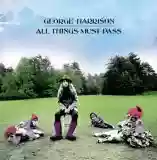
When it was released in November 1970, "All Things Must Pass" surprised practically everyone who never expected a triple debut and all of excellent level from him, George, "The Quiet One" of the Fab Four, the one confused by Sinatra, the one who, to record "While My Guitar Gently Weeps," had to (even there!) call in trusted friends, as the Fab had refused. The success, both critical and public, was enormous, "My Sweet Lord" was the first solo Beatle piece to reach the top of the charts. But Destiny played hard with "All Things Must Pass" and with George. First, a few years later came the infamous legal saga already mentioned. Second, George, though recording some more good albums, never again reached the artistic peaks of this illustrious predecessor. To keep up the value of this work, the exaggerated, overabundant production of Spector, destined within a couple of decades to become unfashionable, did not help. If then one adds a disastrous quality, from the point of view of sound rendering, of the first remastered cd edition, it is well imaginable how "All Things Must Pass" became a sort of treasure in the old vinyl edition of some passionate old-timer. Over time, however, things have rebalanced, "All Things Must Pass" has regained its artistic value, also thanks to a beautiful thirtieth-anniversary edition personally curated by the still-living George at the time, strongly recommended by me as an alternative to the good old vinyl, with plenty of fun and nostalgic author's liner notes and photographs of the era, as well as bonus tracks, some interesting, some less so.
All things must pass, but not quite all.
Loading comments slowly
Summary by Bot
This review highlights George Harrison's emergence from the Beatles' shadow with his monumental triple album 'All Things Must Pass.' It covers his spiritual and musical growth, the collaboration with Phil Spector and friends, and the album's diverse styles from rock to folk. The album's success is praised despite later sound production criticisms and a famous legal dispute. The review recommends the 30th-anniversary edition as a definitive listening experience.Tracklist Lyrics Videos
George Harrison
George Harrison (1943–2001) was an English musician, songwriter and guitarist, best known as a member of the Beatles. His solo work is frequently discussed around the landmark 1970 triple album All Things Must Pass, his spiritual songwriting, benefit work connected to Bangladesh, and later-career resurgence with Cloud Nine before his final album Brainwashed was released posthumously.21 Reviews
Other reviews
By Lorenzo_1987
"George Harrison’s genius, overshadowed for years, bursts forth in all its beauty in an album that is undoubtedly a masterpiece."
"‘My Sweet Lord’ was the subject of a years-long legal battle but remains Harrison's most famous and controversial song."
