
 •
Rating:
•
Rating:
THE REVIEW
I love Genesis, there's no denying it: they have and will always have my infinite esteem. But talking about them is difficult, partly because they are a highly talked-about band, and partly because their fans don't represent a united group at all. It's clear that the great divide that splits the group's history in two has also been reflected over the years among their supporters, generally distinguishing the "Gabrielites" from the "Collinsians." The former are particularly hostile towards the post-'77 production, and many of them are ready with guns blazing to criticize the albums of the Collins era.
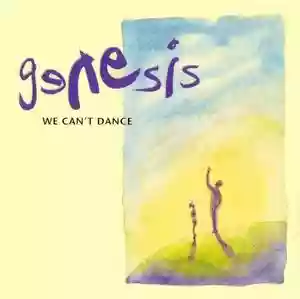
That said, I would like to point out that there exists a group of fans with slightly more flexible attitudes who, although with the necessary distinctions, take Genesis and their production for what it is: a way of making music, debatable if you like, but perfectly legitimate; these fans appreciate the entire output of the band, I reiterate, with due objectivity and necessary critique. If it's true that the records from the early period remain absolute masterpieces, it's also true that the "pop turn" has nonetheless managed to generate, among others, albums of great value. I believe that 'We Can't Dance' is among these.
An album from 1991 that finds the band still in great shape five years after the synthetic binge and the enormous success of the hardly salvageable 'Invisible Touch', compared to which it represents a significant step forward. First of all, the sound changes a lot: out go the electronic drums, out goes Hugh Padgham, the architect of Genesis's 80s sound, and in comes Nick Davis, who rediscovers the effectiveness of more stripped-down arrangements, rich keyboard sounds, very dry and direct drums. The drum machines remain with their typical, somewhat cliché liquid sound since the days of 'Duke', while the bass parts are absolutely not up to par, but the results still manage to surprise the more attentive listeners. The album was recorded at The Farm studios, and the music, all composed from improvisations, with nothing reworked, was collectively written by the trio.
It starts with No Son Of Mine: metronome ticking, distorted guitar with a rhythmic role, and Banks' famous "mooing" (i.e., an altered and sampled effect of Mike's guitar) create a dramatic atmosphere that perfectly suits Collins's powerful drumming with sharp hits and cymbal scans. The chorus is less effective with its overly sleek crystal clear keyboard sound, very evocative and intense instead is the ending, with Mike's guitar precisely embellishing in the background. Phil is also excellent in the singing part and the text is very beautiful, telling a grim story of domestic violence and escape. An excellent start that presents the Genesis of the 90s well. Following is the fast and sly Jesus He Knows Me, an ironic song against the evangelicalism of TV preachers, with a very simple but effective rhythm, opened by Tony's electric and skewed synth sound and supported by Mike's chord strikes. Around halfway, there's a funny almost reggae interlude that contributes to the song's pleasant listening.
With Driving The Last Spike comes the first great surprise. An aquatic drum machine sound immediately supported by the electric guitar opens this exciting ten-minute crescendo that moves from the tender tones of a ballad to more frantic phases where the drums travel dry and steady; the guitar dialogues with the keyboards in thrilling back-and-forth exchanges, but also performs hard riffs and rhythmic scans. The interesting text enriches the piece even more, and talks about the workers who built the British railways in the 1800s, paying a high blood tribute. A surprising and original piece, far from past glories but which attests to the rediscovered artistic vein of Mike, Tony, and Phil.
I Can't Dance is a curious song, with a rhythmic guitar riff over which the voice and synth unravel, and in the second part also the piano. Remark the bizarre effect from Tony's synthesizer and Phil's very "black" voice, singing very well a sarcastic text against empty tabloid beauties. With Never A Time we encounter a rather flat song, reminiscent of the horrid It's Gonna Get Better from the 'Genesis 'album, forgotten without any regret. Everything is ordinary, diligent keyboards, guitar embroidering in the background, impeccable voice, but very few emotions.
Things definitely improve with the long and evocative Dreaming While You Sleep, in which a highly reverberated drum machine creates a sound carpet on which Mike's guitar carves long and haunting notes while Tony limits himself to refinements and Phil's voice remains muted; the song rises in the extremely intense chorus, where the drums explode with powerful hits and Collins goes wild (a vague memory of Mama?). The ending is beautiful with Rutherford's long notes and Tony's rich keyboards, and once again the text is noteworthy, written by the guitarist: the gloomy story of a hit-and-run driver who, after hitting a girl, is tormented by remorse all his life. Tell My Why is another somewhat so-so song, but Mike's arpeggios are cute on the reborn 12-string, while the rest doesn't stand out for originality. The ratings go up with the next Living Forever, a very cheerful song, opened by excellent jazzy drumming working with brushes and cymbals (I believe there are also electronic percussion which, however, don't annoy), rhythmic guitar riffs, and keyboards that stand out with airy notes. The ending is instrumental and characteristic, with Tony prominently in a solo, but Mike also makes himself heard, while Phil demonstrates once more all his class.
Sharp reversal of trend with Hold On My Heart: it will please Collins's fans, but insufficient for slightly more sophisticated tastes. It can provide a certain atmosphere, to be generous, but a band like Genesis has the right to be asked for more. A similar discourse for the irritating Way Of The World, which has very little to appreciate, maybe Tony's solo, which still finds little relevance. Forgettable. A sentimental Christmas-song-like rhythm characterizes Since I Lost You, which however, upon careful listening, offers some extra cues, primarily in Collins's very warm and expressive voice and in Mike's delicate counterpoints at the end; perhaps a bit too romantic and cheesy, but so be it. The text does not concern yet another Collins divorce, but the death of Connor Clapton, the young son of the great Eric and, listen up, Lory Del Santo (!).
Grand finale, it must be said, with the magnificent Fading Lights, in my opinion the best track on the album, ten minutes that condense a little all the recent art of Genesis. It starts with a usual percussive base created by the drum machine, then Tony's keyboards enter with a beautiful string sound and a sequence of chilling chords. Collins's voice is moving and particular, the atmosphere intense, while Mike inserts himself with delicate supporting arpeggios after the first stanza. After three and a half minutes, a very powerful drum roll and hard guitar strikes open the amazing instrumental section, of which Tony takes the helm performing an epic and evocative solo, making the track very striking. Meanwhile, Phil marks the rhythm with his usual impeccable precision and inventiveness, and Mike demonstrates his class by supporting it all with hidden guitar notes, up to the final stanza, where he stands out with a brief but effective meticulously crafted solo; the piece concludes in the same ethereal manner it began, also giving us, with its poignant lyrics, a warm goodbye to times past and to Phil Collins, on his last album with the group.
All in all, 'We Can't Dance' appears to me as a very good work. The tendencies towards synthetic and easy pop have, I think, affected our heroes more honorably than in the Eighties; Tony, Phil, and Mike demonstrate their style and, in a sense, their maturity. Very beautiful from a lyrical point of view, this album is also musically interesting: I don't think it can be defined as a "Phil Collins album," because songs like Driving The Last Spike, Dreaming While You Sleep, Living Forever and the excellent Fading Lights undoubtedly show more than others the fundamental contribution of Tony and Mike, which is there, and is heard. Evocative and at times fascinating, it is an interesting effort by Genesis, also considering their recent reunion. I don't aim to convert anyone, but I hope to help those who want to approach Genesis with confidence or those who, in a surge of kindness, feel like giving the three great musicians another chance, sixteen years later.
For those interested, appointment in Rome on July 14, 2007.
Loading comments slowly
Summary by Bot
This review appreciates Genesis' 1991 album 'We Can’t Dance' as a mature return with a balanced mix of pop and progressive rock. It notes a departure from their 80s synthetic sound, highlights standout tracks like 'Driving The Last Spike' and 'Fading Lights,' and emphasizes the strong contributions of all three band members. Though not flawless, the album is praised for its lyrical and musical qualities, appealing to both loyal and open-minded fans.Tracklist Lyrics Videos
Genesis
English rock band formed in 1967, celebrated for landmark early-1970s progressive albums (Foxtrot, Selling England by the Pound, The Lamb) and a later, more pop-oriented phase led commercially by Phil Collins.116 Reviews
Other reviews
By Andrea12
The result of years of meditation is immediately evident from the opening notes of No Son Of Mine.
Driving The Last Spike is the most beautiful track on the album, 10 minutes in which Genesis tells the story of the workers who built the English railways.
By paolo1968
"'We Can't Dance,' though fully in a pop dimension and with a typical '90s sound, is pleasantly listenable."
"Successfully combining quality and success is no small feat."
By GenesisForEver
"No Son of Mine" is beautiful, at times almost moving, and Phil gives an extraordinary vocal performance.
"We Can’t Dance" is the best work of the Genesis 'trio formation,' showcasing a partial return to earlier sounds without losing sight of the charts.
