
 •
Rating:
•
Rating:
THE REVIEW
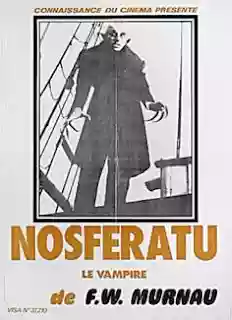
Once again, we read 192x in the data concerning the production of another important work of expressionism and world cinema. After all, it was that period... Unlike what is seen in Metropolis, however, in this case, the setting is anything but futuristic (we are in the setting narrated by Bram Stoker in Dracula) and the duration is much more contained. Even the special effects, if they can be called that, are years behind (and to think that only 5 years later the aforementioned film will be born).
Murnau had to change the names and plot within this film of his "loosely inspired" by the famous Stokerian work, and nevertheless, he still fell victim to a lawsuit that would force him to destroy every film containing his work... except for one that he clandestinely preserved, thus allowing us to enjoy Nosferatu today. To play the character of Count Orlok (alias Dracula), Murnau relied on the actor Max Schreck, so talented (and unlucky in name) that he became the protagonist of a legend upon which a film was made a few years ago called Shadow of the Vampire, in which it was hypothesized that the famous German director wanted such a realistic result that he ended up hiring a real vampire as the main actor, namely our excellent Max Schreck ("Maximum Fright" in German, for that matter). Other important characters in the film are the real estate agent Hutter and his wife, basically, if you exclude a couple of relatively important appearances. All of them are played very well, with masterful mimicry that well suppresses the "problem" of silent cinema. The captions are clear and essential just at the right point.
The sound section of the version I watched is deplorable: it consists of an hour of piano music played well if you will, but totally disconnected and unsuitable compared to the accompanying images. Moreover, there are also some significant and insensible volume fluctuations, but I am already looking for a version with more suitable music (possibly the original one) that will allow me to evaluate this point more seriously, as I am convinced that an artist like Murnau would NEVER have allowed the musical section of his film to be neglected and inadequate to such an extent. Besides the interpretation, again, excellent (especially regarding the Count), no doubt the settings of the film must be mentioned: the Transylvania shown is extremely fascinating and evocative. Castles, plains, cities: everything is, in reality, very simple and essential, but there is a shroud of decadence perfectly perceptible by the human soul that communicates a sense of oppression and anguish when necessary. The atmosphere, in general, I would define as a manifestation of dreamlike decay, really impactful and which, even long after viewing the film, resurfaces and begins to corrode the mind with its undefined but effective connotation. Remarkable is also the idea and realization of Nosferatu's Shadow, which in some scenes travels autonomously on the set and further accentuates the surreal and hallucinatory side of the work. Other decidedly homemade but not disposable effects fill the film with an additional vein of eeriness, which in the end is all poured onto the viewer, who may not be gravely affected at the moment but will slowly begin to feel a weight on their soul to carry away after viewing.
And it is for this reason that we, as good masochists, absolutely must watch this film and experience its dreamlike unease.
Rating: 82/100
Loading comments slowly
Summary by Bot
F.W. Murnau’s Nosferatu stands as a landmark of expressionist and world cinema despite its age and technical limitations. The film’s eerie atmosphere, haunting visuals, and Max Schreck’s unforgettable portrayal of Count Orlok create a chilling experience. While the available soundtrack may be lacking, the film’s evocative settings and surreal effects leave a lasting impression. Nosferatu’s legacy endures through its dreamlike decay and profound impact on horror cinema.
F.W. Murnau
Friedrich Wilhelm (F. W.) Murnau (1888–1931) was a German film director and a leading figure of German Expressionist cinema, best known for Nosferatu (1922) and other silent-era masterpieces.02 Reviews
Other reviews
By Stronko
This “Nosferatu” by Friedrich Wilhelm Murnau from 1922 is no exception.
Still one of the best representations of Count Dracula ever appeared on screen.
