 •
Rating:
•
Rating:
THE REVIEW
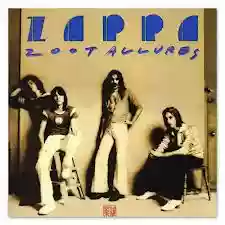
Premise: This review aims to do justice to one of Frank Zappa's most underrated albums, considered by many to be inferior, likely criticizing the lack of quality in the recording studio, which is usually very high in the master's albums. This record, far from being a mediocre work, is a masterpiece that can only be re-evaluated by better analyzing the lyrics and their relationship with the album's music.
Let's start, for example, by judging the album in its entirety and evaluating the work as a whole. At a superficial approach, it may appear as a work lacking internal homogeneity, and the songs don't seem very connected to each other. In reality, upon closer listening, one can notice that the album manages, in a total and complete manner, to satirize the worst and lowest aspects of today's society. Through the lyrics, we are presented with the most absurd and mean aspects of consumerist society, from increasingly impersonal sex (Mrs. Pinky) to lack of prospects (Wind Up Workin' In A Gas Station) to the illusory and alienating fun of nightclubs (Disco Boy).
Frank Zappa's pessimism, typical of a man who has witnessed the ruin of the yuppie generation under the scourge of consumerism and drugs, seems to leave no hope in the face of the decline scenario before our eyes. However, there is hope, and he seems to indicate it: it is Music. Indeed, almost to bring a ray of sunshine into this lost world, a sung song is followed by an instrumental one; this, in my opinion, means that even in the face of sadness, Art is what can save man, elevating him from material problems. However, it is not a definitive solution; in fact, the album does not conclude with a consolatory instrumental piece, but with "Disco Boy," confirming that music does not bring definitive satisfaction.
Let's start with the first piece, "Wind Up Workin' In A Gas Station." In a simple and only apparently trivial manner, it mocks the American school system, stating the sad fate that awaits all its students. The chord progression, simple and minimalist, which lasts throughout the album, might lead one to think of a cheerful and upbeat song, but the coldness of the recording studio and the equally simple bass, which has the effect of making the track even gloomier, keep the song perpetually balanced between the comedic and the tragic. The same background choruses, initially funny and grotesque, end up seeming a successful and sad imitation of advertising slogans.
The second piece is entirely instrumental. It is "Black Napkins," an improvised live solo from the same year. Since it's an instrumental, I'll skip the words and leave you to the music. As Zappa would say, "talking about music is like dancing about architecture."
The third piece, "The Torture Never Stops," is the longest of the entire album; in it, Zappa plays all the instruments except Terry Bozzio's drums. It's decidedly the most successful song of the entire album, in which the sadness and darkness blend perfectly with musicality. The song, with rather obscure lyrics, lends itself to various interpretations. We can interpret it as a sort of parody of Glam Rock or, and this is in my opinion the best hypothesis, as a description of our society itself; a society in which the individual believes they are free but is entirely enslaved by an alienating system. The background orgasms, instead, would give the idea of the commodification of sex in our society. Even putting that aside, it's still a criticism of power in general and the cruelty with which it imposes itself.
Once "The Torture Never Stops" ends, the orgasm that opens "Mrs. Pinky" reminds us that sex is not over; it shifts from sex as spectacle to sex as alienation. How can we not recall the prevailing trend in our society of sex as an object, not only with inflatable dolls but also seen in a selfish and personal manner, without the pretense of any sentiment from the other side. The inflatable doll is the symbol of the depersonalization that sex is undergoing in our society, which is only a demonstration that man, separated from the environment, becomes increasingly attached to objects and less to nature.
We then move on to "Find Her Finer," which still revolves around the same topic: sex. Sex, which is seen as a deceit towards the loved object. The bourgeois society indeed imposes a selfish and unrestrained hedonism that is covertly promoted by television and advertising. The advertising style is also found in Frank Zappa's voice, which almost seems to offer advice on fooling the unfortunate victim. The song, which starts incredibly cheerfully, becomes progressively sadder as the bass takes over and imposes its somber air. This leads to a perfect fusion of the comedic and tragic intent, causing the listener to both laugh and cry at the truth of the statements.
As "Find Her Finer" dies down, "Friendly Little Finger" starts. Here too, the music isn't judged.
Let's talk about "Wonderful Wino." It's not by Zappa but by Jeff Simmons, the band's guitarist, who plays rhythm guitar for the occasion. The song is perhaps the least original of the album. However, it also has its reason; it serves to satirize another alienating aspect of bourgeois society, alcohol. In the face of today's flaunting of inebriated minors who ruin their livers thinking they're having fun, how can we blame Frank. The drunkard in question, far from being happy, appears ridiculous and pathetic, ending up unable to control himself.
Another musical space, "Zoot Allures." Listen and enjoy. The choirs of Paradise.
The album does not conclude with a happy ending, but with "Disco Boy." The song in question, because it imitates disco tracks, will be commercially the most appealing and will be extracted as a single. But upon closer look, it's devoid of that foolish cheerfulness that characterizes disco music songs both then and now. Indeed, it depicts the sad life of the ultimate alienated individual, the club animal. The procedures he uses for the occasion are described, such as obsessively combing his hair and snorting lines of coke, all for one goal: the vagina, the "chicken delight." The whole procedure ends in failure: the girl leaves with his friend, and he can't even drink to alienate himself because they've closed the bar. But the Disco Boy keeps going, in the name of the Lord and the Drug. With a saddening, yet simple instrumental that almost gives the idea of the poor Disco Boy continuing his descent into Hell, the album concludes.
Guys, a score of 8, not to aim for perfection, and 5 stars.
Loading comments slowly
Summary by Bot
This review highlights Frank Zappa's 'Zoot Allures' as an underrated masterpiece that critiques consumerism, alienation, and societal decay. The album's mix of satirical lyrics and intricate music reveals a pessimistic yet hopeful view, emphasizing music's power to elevate humanity. Each track is analyzed for its thematic depth, balancing comedy with tragedy. The album ends with a poignant reflection on societal decline.Tracklist Lyrics Videos
Frank Zappa
Frank Vincent Zappa (1940–1993) was an American composer, guitarist, bandleader and producer known for genre-defying albums, abrasive satire and orchestral experiments. He released extensive studio and live material, explored electronic composition (Synclavier) and advanced both rock-fusion and contemporary classical idioms.54 Reviews
Other reviews
By 4urelio
If this is a mediocre album, how will the creative peaks astonish me?
An album that perhaps appears weak compared to the rest of the discography, but from my point of view, it’s a masterpiece and will be an excellent starting point for my future listening.
