
 •
Rating:
•
Rating:
THE REVIEW
Eh eh, Frank Zappa… I wasn’t expecting a normal album from Frank Zappa, but rather an album that isn’t even an album… Yes, because this “We’re only in it for the money” is a work that cannot be categorized as an album, but is something completely different, which only shares notes (and sometimes not even those) with a typical album.
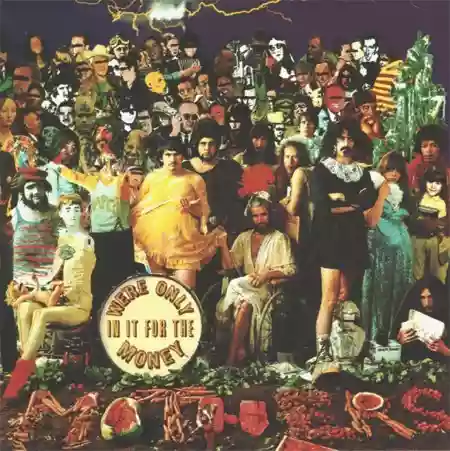
This album was released in '68, at the height of the hippie era: Zappa should have been a flag-bearer, being a freak before his time, yet instead... Instead, he releases an album that from the very cover, a parody of the well-known Beatles' “Sgt. Pepper”, mocks psychedelia; if the cover is merely ironic and irreverent, the grooves of the vinyl are caustic, probably unprecedented. The lyrics talk, with unexpected maturity, about the effects of the protests by the long-haired on the young and old population, about why and how society leads young people to drugs, about how consumerism has crushed the American family (see the tragicomic portrayal of domestic violence in “Harry you’re a beast”), has destroyed its principles and values, and finally how even the protest carried out by the youth of ’68 has become part of the system: in “Flower punk”, as in “Who needs the peace corps”, Zappa outlines a youth that comes to San Francisco not for the sit-ins, but just to screw, get high, join a psychedelic band for more drugs, to screw more, and so on.
But also musically, the album is a bomb, a punch in the stomach: there isn’t a real song, just sound sketches lasting between one and three minutes; and the beauty is that they are all of an incredibly high compositional quality, as well as of astounding variety, confirming our musical genius; moreover, the notes themselves become mockery, taunt, parody of thousands of identical melodies, of thousands of pseudo-experimental suites popular at the time: just listen to the empty and useless six minutes of “The Chrome Plated Megaphone Of Destiny”, full of meaningless noises and laughs that the bands of the era intended to be unsettling, but that Zappa, interspersed with coughs, makes even more ridiculous.
This isn’t an album, it’s a raw and pure invective against a society that Zappa never belonged to and against the movement that would criticize it, and it deserves a place of honor in Zappa's discography.
Loading comments slowly
Summary by Bot
Frank Zappa's 'We're Only In It For The Money' is not your typical album, blending sharp social commentary with complex and satirical compositions. Released in 1968, it mocks the hippie movement and consumerism through ironic lyrics and musical sketches. The album's unconventional structure and parody of psychedelia highlight Zappa's unique genius. This intense and provocative work holds a significant place in Zappa's discography.Tracklist Lyrics Videos
01 Are You Hung Up? (01:30)
03 Concentration Moon (02:17)
06 Bow Tie Daddy (00:33)
07 Harry, You’re a Beast (01:22)
08 What’s the Ugliest Part of Your Body? (01:03)
11 Hot Poop (00:30)
12 Nasal Retentive Calliope Music (02:03)
13 Let’s Make the Water Turn Black (01:45)
15 Lonely Little Girl (01:45)
17 What’s the Ugliest Part of Your Body (reprise) (00:57)
18 Mother People (02:32)
19 The Chrome Plated Megaphone of Destiny (06:26)
20 Lumpy Gravy I (15:49)
21 Lumpy Gravy II (15:49)
Frank Zappa
Frank Vincent Zappa (1940–1993) was an American composer, guitarist, bandleader and producer known for genre-defying albums, abrasive satire and orchestral experiments. He released extensive studio and live material, explored electronic composition (Synclavier) and advanced both rock-fusion and contemporary classical idioms.54 Reviews
