
 •
Rating:
•
Rating:
THE REVIEW
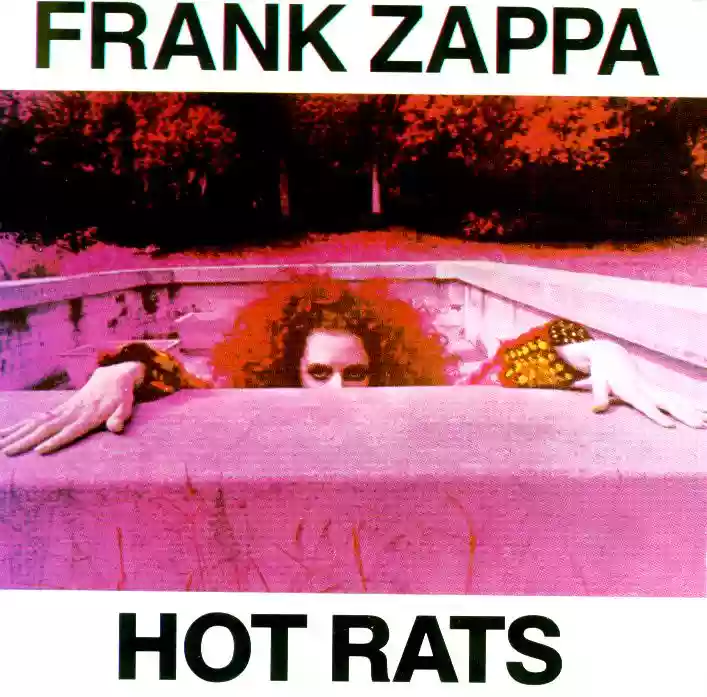
One day by chance I listened to "Peaches En Regalia". Until then I didn't have a truly favorite track, my... "Song of the heart". That day I was listening to this little gem and I thought: "Cribbio, what is this? I like this stuff! But a lot! But very much! But very much indeed!". "Peaches En Regalia" had become my favorite track. Time (quite a lot of it) later, I felt the urge to explore the album of this beautiful creation by Don F. Zappa. I listened to all of Hot Rats. Twice.
And right then and there... I was confused! One moment. My favorite track was "Peaches En Regalia", yet this "Son of Mr. Green Genes" seemed to be even more beautiful, even more sublime, a MAGNUM OPUS.
The album had it all. Guitar solos, saxophone solos, violin, keyboards, synthesizers... and God only knows what else (in my opinion, Zappa himself wasn't that clear about it).
When you listen to the son of the green Mr. Gene, you find yourself thinking that there couldn't have been just one person behind that composition: evolution is something that comes from the union of the DNA of different individuals. Frank Zappa couldn't have composed all this by himself; so, can we call it a miracle? Can we sanctify this man? This Zappa can perform miracles!
In fact, Zappa is in itself a micro-universe of sounds, movements, and sensations; and when I listen to him, I find that my mind forms images like those of many authors compressed and tightly held together as one. Zappa was a guitarist, but shall we talk about his way of composing for saxophone? "It Must Be a Camel"; "Little Umbrellas", "Gumbo Variations". Pieces where there is no singer. And do you need one? There's the saxophone!
This instrument indeed is the one that comes closest to the human voice (among "classical" instruments, if you have invented the "voxfono" and everyone refuses to play it, it's not my fault), it's simply easier to use, has a great timbre and allows much faster transitions. And Zappa is and needs this: extreme simplicity in doing what seems impossible to others!
The relationship between Zappa and the saxophone is beautiful, but the jazz violin is no less: I think "Gumbo Variations" and "Willie The Pimp" are two pieces that have given much to this instrument, historically more linked to classical music.
And the percussion? Ah well, those are entirely subjective. In this album, almost all instruments are used at least once for rhythmic parts: obsessive, challenging, sometimes almost cacophonous. Instead, percussions act as a coronide rumorale throughout the album; they serve to make the sound unique. Truly unique. Even I could play Zappa's sheet music with the saxophone, guitar, or violin (which, incidentally, is played by a certain Jean-Luc Ponty). Not the percussion. Those are exclusively Zappa's.
In short: I don't know if you realize the magnitude of this album. Let me give you an example. Many albums are indisputably beautiful and full of great pieces that will go down in history. In this album, all the tracks are equal in perfection, and "Peaches En Regalia" and "Son of Mr. Green Genes" are simply first inter pares.
And after this album, I recommend listening to "We Are Not Alone". After all, Zappa may have physically left us, but his music continues to be an enormous source of inspiration for future generations. His pieces are played on every instrument in all sorts of ways.
Zappa is great. Very.
Loading comments slowly
Summary by Bot
The review explores Frank Zappa’s Hot Rats album, celebrating its rich instrumental diversity and innovative compositions. Highlighting tracks like 'Peaches En Regalia' and 'Son of Mr. Green Genes,' the author praises the blend of guitar, saxophone, and violin as sublime and unique. The album is seen as a micro-universe of sounds that showcases Zappa’s virtuosity and creativity. It strongly recommends experiencing the full album and reflects on Zappa’s lasting musical influence.Tracklist Lyrics Videos
Frank Zappa
Frank Vincent Zappa (1940–1993) was an American composer, guitarist, bandleader and producer known for genre-defying albums, abrasive satire and orchestral experiments. He released extensive studio and live material, explored electronic composition (Synclavier) and advanced both rock-fusion and contemporary classical idioms.54 Reviews
Other reviews
By puntiniCAZpuntini
The hardest thing to do is to break the rules and silence everyone.
Franco did not care about the opinions of others.
By paloz
He is the one who gave life to the perfect fusion of Rock, Jazz, Classical music, and Pop.
'The Gumbo Variations': A track of almost 17 minutes marked by sax, violin, bass solos and more!!! Gigantic.
By De-cano
The Zappa jazzrock roars, stands out, is depraved like "Willie the Pimp," is without his Mothers of Invention and thus, free.
Let's remember Zappa, let's not allow "Hot Rats" to be devoured by rats in any filthy attic, insert it into the player and you'll understand!
