
 •
Rating:
•
Rating:
THE REVIEW
You should have been there, to witness the scene.
Anyway, during a break in the rehearsal sessions, Frank takes the opportunity to stretch his legs along the corridors of Capitol. Wandering back and forth with no particular destination and whistling two notes mixed with incomprehensible words – something like "I got you (firulì firulà) under my thumb (firulì firulà)" – he bumps into his friend Billy.
After exchanging pleasantries, at a certain point Billy says, "Listen, dear Frankie, aren't you tired of all this sticky syrup they keep pouring on you? Take my advice, you should start going to a pool and do a few laps every day, because the times are changing and if you don't learn to swim properly, you'll sink."
"Apart from the fact that you shouldn't call me dear Frankie," Frank retorts, "because I'm already being pursued for my associations – haven't you seen Scorsese's films? – apart from that, what is this nonsense about going to the pool to change the times?"
He leaves, resuming whistling what he was whistling before bumping into good old Billy, and thinking that surely Billy has just downed a bottle of the good stuff.
An encounter that takes place in the cold winter of 1955.
A few days later, Elvis comes out in the open with his pelvic movements and reveals to the world his dark side, sex, drugs, and also rock 'n' roll; Frank, at that very moment, is busy with serenades for spineless lovers and has decided that "... under my thumb ..." means nothing at all, so he changes it all to "I got you (firulì firulà) under my skin (firulì firulà)".
Unfortunately, Frank is recovering from that unbearably boring "In The Wee Small Hours" and adding a bit of rhythm to "Songs For Swingin' Lovers" doesn’t improve the situation much. What swingin' lovers and swingin' lovers of Egypt, when there's a shady character like Jerry Lee marrying his underage cousin and causing a scandal, while Marlon is taking the screens by storm in the role of the savage.
Times have really changed: booooom!
"What did Billy say a few months ago?" Frank ponders as he dials the number and calls him.
"Dear Frankie," says Billy on the other end of the line, "how's life treating you?"
"It's looking grim... With all these hooligans and slicked-back pompadours around, no one pays me any mind."
"You're burnt out, dear Frankie, you're burnt out like an old tire. But if you trust me, I know how to get you back on track. Let's meet tomorrow at my place and bring a bottle of the good stuff to clear your head."
Dear Frankie is really burnt out, so much so that he doesn't even utter a word when Billy addresses him like that; so the next day he goes to Billy’s and brings a bottle of the good stuff with him; he rings the doorbell; Billy opens it and quickly shuts the door behind him, with a furtive manner. What the two of them are up to, protected by those four walls, nobody knows for sure. Certainly, it is known that the meeting doesn’t last long, just enough time to down a bottle of the good stuff.
And if you're wondering how I know all these details, I'll confess without hesitation or shame that I made it all up from scratch, except that cheapskates like Bob and Mick should pay Frank and Billy royalties until the last of their days and beyond…
… truthfully, it is known for certain what happens next.
First a timid attempt in the recording studio, "Come Fly With Me", and yet it already smells new.
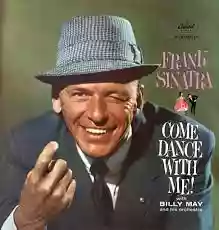
Then the big bang: "Come Dance With Me".
What wee small hours and swingin' lovers of Egypt; what sighs, tender kisses, and languid caresses. It's the gggiovani who are buying records; the gggiovani are listening and dancing to rock 'n' roll; therefore, Frank and Billy together create one of the greatest albums of all time for dancing to rock 'n' roll.
Frank and Billy have equal merits; because Frank is always Frank and has a sense for music and rhythm that no one before him and no one after, and how his voice can settle in that way is an unfathomable mystery; but the big band and the arrangements Billy prepares for the occasion are explosive and create fire and flames.
"Come Dance With Me" are no longer sighs, nor tender kisses, nor languid caresses, but only little legs shaking and little bottoms wiggling to hyper-kinetic rhythms; and if couples – at that time, dances were in couples, thank Heaven – and if the couples barely know each other and don’t love each other and won't see each other again after that sweat bath, all the better. A quick fling, as Billy thinks and as Frank now thinks too.
All the songs are the same, all the songs are beautiful, starting with the opening "Come Dance With Me" to the closing "The Last Dance", which is actually a slow smooch – it is still Frank leading the dances, although Billy urges him – but it’s perfect for ending the evening in style. Or rather, all the songs are the same and are all beautiful, except one, which is something more: their version of "Cheek To Cheek" which unfortunately it’s too late to put in a dance movie with Fred and Ginger at the peak of their glory.
And anyway, get it out of your head that this is a "constructed" record in the detrimental sense of the term. It’s true that Frank lets himself be convinced by Billy and records it solely to capture the sentiments of the era, but those sentiments are also his, he just needs someone to help him express them. Has anyone ever accused Sam of being "constructed" for the wonderful coexistence between "Live At The Copa" and "Live At The Harlem Square"? Ask yourself the question and give yourself the answer.
In any case, I’ll do it for you: two questions and two answers on "Come Dance With Me".
Is it one of the best fusions of jazz, swing, and rock 'n' roll? Without a doubt!
Is it a proto-punk album? Without a doubt, once again, because between the "Come Dance With Me" of 1959 and the "Let's Dance" and "Do You Wanna Dance" of 1977, there is no difference!
Booooom!
Loading comments slowly
Summary by Bot
This review narrates a creatively imagined backstory of Frank Sinatra during the recording of Come Dance With Me!, highlighting its energetic fusion of jazz, swing, and early rock 'n' roll. It praises Billy May’s explosive arrangements and the album’s role in engaging a new generation of listeners. Considered one of the greatest dance albums, it marks Sinatra’s shift towards more rhythmic and lively music, contrasting his previous, moodier works.Tracklist Lyrics
01 Come Dance With Me (02:31)
02 Something's Gotta Give (02:38)
03 Just in Time (02:24)
05 Too Close for Comfort (02:34)
06 I Could Have Danced All Night (02:40)
07 Saturday Night (Is the Loneliest Night of the Week) (01:54)
08 Day In-Day Out (03:25)
11 The Song Is You (02:43)
12 The Last Dance (02:11)
14 Nothing in Common (02:32)
15 Same Old Song and Dance (02:52)
16 How Are Ya' Fixed for Love? (02:25)
Frank Sinatra
Frank Sinatra (1915–1998) was an American singer and actor who rose to fame in the 1940s, defined the concept-album era at Capitol in the 1950s, and later founded Reprise Records. His work spanned swing, traditional pop, and collaborations that brought jazz and bossa nova to a wide audience.05 Reviews
