
 •
Rating:
•
Rating:
THE REVIEW
Sometimes we make memorable mistakes. It even happens that you lend a record to one of those friends who first ask for it, then don't listen to it and finally leave for Ireland, and when you see them again three years later, you just don't feel like asking for it back. At a certain point, you resign yourself, and you don't lose hope only because, if you want, you can find it in every store. But you don't buy it; every time your eye sees it, but your hand stops, blocked by an invisible pride. Then, but at least fifteen years have passed, you find yourself singing it on one of those days when the car stereo skips continuously, you're on the Cisa pass, and you don't feel like listening to some insipid commercial radio. At the first opportunity, you give in. You reacquire it. "Orizzonti Perduti" becomes yours once again.
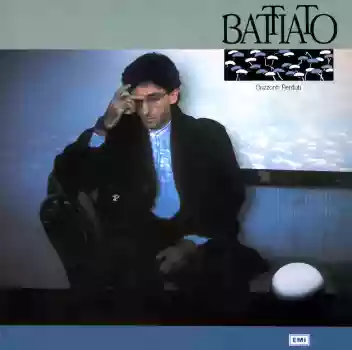
It is a peculiar record: eight tracks, all very short and essentially similar in their typical structure of verse and chorus exactly repeated, supported solely by electronic instrumentation. On the cover, a thoughtful Battiato reflects on his present. This is the keystone of the entire work, an unusually concrete, material reflection from the Sicilian artist who has reached a turning point in his life. The lyrics are imbued with a magical realism that overlaps with the icy precision of the synthesizers. The constant theme is the contrast between an alienating metropolitan reality, the Milan where Battiato had lived for many years and which he was contemplating leaving, and Sicily, his magical native land, a destination to rediscover.
So in "Tramonto Occidentale" there are mentions of "passeggiate in Galleria" and "bandiere fuori dalle macchine all'uscita dello stadio", while in "Zone Depresse" glimpses of "donne sotto i pergolati a chiacchierare" can be seen; it talks about the now disappeared "idrolitina" and men going to the barber on Saturdays "to chat and take turns reading the newspaper". The following track "Un'altra vita" focuses on the topic in a succinct way: solutions can no longer be found in ideologies, therapies, or tranquilizers, there is a need for "un'altra vita". Perhaps the life of "Mal d'Africa," where "after lunch, you would go to rest, lulled by mosquito nets and kitchen noises" and people sat on the street in "pantaloncini e canottiera". How is it possible to return to this in an era "di bassa fedeltà ed altissimo rumore" Battiato reflects in "La musica è stanca," a controversial nursery rhyme on the degradation of the art of sound. How is it possible in this city where the "Gente in progresso" "works to have a month of vacation a year"? Returning, returning south to the time when you skipped school "running after butterflies" and to other ancestral memories that escaped the maturity of a man degraded by the metropolis. It ends by getting the prediction right.
A few years later, Battiato would return to live at the foot of his volcano. "Orizzonti Perduti" is a very particular work in the vast discography of its author. If musically we find splendid airy melodies, scourged by inevitably dated sounds, in the lyrics, the mystic themes characteristic of his production are left in the background. There is rather a search for a mystic of the everyday that proceeds through concrete, corporeal, tangible images; in search of a dimension that respects our physical needs as a starting point to reach higher goals.
Loading comments slowly
Summary by Bot
Orizzonti Perduti is an introspective album by Franco Battiato, characterized by short, synth-driven tracks paired with lyrics exploring the contrast between alienating city life in Milan and the nostalgic pull of Sicily. The album marks a turning point, focusing on tangible daily experiences rather than mystical themes. Despite its dated electronic sounds, the melodies remain appealing, highlighting a search for meaning grounded in physical reality and memory.
Franco Battiato
Italian singer-songwriter and composer from Sicily, Battiato moved from 1970s electronic/progressive experimentation to chart-topping pop with La voce del padrone, and later to spiritual, orchestral and operatic works. He frequently collaborated with arranger Giusto Pio and philosopher Manlio Sgalambro.100 Reviews
Other reviews
By primiballi
He entertained while making people reflect.
Battiato appears just a bit more mature and disenchanted. And these feelings that may generate sadness or melancholy in others, for him generate immortal and perfect verses.
By DaveJonGilmour
Franco Battiato, the Artist (allow me the capital letter, at least to distinguish him among the many)...
From a technical standpoint, the use of electronics is nothing short of perfect, and with increasingly advanced technologies, not surprisingly, he was the one to drag the avant-garde into the Boot.
