
 •
Rating:
•
Rating:
THE REVIEW
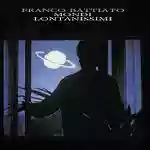
"Tell me about existence, of faraway worlds... ", that is, tell me about Battiato.
The slender Sicilian singer-songwriter with a monastic voice lays down his ace and doubles down, or rather, perfects himself. After the great success of "La voce del padrone" (almost a million copies sold) and after two not particularly successful contributions ("L'arca di Noé" and "Orizzonti perduti"), Battiato attempts the difficult path of sci-fi-intellectual music. And so, after the adventures of "Jesuits, Euclidean" and "serenades to the teaching institute," here are the mystical and profound sounds of the Galaxy: a mysterious and dark journey, difficult and transcendental, a sort of modern reinterpretation of Dante's "Comedy" (clear references to the Inferno) and Kubrickian anxieties of "2001: A Space Odyssey" (the famous "Vanguards of another solar system").
It's a renewed Battiato, certainly less serene, or perhaps simply more introspective. An album that is heavily influenced by the musical experiences of the so-called "world-music" of the Eighties: music that is almost never catchy, few moments of broad musical breath, a considerable dose of digitization (very clear in "No time no space"), but Battiato's strength is another, the ability to distance himself from Italian popular music, and to push towards more American Style sounds and atmospheres, and this is neither a vicious nor a trivial argument since, precisely during that period, the masses praised, as the pinnacle of musical achievement, Albano and Miguel Bosé. Sure, a few years earlier Battisti had already tried to record something less Italian, but he came out with "E già", not exactly a masterpiece. Here and there, some niche singer-songwriters tried to diversify the Italian musical offer (see Faust'o, for example, with however scant results), and Battiato's great merit was therefore to renew certain popular trends typical of the Belpaese while meanwhile not being considered just a 'niche author' (of course, the great success of "La voce del padrone" had been more than an excellent launching pad).
Among the best tracks (but here the choice is absolutely personal and debatable) I would choose, off the cuff, "No time no space", "L'animale" and "I treni di Tozeur". The first is a beautiful representation of the mysteries of the Universe with significant philosophical undertones (Battiato needs only a few verses to build an atmosphere, those "anomalous travelers in mystic territories" are unforgettable); the second is one of the most beautiful love songs in the history of music, reflective, autobiographical, very personal, much imitated, and after all, with such an effective text, it was difficult to get the atmosphere wrong ("Living is not difficult, if then you can be reborn, I would change a few things, a bit of lightness and stupidity" [. . . ] "But the animal within me never lets me live happily, takes everything, even my coffee, and makes me a slave of my passions"), a spur, never officially, for a subsequent Battiato hit, "La cura". "I treni di Tozeur" is simply magnificent, metaphors, assonances, music halfway between illusion and reality, a thread of light stands out in the Galaxy "and for a moment returns the desire to live at another speed". These are the tracks worth dwelling on a bit more, but even the rest is absolutely flawless.
Exemplary is "Il re del mondo" where Battiato exhibits his whole very personal mystical singer-songwriter streak (Echoes of Sufi Dances, and that alone could suffice) and manages, with sweetness and melancholy, to talk to us about something pessimistic, apocalyptic, final, as he expressly says halfway through the song ("The more everything becomes useless, and the more you believe it's true, the Day of the End, you won't need English"). Also noteworthy are the great "Via Lattea", "Risveglio di primavera", "Personal Computer" (almost science fiction for the era!) and "Temporary Road". A separate discussion deserves "Chanson Egocentrique" unleashed electro-pop suspended between Italian, English, and French. A nonsensical, crazy, and disordered text, yet surprising (the metrics are absolutely exemplary) and, at times, even amusing: "I remember prehistoric sound, was the time of the dinosaur age, oh, nein". And as usual, indispensable, the popular Sixties citation: this time it’s up to Little Tony and his Sanremo classic "Quando vedrai la mia ragazza".
All in all, when the album finishes, you are a bit disappointed. But not because of what we've heard (everything beautiful, everything excellent) but because we would have loved to continue listening to Battiato's voice (and stories). And it's no coincidence that, more than "La voce del padrone", it was "Mondi lontanissimi" the album with which Battiato would open the second phase of his career: that of the Nineties, of "Caffè de la Paix" and of "Dieci stratagemmi".
Loading comments slowly
Summary by Bot
Franco Battiato's Mondi Lontanissimi is a deep and introspective album merging sci-fi concepts with mystical and philosophical music. It marks a significant artistic renewal after previous works and introduces a blend of world music and American-style sounds. Notable tracks like 'No time no space', 'L'animale,' and 'I treni di Tozeur' stand out for their lyrical depth and atmosphere. The album is praised for pushing Italian popular music boundaries and opening a new phase in Battiato's career.Tracklist Lyrics Videos
Franco Battiato
Italian singer-songwriter and composer from Sicily, Battiato moved from 1970s electronic/progressive experimentation to chart-topping pop with La voce del padrone, and later to spiritual, orchestral and operatic works. He frequently collaborated with arranger Giusto Pio and philosopher Manlio Sgalambro.100 Reviews
Other reviews
By Martello
My mind, like the public vehicle, made diagonal routes within the Milky Way.
I have escaped from the Mondi lontanissimi.
