
 •
Rating:
•
Rating:
THE REVIEW
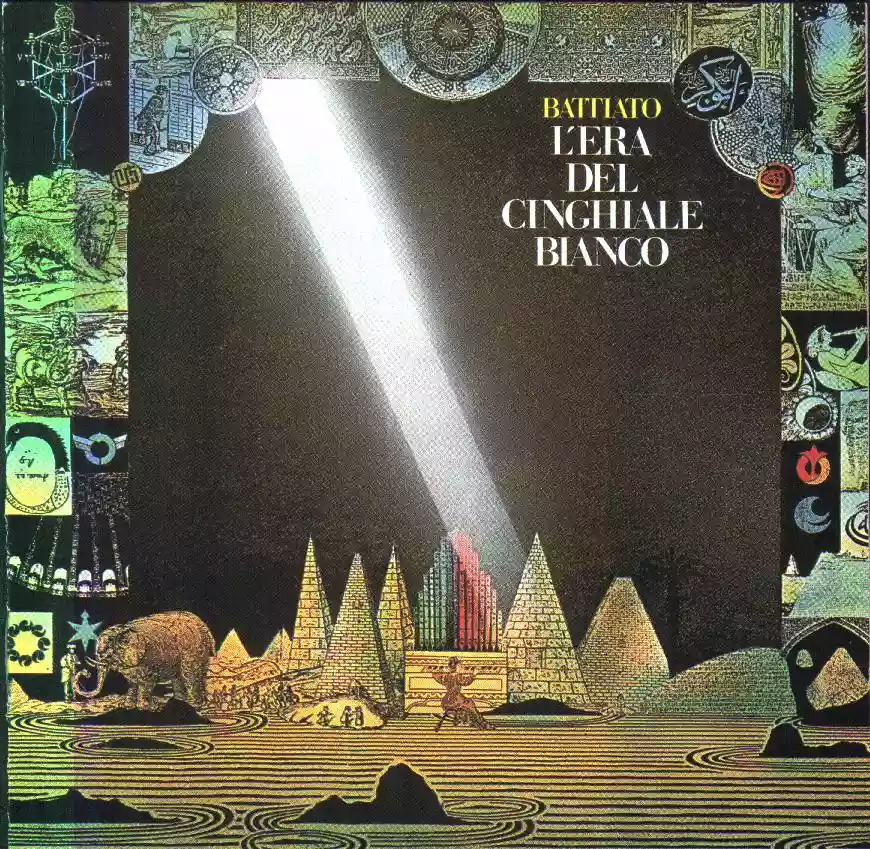
This is certainly a unique album...
Even from a cursory listening, one can detect that aftertaste of oriental sands and palms that are so dear to the Maestro; the era of the white boar, among the ancient Celts, peoples who dominated pre-Roman Europe, meant the age of Absolute Knowledge.
The result of experiments and research conducted over seven years, traveling through oriental sounds. The listener is given moments of magical and almost supernatural mysticism. Battiato gifts us seven pearls of ancestral wisdom in a melodic pop key that might seem like banal "light music" to many, while in "L'Era del Cinghiale Bianco," right behind those sounds lie riff and artistically brilliant violin tunes that contribute to the creation of an unmistakable atmosphere, present throughout the work.
"Music Shop" is a brilliantly satirical description, in a strictly personal opinion, of the sacred/profane union of our times ("the Sickle no longer makes one think of grain, the Buddhas sit on nightstands, the Egyptian Pyramids are cute, Supermarkets with sacred departments selling Dior incense, open columns on the Pope's hair...") and still represents a critique of the consumerist mindset of today and back then (1979) which, alas, remains current. In the frenetic and overwhelming rhythm of "Strade dell'Est", the Sicilian singer-songwriter wants to transport the listener through those oriental streets filled with enchantment and scented incense; he describes what he sees in a simplistic manner, without caring for details, following that futuristic vein found in many of his creations (everything will become clearer when listening to "La Voce del Padrone").
"Luna Indiana" is a pleasant interlude of piano duo that flows quickly and enjoyably without affecting the mystical atmosphere according to which all tracks are connected. The piano notes ferry us towards "Il Re del Mondo", a character that philosophers believe resided near Tibet, in the untouched land of Agharti, but none of this is mentioned in the song, which instead is the only one where the feeling of calm and the sensation of happiness paradoxically are lacking, without turning, however, into tragedy ("And on bicycles towards home / life brushed us by / but the King of the World / holds our hearts prisoner"). "Pasqua Etiope" remains, as always, in the ambiance of the work and sees the singer proclaiming prayers in Latin and Greek over oriental rhythms, creating an effect almost soporific but pleasantly intelligent which, as strange as it may be, in an album like L'Era del Cinghiale Bianco has its rightful place. Finally, we reach the last romantic gem of the album, the noted "Stranezza d'Amuri", the story of a young person's discovery of love; all in the Sicilian dialect (not coincidentally the singer made a cover in the tribute CD to the Maestro "Voli Imprevedibili"), earning its place as the classic romantic ballad that, without straying too far from the album's style, certainly cannot be missing in a Battiato album.
Battiato thus manages to preserve that concept of wise music that is so often discussed without deviating from his musical intentions and without giving up on his continuous experiments that from "Fetus" reach "Il Vuoto" (last album published, 2006 ed.) without ever showing any sort of musical stagnation. Truly a great merit that few possess.
Loading comments slowly
Summary by Bot
L’era del cinghiale bianco is a unique Franco Battiato album blending oriental sounds with ancestral wisdom wrapped in melodic pop. The album presents mystical and experimental music that explores cultural themes and philosophical ideas. Tracks like "Music Shop" and "Strade dell’Est" offer satirical and sensory journeys through modernity and ancient mysticism. Battiato’s timeless creativity shines throughout this enduring 1979 masterpiece.Tracklist Lyrics Videos
Franco Battiato
Italian singer-songwriter and composer from Sicily, Battiato moved from 1970s electronic/progressive experimentation to chart-topping pop with La voce del padrone, and later to spiritual, orchestral and operatic works. He frequently collaborated with arranger Giusto Pio and philosopher Manlio Sgalambro.98 Reviews
Other reviews
By David Bowie
The title-track paints exotic scenarios evoking Tunisian hotels, Turkish cigarettes, evening air fragrances, and students from Damascus.
Il Re del Mondo enchants with its magical, nocturnal, and evocative progress like a fairy tale.
