
 •
Rating:
•
Rating:
THE REVIEW
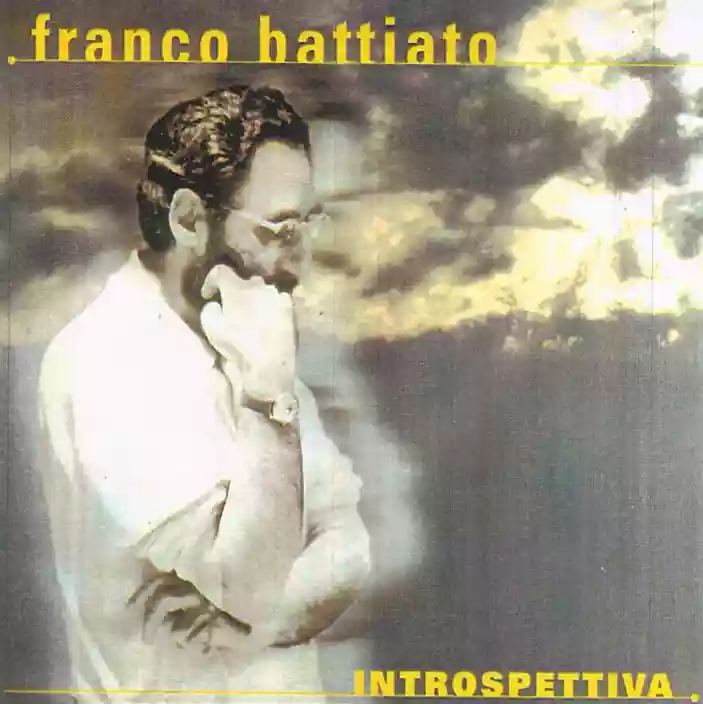
Christmas Holidays 2001. After the success of "Ferro Battuto," Franco Battiato returns to the market with an anthological collection titled "Introspettiva." Franco gives us great emotions in this anthology CD, where the clichéd "Best" formulas are avoided, and instead, a themed playlist is preferred. The theme is precisely that of the psychological introspection of the Protagonist. Twenty years of "pop" career, from "L'era del cinghiale bianco" in 1979 to "Fleurs" in 1999, with 18 gems from his precious discography.
It starts with "Il Re del Mondo," perhaps his absolute masterpiece, which cites the text of the famous esotericist René Guénon. The most beautiful aspect of this collection is that each song also represents the psychological introspection of the listener, who recontextualizes these splendid tracks in their own existence. For instance, in the opening track, our "Re del Mondo" might be the media world, the oppression we endure every day from the news broadcasts after perhaps a nice day out, seeing indeed "the bicycles towards home." The same goes for "Le aquile"; maybe those who go to the gym completely identify with this song, where in everyday life there is a tension towards the Transcendent. "Segnali di vita" is a masterpiece of the highest level, a reflection on time and space, with a light breath of Quasimodo, in fact, "signals of life in the courtyards and in the houses at dusk" makes one think of "And suddenly it's evening" by the Italian Nobel Prize. Cosmic journeys and journeys in the world, and so "Radio Varsavia" is a wonderful fresco of Eastern European societies, it almost seems to live the scenes described in real-time. Then we move on to "Mal D'Africa": how not to identify with the "smell of brilliantine," and in certain lunches that we all had as children with parents and relatives? Thus, a peak of Battiato's production is reached with "L'animale" from 1985, again you can recognize yourself in a loving tendency towards women. The songs thus become the soundtrack and frame of one's life. "Secondo imbrunire," everything is perfect, especially in certain landscapes of southern Italy, where "the low walls of lava stone reach the sea," and in the wonderful passage of the "old Carabinieri barracks." In my area, there is an abandoned barracks, and every time I passed it, I sang this song; it seemed that Franco was singing my life! Incredible! In the following "Giubbe Rosse," the power of identification continues, in the attempt not to kill lizards or other animals on the road. The rest of the song then, for those who live near Vesuvius, is truly a successful narrative "And the incandescent fire of the Volcano" and also "Return to the South": how many people have emigrated to the North and then returned to the South?! It really makes you cry listening to this song. With "Povera Patria," after the first song, there is a "political" moment, a "return to the world": this song is also associated with what is seen on TV once you return home every day, after days of lived life and contact with others and nature. It's time to sleep. But "at night, in sleep, when I am not conscious," there is a need for the Protector. Many people seem to lose contact with their being before falling asleep, wondering about the true meaning of existence. "Lode all'inviolato" is another gem that reminds "No u turn," the personality conflicts of youth, and the many "useless characters worn" that each of us has worn, more or less explicitly. "Haiku" for those who have a tree to meditate under is pure autobiography. "Breve invito a rinviare il suicidio" is genius, the theme of suicide is addressed stoically, but "this semblance of life has made suicide obsolete." Unfortunately, many people were not so clear-headed... "La Cura," 1996, returns to the amorous impulses of "L'animale," in a song of which so much has already been said and represents one of the most beautiful love songs of the century. With "Casta Diva," Battiato appropriates the life of another person, Maria Callas, perhaps to speak of his own, to see himself in the Other, "Deity of the supreme voice, your temporality has entered my bones." "Vite parallele," taking up Plutarch, speaks of each of our lives, "each with a center, with an adventure, and someone who warms my heart." This song perhaps also speaks of our being "One, No One, and One Hundred Thousand." This splendid compilation closes with "Ed io tra di voi," a cover of the famous song by Charles Aznavour, where Battiato, after having appropriated Maria Callas' life, takes over another's text and song, perhaps retracing a youthful incident of unrequited feelings.
End of the journey, a journey lasting over seventy minutes, in which every listener can see Themselves.
This is the key I intend to give to this work which, although anthological, organized in this way represents a truly "new" work.
Recommended, along with the collection "La Cura" from 2000, to all those who want to approach the Sicilian Master, a true pride of our music and our culture.
Loading comments slowly
Summary by Bot
Introspettiva is a profound anthology from Franco Battiato, avoiding typical 'best of' formulas to focus on themes of psychological introspection. Spanning 20 years, it gathers 18 significant tracks that evoke personal and cultural reflections. The review highlights the powerful identification listeners feel with songs and recommends it alongside 'La Cura' for new listeners. It praises the album as a unique and moving musical journey.Tracklist Lyrics Videos
Franco Battiato
Franco Battiato (Catania, 1945–2021) was an Italian singer-songwriter, composer and filmmaker whose career bridged avant‑garde electronics, chart‑topping pop and sacred/classical works. After pioneering experimental albums in the 1970s, he reached mass audiences in the 1980s and later pursued spiritual and orchestral projects, often collaborating with philosopher Manlio Sgalambro. He also composed operas and directed films.98 Reviews
