
 •
Rating:
•
Rating:
THE REVIEW
In every album by Francesco Guccini, there is a song destined to become an obsession at his concerts over time.
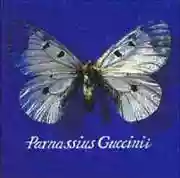
In this “Parnassius Guccinii”, titled after the real name of a butterfly discovered by a zoo enthusiast friend of his and dedicated to him for the flamingo's size, the standout song is undoubtedly “Canzone per Silvia”, dedicated to Silvia Baraldini, whose case, in 1993, was at the center of attention for anyone who cared about human rights. A very heartfelt dedication, a song that speaks of the contradictions of this America (and also of other countries, one might say), which seems so free, with a statue symbolizing freedom. To Silvia and many like her, this statue symbolizes only a federal prison. There are no ideas worth staying in prison for, and she was one of those people jailed without ever having killed anyone or stolen anything.
“Acque” is a piece that was supposed to end up in the soundtrack of a film, “Nero”, by Dylan Dog's creator, Tiziano Sclavi. It is a beautiful song, slow with good saxophone and accordion inserts. As the title suggests, it is a song about water flowing without questioning why.
Then there's a story that seems very real, set in a suburban Milan, a schizophrenic Milan of these times. A story between two young people, Samantha and Andrea, two youngsters who would like to speak of love but lack the courage, and it is the piece that contains one of the phrases with which Francesco is still identified today: “and I, puppeteer of words”.
“Farewell” is the memory of a distant love story, a love once thought special that ended like a “normal” story, melancholy oozes from every line of this beautiful piece.
The burst of irony (I would say almost sarcasm) comes from “Nostra Signora dell’Ipocrisia”, with a phrase that fits these days where “at fashion shows, people transgressed with less joy”, does it remind you of anything? Anyway, a ruthless snapshot of what, even today, perhaps more than ever, is the bleak world of the mass media and politics. Francesco, in an interview, drew comparisons between his song and Fabrizio De André’s “La Domenica delle Salme”, and I would say that in some way the two songs can also be juxtaposed for their thematic similarity.
Our life is increasingly becoming a gigantic “reality show”, at this point, in this world where art is increasingly reduced to merchandising, and given that it seems that the masses want more and more of these pseudo-programs and that the “Keyhole” is in the running for the cultural Telegatti, “let's all do cinema”.
“One should never go back. Why tread on your old steps, kick the same stones on streets that have already seen you with lowered eyes?” Yet Francesco always retraces his steps, he is one who remembers. And often memories hurt in old age.
In “Luna Fortuna”, Argentine music, a chacarera, you can hear the clear influence, as well as the voice of Juan Carlos Biondini “Flaco”, the Argentine guitarist who has been by Francesco's side for a lifetime. Francesco erroneously wrote the text in downbeat, forgetting that Argentine music is all in upbeat, but from this mistake, a piece still fascinating was born.
The album closes with a minor track, a “leftover,” as Francesco also admits, due to the need to “fill” the CD. However, it is not bad, on the contrary, it's a cheerful little piece that talks about what it means to write songs.
An art that Francesco has always known how to do excellently, despite his ups and downs. This album undoubtedly belongs to his “highs”.
Loading comments slowly
Summary by Bot
Parnassius Guccinii is an album rich in poetic and heartfelt songs, notably "Canzone per Silvia," a tribute to human rights. Guccini explores social contradictions, personal memories, and political irony. The music blends folk elements with accordion and saxophone, delivering both emotional depth and critical reflection. This work stands as one of Guccini's artistic highs.Tracklist Lyrics Videos
Francesco Guccini
Francesco Guccini (born 1940) is an Italian singer-songwriter and author, active since the 1960s and known for poetic, narrative lyrics and a long career as one of Italy's major cantautori.48 Reviews
