
 •
Rating:
•
Rating:
THE REVIEW
"But more beautiful than all, the Never-Found Island
the one that the King of Spain received from his cousin
the King of Portugal with a sealed signature
and a papal bull in Gothic Latin."
G. Gozzano, 'The Most Beautiful', 1913
"The King of Spain set sail..." and thus it begins: the ship is ready, the crew is already on board, there is no more waiting to set off toward a destination that does not exist, an island that hasn’t been found, and that will never be found. But one travels, one must travel, through Life, and the time that makes it so ambiguous, vulgar, precarious, and senseless.
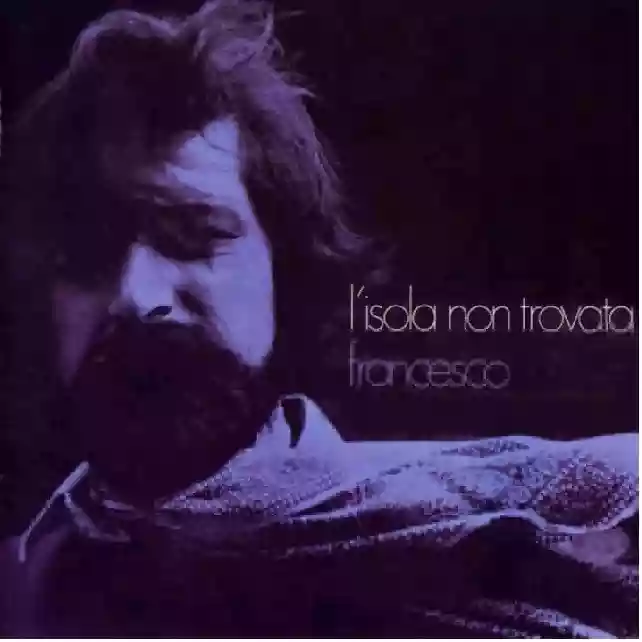
Guccini knows these things well, and even if hints of the crepuscular were noticeable in the first two LPs, it is with this one from 1970 that he begins his journey into the unknown, a journey of songs that, with a bit of courage and imagination, we might consider concluded more than ten years later, when in 'Guccini', he will contemplate the vanity of the journey, of the search, and will involuntarily interrupt the production of unsurpassable, highly valid albums.
It begins with 'The Never-Found Island', the first of many masterpieces, a quite noticeable break from the previous two LPs, less homogeneous, more forced and compilative than this one, where instead, he often insists on the same theme: time, and its function in our life, human linearity so contrary to the cyclic nature of Nature, existential unease, emptiness. The only reaction: the journey, the search. The same reaction will be had by Vecchioni with an album entitled 'Elisir', where a good remedy, almost magical, to doubt, futility, and vulgarity will, again, be the journey. Two very different journeys between the two authors, but we will see this another time.
The tracks are not few, compared to Guccini’s 70s formula of six recurring tracks. There are 10, and among them, there are no shortages of 'fillers', watch out, for albums like this and also like 'Elisir' before, which have the same number of tracks, fillers are inevitably there, but they are such compared to the greatness of some tracks that they accompany, so relatively.
Among the 'weaker' tracks, I generally point out the second part of the LP, side B: which offers the triptych 'Night Song'; 'The Theme'; 'The Man', besides the excellent track 'Asia', and the reprise of the beginning. Therefore, sparser than side A. The aforementioned triptych consists of the less strong tracks, 'Night Song' is ambiguous, between jest and gloom, but doesn't manage to have a very effective effect; 'The Man' is too similar, in concept, to the first two LPs, reminds me of the descriptions, the brief stories of 'The Tree and I' or 'The Birthday', where something sinister is felt, but it's not well framed, the execution is excellent, very Guccinian, also in the choice of words, it’s the idea that lacks impetus, you can feel that it's not conceived as a standout track; 'The Theme' returns to the 'theme' precisely of time, despite already having heard in side A the manifesto of this theme, a much more famous and better-executed track: 'Another Day Has Gone'.
This first masterpiece of Guccini doesn’t feature only indispensable tracks, but let’s go to the best moments. The opening and closing, so mystical, murky, dark, 'the never-found island', towards which one moves exploring the dark, straining the eye between doubts and clouds, and then the singing, so harsh with such warm words "...the ancient maps of corsairs/ bear a mysterious sign/ the sailors speak of it quietly/ with superstitious fear..."
But above all the existentialism of 'The Hill', a very Guccinian track, more for the idea than the actual execution, which greatly influences my high regard for the album. 'Another Day Has Gone', one of the best tracks on time, on its vagueness and elusiveness, a theme he will return to often and of which this track can be considered an early and somewhat naive manifesto (if compared to the relentless time of 'Song of Daily Life', perhaps the most Guccinian track of all his production), the portrait of 'The Monk', certainly describing a part of Guccini himself, but which in these identifications suffers a bit, feeling constrained, they work better with Vecchioni who instead weaves in and out of the clothes of many characters with ease and mixing historical coherence (almost never important) with autobiographical elements. Then again 'Asia', an atypical track, stationary, static, talks about Asia, indeed, hard to say whether it’s an 'important' track or transitional, hard to understand the connection with a never-found island, Asia is there, but it will always remain a mystery for the Western man.
Loading comments slowly
Summary by Bot
Francesco Guccini's 1970 album 'L'isola non trovata' marks a pivotal moment in his career, embracing themes of time, existential unease, and the endless search for meaning. The album features a strong side A with standout tracks like the title track and 'Another Day Has Gone,' while side B is more uneven but still compelling. Guccini's poetic lyricism and folk melodies create a deeply reflective journey, influencing Italian singer-songwriters including Vecchioni. This album is a foundational masterpiece in Guccini's discography.Tracklist Lyrics Videos
Francesco Guccini
Francesco Guccini (born 1940) is an Italian singer-songwriter and author, active since the 1960s and known for poetic, narrative lyrics and a long career as one of Italy's major cantautori.48 Reviews
Other reviews
By Grasshopper
The Unfound Island is the symbol of the truth that eludes us, the continuous effort to reach it, naturally destined to remain in vain, but at the same time a reason for living.
It is clear that this is a classic 'to be read' album more than to be listened to, and in this sense, it is one of the best that our songwriters have ever given us.
