
 •
Rating:
•
Rating:
THE REVIEW
Aldo Moro was already dead, and "Star Wars" was already a cult. Guccini was a left-leaning, easygoing professor, and I Nomadi were a militant and beloved band.
The 1979, would bring to Italy some surprises and many disappointments: Alan Sorrenti conquered the charts with a lucrative and self-serving hit, "Tu sei l'unica donna per me"; De Gregori released one of his less convincing albums, "Viva l'Italia"; Renato Zero sang with suffering "Il carrozzone", Venditti self-destructed a very dignified songwriting career; Celentano reminded us, somewhat sadly, that in the end, beautiful or ugly, we are all, inexorably, "Soli".
And abroad it wasn't much better: Dylan converted to Christianity (and recorded the abstruse "Slow Train Coming"); Elton John released the terrible "Victim of Love"; Stevie Wonder composed a double album to promote a bizarre documentary film about plants ("Journey Through the Secret Life of Plants," remember?); Paul MacCartney recorded out of obligation rather than real desire a series of disgraceful and mediocre albums.
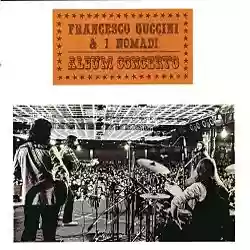
Here and there, almost like a mirage, a series of more or less significant surprises exploded, quite unexpectedly: "Album Concerto" by Guccini and I Nomadi is undeniably the best example.
The professor and the pupil (embodied by the unforgettable Augusto Daolio) speculative and complementary: Guccini sings (not very well, but then again, when has he ever sung very well?) while I Nomadi, thanks to modern and stunning arrangements, add spice to a series of political and committed songs (see for example the memorable "L'atomica") and revive an artist, Guccini, who was beginning, alas, to show signs of heaviness and fatigue (but then "Metropolis" will come, and we will all be happily proven wrong).
An immensely important, almost indispensable record, the father of all the live albums that, from Baglioni to De Andrè, will exponentially flood the shelves and stalls of the large, and very crowded, Italian shopping centers (in 1979 the Pfm also teamed up with De Andrè to record a double live album: the result will be commendable, but this "Album Concerto", although less refined, appears more straightforward and convincing).
From Pavana to Modena, from Via Emilia to the West: Guccini and I Nomadi spare nothing, not even the rhetoric. Every now and then, often after performing a couple of songs, Guccini takes the microphone and starts to monologue. For most, it will be unbearable and even not very amusing (and indeed, you can say anything about Guccini except that he is funny), but when the music begins to make itself heard and Beppe Carletti starts cursing at the piano keyboard, well, what can I say, there is little to laugh at, there is only to listen.
It starts with "Canzone per un'amica" (and how else?) and continues with "Statale 17", the apocalyptic "Noi non ci saremo" (..."and the summer wind that comes from the sea / will sing a song among a thousand ruins / among the rubble of cities / among houses and palaces that time will slowly crumble / among cars and roads, the new world will rise / but we will not be there"), the highly censored "Dio è morto". And the highly underrated "Per fare un uomo" is, say what you will, a masterpiece.
A separate discourse deserves the scandalous "Auschwitz", a chilling and shocking account of a life (or rather, of many lives) devoured and lost during the horrors of the Second World War (the famous opening line: "I died when I was a child, passed through the chimney and now, I am in the wind"). Guccini had already recorded it in his very first album, "Folk Beat n. 1", but Beppe Carletti's arrangements and Augusto Daolio's interludes seem to give it an epic and grand tone, yet still suffering and dramatic. To listen to again in the most religious and tortured silence.
Therefore, it is a historic and epochal album: it is not a live of The Who or Deep Purple, but, at least in Italy, we could use more live albums like this!
Loading comments slowly
Summary by Bot
Francesco Guccini and Nomadi's Album Concerto stands out as a historic and important live album in Italian music, combining political themes with powerful arrangements. Despite Guccini's unpolished singing, the collaboration with Nomadi, especially Augusto Daolio's presence and Carletti's arrangements, revitalized the artist and set a live album standard. The record features memorable songs such as 'L’atomica,' 'Dio è morto,' and the chilling 'Auschwitz.' It's a must-listen for lovers of committed and epic Italian songwriting.Tracklist Lyrics Videos
Francesco Guccini
Francesco Guccini (born 1940) is an Italian singer-songwriter and author, active since the 1960s and known for poetic, narrative lyrics and a long career as one of Italy's major cantautori.48 Reviews
