
 •
Rating:
•
Rating:
THE REVIEW
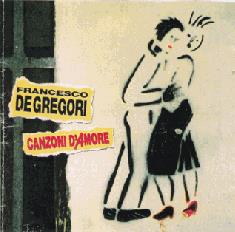
"Did you really believe / that we would talk about love? / Did you really believe it / or did you just hope for it with your heart?", sings De Gregori slyly, in Rumore di Niente, the last of these "Canzoni d’Amore." Indeed, a title as misleading as ever, considering that out of eleven tracks, there are really only two actual love songs (Bellamore and Stella della Strada).
The truth is that with this album, De Gregori continues the discourse started with the previous Miramare 19. 4. 1989, in a raw examination of contemporary reality, where there's very little space for love. Consequently, the album can only be bitter: the lyrics represent a deep dismay, a society that makes one uncomfortable, where one cannot relate, where illegality and inhumanity triumph, a world where you see "men fallen on the ground / and no one stopping to look / and the innocent getting confused and the assassins dancing / the innocent getting corrupted and the assassins cheering", where Old Friends (Venditti again?) win, the schemers, those who believe the rules are made for others (the divorced Christians who take communion), the prototype of the person already sung about in the previous album in Pentathlon. And if we want at least a bit of consolation, we shouldn’t look for it outside, but we can only find it by retreating, closing ourselves in love (Bellamore, Stella della Strada), the only means capable of making this damned time pass "without harming us". And hope, if there can be a bit of hope, is not here and not now. It might be further on, when age and experience grant us the secret to accept all this, maybe even to find something good in it, when we are, perhaps, like that old man who, who knows how, manages to see Tutto Più Chiaro Che Qui.
Politics take up a lot of space, particularly in Chi Ruba nei Supermercati?, although frankly that chorus, so simplistic and generalist ("Whose side are you on? / Are you on the side of those who steal from supermarkets / or those who built them, stealing?", which somewhat reminds me of the same logic as the recent Rifondazione billboards on the financial matters - those of the rich crying with the photo of the superyacht) is rather disappointing and unexpected from De Gregori. Or again in La Ballata dell' Uomo Ragno, decidedly better and dedicated, as confirmed by De Gregori himself, to Bettino Craxi, the politician who loved to surround himself with dwarfs and dancers. The song is still extremely current, easily adaptable as it is to one of those dwarfs who danced around him so much, the one who "took the field" to save the beloved country from communist censorship (and himself from certain jail: "they hide the past by talking about the future / and if they find the eye of the needle / they will surely devour it"). Or again in the same Rumore di Niente, a bitter and cryptic reflection on the events that in those years changed the world (the USSR crumbling, the Berlin Wall falling, in Italy the Bolognina turning point), opening to globalization, chaos, and the loss of everyday reference points that followed.
In this album, in my opinion, there isn't the best of De Gregori, the absolute genius touch is missing; however, there is an honest, rigorous artist, still above the average circulating (just to be in Italy, in 1992 the 883 with Hanno ucciso l' Uomo Ragno were all the rage...), capable of perfectly expressing the discomfort of living in a reality that resembles him less and less, and strongly denouncing its grotesque and paradoxical aspects. The album is therefore definitely more than dignified, with pieces of absolute value: Adelante! Adelante!, full of images in pure De Gregori style, somewhat like I Muscoli del Capitano, to make you understand; Sangue Su Sangue, the most rock piece on the album; Povero Me, my favorite (in live performances almost "recited"). From a musical standpoint, the entire album pleases me quite a lot: perfect Tutto Più Chiaro Che Qui, Rumore di Niente, Povero Me, Viaggi & Miraggi (the only truly carefree song on the album) with that sax, the piano in La Ballata dell' Uomo Ragno.
In short, my personal judgment would be a 3.5: in the impossibility of half scores, I rely on luck: heads (ahem... the little man of Leonardo), I round up; tails (Europe), I round down.
Leonardo came out, and I believe it’s fitting.
Loading comments slowly
Summary by Bot
Francesco De Gregori's album Canzoni d'Amore is a continuation of his earlier work exploring the harsh realities of society, rather than focusing on love. With only two true love songs, the album offers biting social and political commentary wrapped in poetic lyrics. Despite lacking De Gregori's absolute genius touch, it remains a solid and honest expression of discomfort in a changing world. Highlights include tracks like 'Adelante! Adelante!' and 'Povero Me'.Tracklist Lyrics Videos
Francesco De Gregori
Francesco De Gregori (born 1951, Rome) is an Italian singer-songwriter known for poetic, often hermetic lyrics and a pivotal role in modern Italian canzone. His catalogue spans intimate ballads, historical narratives and politically charged pieces.68 Reviews
