
 •
Rating:
•
Rating:
THE REVIEW
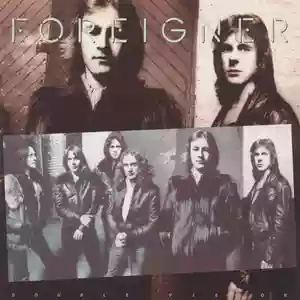
With a cover that is admittedly not very remarkable, Foreigner released their second album in 1978, after their debut had done fairly well the previous year in the USA, the main playing field for this Anglo/American band. The “double vision” of their guitarist Mick Jones (ex-Spooky Tooth) and multi-instrumentalist Ian McDonald (ex-King Crimson)—the two shown in the foreground, cropped from the original group photo—formally set out the state of the band at the time: they were the leaders, the songwriters.
Jones had ended up in the United States years earlier, following Leslie West Band in the role of second guitarist. The manager of the stout Leslie had advised him—and helped him—to set up his own band, having been impressed by our man’s songwriting and arranging abilities. Ian, too, was living in New York at the time because of his American girlfriend, and their meeting gave rise to this hybrid six-piece, made up of three Americans and three foreigners (besides the two bosses, the drummer Dennis Elliott was also very much English). Hence, the band’s name.
The album is better than the debut, with a greater number of well-executed songs and, above all, the beginning of what would ultimately become the band’s own, shall we say, “bipolar” style: I’m referring to the coexistence of two clearly differentiated forms of composition, mood, arrangement, and intensity, which from this point forward would alternate on all Foreigner records.
The first of these two antithetical approaches is the quintessential hard rock one: in these cases, there is almost always a well-crafted, often sharp and penetrating guitar riff, anything but bland. This is accompanied by high and powerful vocals from frontman/paisà Lou Gramm, driven to the very edge of his range in the high notes.
The second expressive style, clearly distinct from the first, is the intense and enveloping ballad usually composed on piano or at least some kind of keyboard, instruments that guitarist Jones does not master virtuously, but well enough to come up with great ideas and develop them nicely. Sometimes with help from his keyboardist Al Greenwood (and, when the latter would be let go, from illustrious guests).
This progressively affirmed approach would eventually put strain on the group’s other prolific mind, the quiet Ian McDonald, who still finds room here for a couple of tracks featuring his vocals and accented by a sax break. Yet these contributions (“Back Where You Belong” and “I Have Waited so Long”) turn out to be, so to speak, the weak links in the chain—almost anachronistic because of Ian’s voice, which sounds so insecure and fragile compared to the intense and determined performance of the fiery Gramm.
On that whirlwind and at the same time captivating hard rock side, the opening “Hot Blooded” stands out with its simple yet irresistible riff, the eponymous “Double Vision” with its smooth verses and, conversely, syncopated, bouncing chorus, and the driving and more solemn “Blue Morning, Blue Day.”
On that other, more atmospheric and keyboard-driven inspiration, we have “You're All I Am” with its elegant chorus marked by peculiar syncopations; the harpsicord and mellotron flourishes from McDonald in this track are endearing—touches that would soon vanish from Foreigner’s landscape. The same goes for the instrumental “Tramontane,” which seems lifted straight off an Alan Parsons Project album… All embellishments which, after just one more album in this vein, Jones would shed permanently, once and for all focusing Foreigner’s direction onto that aforementioned double track: biting yet irresistible hard rock riffs with the appropriate howls from his singer, alternated with stormy, dramatic, and at the same time slick ballads carried by the operatic, almost tragic delivery of his multifaceted frontman.
The story of Foreigner and their melodic hard rock—at once minimalist and bombastic—is in its way peculiar and seminal. Over the years, I’ve realized it’s rather far from the Italian mainstream palate.
But not from mine, instead. In the eighties, I listened to them profusely, falling in love with many of their songs. And I even had the luck to see them live, and in an absolutely wonderful place, too: a natural amphitheater inside a canyon carved by the Columbia River in the state of Washington.
Loading comments slowly
Summary by Bot
Foreigner's 'Double Vision' receives a favorable review, emphasizing its solid place in classic rock history. The review praises the band's sound and the album's lasting appeal. Highlights include the energy of the tracks and the band's chemistry. 'Double Vision' is notable for its production quality and strong musicianship. Recommended for fans of classic rock and lovers of iconic albums.Tracklist Videos
Foreigner
Foreigner is a British-American rock band formed in New York City in 1976 by Mick Jones and Ian McDonald, with Lou Gramm as lead vocalist. They became AOR mainstays with hits like Cold as Ice, Hot Blooded, Juke Box Hero, Waiting for a Girl Like You, and I Want to Know What Love Is, achieving multi-platinum success through the late 1970s and 1980s and continuing to tour.04 Reviews
