
 •
Rating:
•
Rating:
THE REVIEW
Review by Alia76
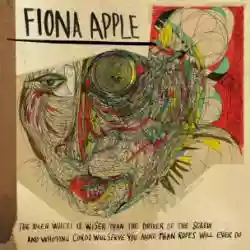
It has been since Bjork's "Homogenic" that I haven't encountered such a magnificently focused album with such a successful and surprising production idea. Where the Icelandic artist built everything on a formula of electronics-string octet-voice, Fiona does the same by exclusively blending voice, piano, and rhythm. There's very little else in this album. Yet it feels like an infinitesimal universe. The almost non-existent melodic fabric of the songs is enriched by masterful, I would say, percussive inserts and noises while the fingers move across a few octaves, and the voice colors each piece with a heartfelt and moving interpretation. Fiona's lyrics are then the jewel of a work that has been awaited for 7 years but has captivated everyone. Thought out in this way, this album is invulnerable and overturns the concept of an “acoustic” album. Furthermore, it presents us with one of those rare cases of a perfectly successful artistic marriage, here with Charley Drayton (previously with Neil Young and Iggy Pop). I haven't found a better album this year.
Rating: *****/*****
Review by cptgaio
Without hiding behind a finger, I don't want to conceal from you dear “debaserians” that reviewing a new work by Fiona Apple creates a bit of embarrassment: firstly because there is already an exhaustive review in the “dedatabase,” then because mine comes as a “guest” to that of, in my opinion, the best living “dereviewer” (in technological terms, of course), and finally because I believe my view is clouded by the inability to see time flowing in its true contemporary essence.
This is a beautiful album: Apple has maintained very high technical levels (especially vocally), the production is to my liking (minimal, symmetrical to the lyrics, played on the dualism of piano/percussions, “soaring” when necessary, “ruthless” at other times) and it reminds me for long stretches of both “Under the Pink” and “Boys forPele” by Amos (but also “Geek the Girl” by Germano, so as not to offend anyone…). I add that there is significant progress over the previous work of the former “Criminal” (which was too planted on jazz-blues idioms, in my humble opinion, whereas here there is a clear attempt at emancipation) so it should excite me.
Yet for days I’ve been wondering if at the end of times I will remember this album or if I will continue, in the harsh “mechanical” days, to seek comfort in songs like “Never is a Promise” that belong to another space-time because, beyond the fleeting enthusiasms, if I have to find a flaw in our artist’s career, I inevitably think that to fully appreciate her, one either completely focuses on the technical side (remarkable as mentioned, but that’s not my case even though I recognize the problem is paradoxically mine) or resigns to the fact that not even she came out very “intact” from the '90s, and an album like “The Idler Wheel…” appears out of time, now, but also inadequate to bear comparison with what was.
Rating:***/*****
Loading comments slowly
Summary by Bot
This review praises Fiona Apple's album The Idler Wheel for its minimalist yet powerful combination of voice, piano, and percussion. The production is regarded as focused and innovative, creating a unique sonic universe. The heartfelt lyrics enhance the emotional impact, making the album a standout release in 2012. Though some ambiguity about its lasting impact is noted, it is acclaimed as a masterpiece in modern music.
Fiona Apple
Fiona Apple is an American singer-songwriter and pianist from New York City. Across five studio albums, she’s known for uncompromising, piano-led songwriting, elastic vocals, and inventive rhythms that push art-pop into raw, personal territory.09 Reviews
Other reviews
By Schadenfroh
The voice ranges from calm to desperate tones with a maturity that lends solidity to the pieces.
This album speaks of your weaknesses, of what you sometimes can’t express, of the things that leave you stunned on the ground without anyone to help you back up.
