
 •
Rating:
•
Rating:
THE REVIEW
If for the average person German music is limited, more or less, to a song and little more, even among the most devoted circles of aficionados, for many, Germany primarily means krautrock, electronic music, and perhaps a bit of industrial. Yet, the bubbling Teutonic New-wave scene, also known under the more exotic epithet of Neue Deutsche Welle, is often forgotten. I must admit that I, too, long ignored it, as what I had come across so far seemed a tad too pop for my aristocratic alternative tastes.
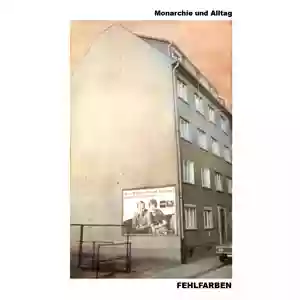
Determined to fill this gap in my knowledge, I decided to look beyond the surface, convinced that at least a couple of interesting groups must exist there, leading me to stumble upon Fehlfarben, a group unknown to me, but apparently one of the most famous in Germany's alternative music scene. With this "Monarchie und Alltag" (=Monarchy and Daily Life), they released what many consider THE manifesto of NDW in its most embryonic and noble stage.
The group hails from Düsseldorf, today a chic and bourgeois city (a true stronghold of the CDU), but at the time a cultural and musical center in full swing. Known, I venture to think, even here on Debaser for giving birth to groups like Kraftwerk, Neu, or DAF, or the more punk-influenced (and commercial) Die Toten Hosen, the capital of the federal state of North Rhine-Westphalia (the most populous region in the Federal Republic of Germany and home to many of its major cities) was indeed also one of the centers of the German new wave movement, along with Berlin, Hamburg, Hannover, and Hagen. Born as a punk-ska band in 1979, Fehlfarben soon found themselves under contract with a subsidiary of EMI, under which they released their debut in 1980, in a studio in nearby Cologne.
Today regarded, as previously mentioned, as one of the seminal albums of German rock, the group's first effort received a mixed reception at the time and was fully re-evaluated later. At the time, the group was accused, as often happens in these cases, of betrayal by a portion of its early fans, while the musical offering remained too challenging and aggressive to break into the mainstream, so much so that only the funky "Es geht voran" managed to break through as a single. The attempt to straddle two worlds simultaneously would lead to friction within the band, so much so that the singer would soon leave the group, which would continue to exist, releasing two more albums before disbanding in 1984 (followed by a first reunion in the '90s and then again in the '00s). But what remains today for us seasoned listeners of the post-modern era from this band of one album and done? What remains is an excellent post-punk record, indeed a touch more "punk" than "post-", capable of appealing to fans of more direct music as well as those with a more sophisticated taste in new wave. Due to the ska-funk influences, some like to compare the band to Gang of Four, but my ear, anything but highly technical, recalls more a mix between Clash and early Wire (let's say the first album and a half).
An album living in contrasts, yet still fresh and immensely enjoyable, certainly worth rediscovering.
Loading comments slowly
Summary by Bot
Fehlfarben's debut album Monarchie Und Alltag is a foundational record in Germany's Neue Deutsche Welle scene, combining punk, ska, and funk influences. Initially met with mixed reactions, it is now recognized as an excellent, fresh post-punk album appealing to both direct music fans and new wave enthusiasts. The album showcases the cultural vibrancy of early 1980s Düsseldorf and remains relevant for modern listeners seeking sophisticated alternative sounds.Tracklist Lyrics Videos
Fehlfarben
Fehlfarben are a German NDW/post-punk band from Düsseldorf, formed in 1979. Their debut Monarchie und Alltag (1980) became a seminal release, with the single “Ein Jahr (Es geht voran)” breaking through. After early albums including 33 Tage in Ketten and Glut und Asche, they disbanded in 1984 and later reunited in the 1990s and 2000s.01 Reviews
