
 •
Rating:
•
Rating:
THE REVIEW
It's difficult to establish whether they invented British folk rock, but without a doubt, they were among the greatest exponents of that genre. I'm talking about Fairport Convention, namely five young men and a young woman who, in 1967, driven by a shared love for Bob Dylan and the Byrds, as well as folksingers like Richard Farina, Tim Buckley, Leonard Cohen, Joni Mitchell, and many others from American folk rock, decided to start playing covers and some (very few, actually) originals. Is that all? Just any cover band? No, not exactly, because these youngsters, aged between 17 and 24, had the insane and for us delightful vice of taking their idols' pieces and deconstructing and reconstructing them with arrangements that were anything but trivial. Let's be clear, there was nothing virtuosic about them, only a crazy and adolescent love of playing, and a tremendous musical feeling, which with sometimes simple, sometimes less so, solutions led them to create little gems...
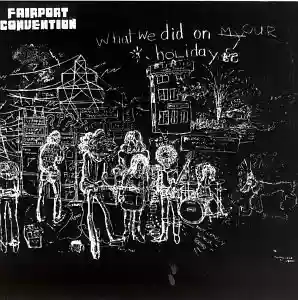
However, after their debut album, in 1968, Fairport immediately lost Judy Dyble, their first female voice (it's unclear whether she left or was removed; in any case, she ended up for a while in the antechamber of King Crimson's court...), and entered the formation Sandy Denny, the most beautiful, legendary, and unforgettable female voice of English folk. Immediately entering the studio, our guys recorded this second album, "What We Did On Our Holidays". This time the group decided to go beyond covers, and all the members, except for drummer Martin Lamble, contributed to the composition of the pieces like good siblings.
It must be said right away that already in this album, the lion's share (or rather, the lioness's) is taken by the recently arrived Sandy, who, despite having musical tastes similar to those of her companions, brought with her a generous dose of traditional Albion music, as understood from the piece that opens the festivities, "Fotheringay", the folk quintessence of the work. On the opposite side is Ian McDonald then Matthews's male voice, a true champion of the Californian wing of Fairport, as understood by listening to "Book Song" (Matthews, not surprisingly, after the album's release, will throw in the towel and emigrate to the US, faced with the traditionalist turn taken by his friends). In between, we find the lead guitar, Richard Thompson, endowed with a unique and personal, acidic yet sweet and unadorned instrumental style, who composed one of the most famous pieces of Fairport's entire catalog, namely "Meet on The Ledge", which is still played today at the annual Cropredy festival. It's a piece with a few chords, dealing with death and separation from loved ones, and knowing that it was written by a nineteen-year-old can't help but leave us, how to say... stunned. And we are even more so, considering that within a few months, fate would deal a pretty hard blow to the group and particularly to Thompson, with a car accident in which Lamble and Richard's girlfriend would lose their lives... finally, an interesting fact: bassist Ashley "Tiger" Hutchings composed the only blues piece, but soon, for the famous countershadow theorem, he would become the most intransigent and integralist guardian of the British folk tradition in the formation.
Still, there are covers of Bob Dylan and Joni Mitchell, both rendered in a masterful and very original way, as well as British traditionals: in a sense, they reflect the transient nature of the album, with an American soul, let's say, opposed to a more traditional one, which would soon prevail without the two elements clashing, but rather giving the work a touch of eclecticism.
In conclusion, "What We Did on Our Holidays" almost forty (yes, indeed... time flies...) years later still sounds very fresh and enjoyable, perhaps also because it lacks the ambition and greater orthodoxy of the subsequent albums, which are nevertheless excellent and would culminate in that masterpiece, "Liege and Lief". Perhaps this sweet naivety that hovers over the album makes it seem like the account of a summer holiday spent by friends joyfully playing, still far from the dramas of adult life around the corner. And it's hard not to feel a bit of emotion with the piece that closes, even ideally, the work, "End of A Holiday", a melancholic guitar arpeggio without vocals, composed by the youngest of the group, Simon Nicol.
Loading comments slowly
Summary by Bot
Fairport Convention's album 'What We Did On Our Holidays' marks a significant point in British folk rock with a fresh and emotional sound. Featuring the legendary Sandy Denny and Richard Thompson's iconic 'Meet on The Ledge', the album blends American influences with traditional British folk. It captures youthful enthusiasm and creative exploration before the band's later, more polished works. Despite its simplicity, the record remains enjoyable and timeless.Tracklist Lyrics Videos
Fairport Convention
Fairport Convention are an English folk rock band formed in London in 1967. Pioneers of British folk rock, they fused traditional songs with electric arrangements; the landmark album Liege & Lief (1969) is widely cited as a cornerstone of the genre. Key figures include Sandy Denny, Richard Thompson, Dave Swarbrick, Simon Nicol, and Ashley Hutchings.09 Reviews
