
 •
Rating:
•
Rating:
THE REVIEW
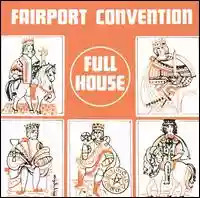
In the wake of the release of the celebrated "Liege & Lief," a true cornerstone of the entire 1970s English "folk revival," the renowned ensemble "Fairport Convention" must record two major defections, those of Ashley Hutchings, bassist but primarily the true "ideologist" of the band, and especially that of Sandy Denny, perhaps the greatest English singer of the decade. The former would continue his tireless work of research and philological rediscovery of the roots of traditional English music, first founding Steeleye Span, then creating the "Albion Country Band" project. The latter, eager to give more space to her own songs, would embark on a solo career; she would return to the band five years later for a brief and controversial reunion, shortly before her premature and tragic death.
With such premises, one might expect an inevitable drifting of the ensemble, orphaned of two personalities of such caliber; however, the remaining members prove everyone wrong by releasing this "Full House," whose music maintains a vertiginous level of quality, with nothing to envy from its illustrious predecessor. If the excellent Dave Pegg is recruited on bass (who would also join Jethro Tull in the eighties and, having survived three decades of turmoil and constant lineup changes, remains today the true "beacon" of the band), it falls to guitarist Richard Thompson and violinist Dave Swarbrick to take on, in addition to songwriting, the vocal duties. They obviously can't compare with Denny's sumptuous voice, but they certainly do not pale in comparison, complementing each other and blending perfectly.
The proof is in the compelling opening track, "Walk Awhile," still today an effective live favorite, a lively and dynamic mid-tempo with Swarbrick's flamboyant violin in great form. The latter also shines in the subsequent and unusually "hard" "Doctor of Physick," which I would dare say is a sort of "hard-folk," characterized by particularly emphatic vocal tones. The pair of frenzied instrumentals "Dirty Linen" and "Flatback Carper" continue the tradition of "traditional arranged" and further the exploration of popular English traditional dances already initiated in "Liege & Lief"; the instrumental cohesion and chemistry reach prodigious levels here, with the five musicians pursuing, intertwining, alternating, competing in virtuosity, at times even seeming to challenge each other to a duel, all to the auditory delight of the listener. The long and expanded ballad (over nine minutes) "Sloth," with its hypnotic and almost listless traits, traces paths almost unexplored by Fairport so far, evoking atmospheres far from "British" but with a vague "West Coast" American flavor, bringing to mind something of the Eagles at their best; needless to say, it too would immediately become a live favorite. "Sir Patrick Spens," another "traditional arranged," is an evocative melody with a medieval flavor, one of those timeless melodies, sung, or rather "told," with an appropriately troubadour-like flair, with its strength in the elegant and effective embroidery of Thompson's electric guitar, the same electric guitar that so much (unjustly) horrified the so-called "purists" of the folk scene. "Now Be Thankful," an evocative choral ballad, closes a memorable album worth counting among the great classics of the genre. Worth mentioning is the recent reissue (from 2001) in a remastered version, containing three bonus tracks, among which an excellent "Bonny Bounce of Roses," a fine and evocative ballad, and a "Now Be Thankful" in "new stereo mix" version.
Loading comments slowly
Summary by Bot
Following the departure of key members, Fairport Convention's Full House defies expectations with stellar performances and memorable songwriting. The album showcases dynamic instrumentals and a blend of traditional and modern folk elements. Highlights include the energetic 'Walk Awhile,' intricate instrumentals, and evocative ballads like 'Sir Patrick Spens.' The 2001 remastered reissue adds valuable bonus tracks, reaffirming the album's status as a folk classic.
Fairport Convention
Fairport Convention are an English folk rock band formed in London in 1967. Pioneers of British folk rock, they fused traditional songs with electric arrangements; the landmark album Liege & Lief (1969) is widely cited as a cornerstone of the genre. Key figures include Sandy Denny, Richard Thompson, Dave Swarbrick, Simon Nicol, and Ashley Hutchings.09 Reviews
