
 •
Rating:
•
Rating:
THE REVIEW
Once upon a time, there was a Scottish-born guy with a voice ravaged by too many cigarettes and whiskey, his name was Rod Stewart. He had played in Jeff Beck's group, a guy who knew his way around a guitar so well that he relegated to the role of bassist someone who would become a legend in a group called the Rolling Stones; his name was Ronnie Wood. There was also a singer and guitarist named Steve Marriott who had left one of the great bands of the '60s, the Small Faces, and had formed a group called Humble Pie. The remaining Small Faces, Ronnie Lane on bass and vocals, Ian McLagan on keyboards, and future Who member Kenney Jones, joined Rod and Ronnie and dropped the "Small," calling themselves simply Faces.
In my opinion, the Faces represent one of the most underrated groups in English rock, perhaps due to the dazzling careers of Stewart and Wood after their breakup or because there were truly amazing groups at the time that overshadowed their great capabilities. However, their sound influenced a great band from the more or less recent past like the Black Crowes and remains personal and recognizable.
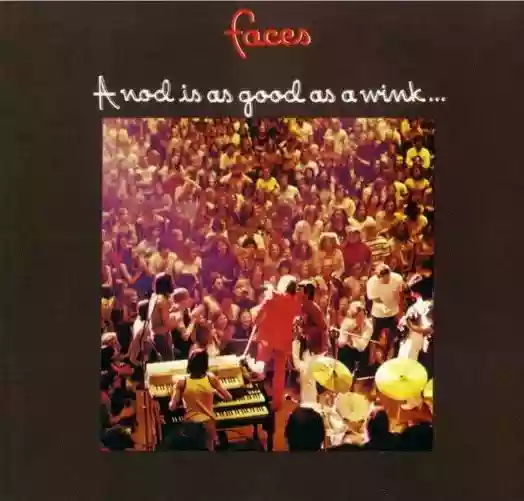
Their album I prefer is the third one, “A Nod Is As Good As A Wink…” which sums up all the characteristics of the group: Stewart’s rough and powerful voice, Wood’s rustic and bluesy guitar, a precise and tight rhythm section, and the keyboards that soften the rough edges with grand injections of piano, electric piano, and a hint of Hammond here and there, and not to forget the alternation of vocals between the leader and bassist Ronnie Lane, whose much lighter and more linear voice equally fits well with the music. The album sits between the second “Long Player” and the stratospheric success of Stewart’s solo acoustic ballad “Maggie May,” which helped draw attention to the group driven by this explosion of the singer’s success.
The undisputed gems of the album are the opening “Miss Judy’s Farm” with its rock’n’roll gait, without a real chorus but with an irresistible groove, like the rhythmic hit-single “Stay With Me,” possibly the best on the record, the ballad “Love Lives Here” that foreshadows Stewart’s future solo career. There is room, as I mentioned, for Lane’s voice in the excellent ballad “Debris”, in the cheerful “Debris”, with keyboards split between honky tonk piano and Hammond and the almost country “Last Orders Please.” To close the album in grand style is a rock blues/rock’n’roll triptych, featuring the Chuck Berry cover “Memphis,” the sharp and hard rock “Too Bad” with cutting riffs and Stewart’s voice in great shape, and the concluding “That’s All You Need” with Ron Wood doing great things on the slide, especially in the central solo interlude.
After this album, however, Rod Stewart’s pop career increasingly took over at the expense of the group’s, so much so that after only 4 records they split, leading Ron Wood to replace the departing Mick Taylor in the Stones, cementing his place in legend and turning the singer with a passion for beautiful women and whiskey into the world-renowned vocalist we all know today—perhaps debatable for stylistic choices but an absolutely crucial voice in the '70s rock scene, who found his best ground in the blues/hard rompings of the Faces.
Loading comments slowly
Summary by Bot
This review praises The Faces as one of the most underrated English rock bands, highlighting their third album 'A Nod Is As Good As A Wink...' as a perfect blend of gritty vocals, bluesy guitars, and tight rhythm. It emphasizes standout tracks such as 'Stay With Me' and 'Miss Judy's Farm,' and notes how the album bridges the band's creative period and Rod Stewart's emerging solo success. The review acknowledges the subsequent impact on rock history and the band's influence on later artists.Tracklist Lyrics Videos
Faces
English rock band formed in 1969 from members of Small Faces and the Jeff Beck Group. Core lineup included Rod Stewart, Ron Wood, Ronnie Lane, Ian McLagan and Kenney Jones. Active primarily 1969–1975.02 Reviews
