
 •
Rating:
•
Rating:
THE REVIEW
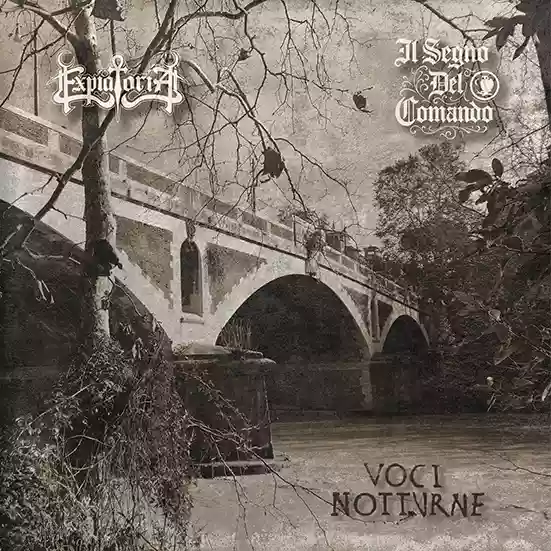
“Voci Notturne”, the split album by ExpiatoriA and Il Segno del Comando, is a record that transforms into music one of the most enigmatic Italian television productions of the '90s: the 1995 miniseries of the same name by Pupi Avati.
The storytelling is a mosaic where reality, esotericism, and tension remain constantly suspended: an ambiguous and unsettling universe that ExpiatoriA and Il Segno del Comando have brilliantly reinterpreted in musical terms. The miniseries unfolds over five episodes that intertwine police investigations with supernatural dimensions: it all begins with the discovery of a young corpse in the Tiber, but very soon the plot expands to involve esoteric rituals, secret societies, and unsettling phone calls from the afterlife. Alongside the Italian investigations, American leads emerge, revealing intrigues, unresolved secrets from the past, and enigmatic characters able to push the story far beyond the boundaries of crime news. The series was subject to censorship due to a formal complaint by the Theosophical Society, which considered the portrayal of its members in the show slanderous, especially for depicting some characters as madmen or criminals. Following these complaints, versions broadcast after the initial 1995 airing were modified. The complete versions are hard to find through official channels, though they occasionally resurface on platforms like YouTube. The strength of the work, as recalled by reviews and the memories of those who watched it, lies not so much in its audience figures—which were initially very low—but in its ability to blend crime drama, esotericism, and unsettling psychology, in a crescendo reminiscent of distant atmospheres, similar in scale to the style of Twin Peaks, but with a profoundly Italian touch.
ExpiatoriA, with their three doom tracks, capture the darkest and most ritualistic side of the series. Monolithic riffs, liturgical atmospheres, and Latin lyrics build an oppressive and disturbing soundscape, perfectly aligned with the suspended tension of the television plot. Their heavy, ritualistic approach conveys the unease and mystery that pervade every scene of the miniseries: not a simple soundtrack, but a sonic exploration of its deepest hidden abysses.
On the other side, Il Segno del Comando interpret the concept of Voci Notturne through their dark and cinematic prog style. The four tracks develop the narrative tension of the series with layered keyboards, shifting moods, and sophisticated arrangements. While the band has already demonstrated sensitivity to Rai television dramas from the '70s in the past, here their focus is entirely on Avati’s concept, amplifying the mysterious and occult undertones of the story without deviating from the main theme.
The result is a coherent and immersive album: ExpiatoriA’s doom digs into the darkness, Il Segno del Comando’s prog constructs narrative scenarios and tension, and together they recreate the ambiguous and unsettling charm of Voci Notturne. The long gestation of the record, its meticulous production, and its live presentation in Genoa consolidate the work as a true cult object, capable of returning through music the same sense of mystery and irresolution that made the series a minor classic of Italian thriller television.
Loading comments slowly
Summary by Bot
This review highly praises Voci Notturne, a collaboration between ExpiatoriA and Il Segno del Comando. The album is lauded for its rich, gothic atmosphere and progressive rock elements. The reviewer awards it the highest possible rating. Themes of darkness and musical storytelling stand out. A recommended listen for genre enthusiasts.
ExpiatoriA - Il Segno del Comando
ExpiatoriA - Il Segno del Comando is the joint credit for the split album Voci Notturne, uniting the Italian doom outfit ExpiatoriA with the dark, cinematic prog group Il Segno del Comando to reinterpret Pupi Avati’s 1995 miniseries.01 Reviews
