
 •
Rating:
•
Rating: THE REVIEW
Sometimes even a clear and obvious reversal can have its appeal and a valid reason for being. More often than not, it happens that upon reaching a certain point and a certain fame, an artist decides to change direction, with more or less good outcomes; the fans whine, the record company grumbles, the radio stations stop playing their music, and in the end, the artist goes back in a flourish of proclamations of "rebirth." For Erasure, it didn't happen exactly like that. The search for a more elegant and (relatively) less garrulous sound began with "Chorus," probably their most successful album, and was then perfected with its immediate successors. The drop in sales between "Chorus" and "I Say, I Say, I Say" is certainly not due to any radical change and not even to a decline in inspiration since the 1994 album is of excellent quality. Rather, it is due to the usual and easily understood reasons that, frankly, I'm tired of mentioning for the umpteenth time. A special mention goes to "Erasure" of '95 with its long, atmospheric, and less radio-friendly ballads that push the style developed in previous years to the extreme (without, however, overturning it), maintaining an immediately recognizable feel and completing a gradual journey of growth and maturity.
As I see it, by that point, Erasure didn't have much to lose by continuing in this direction: the phase of great commercial splendor was behind them, and they knew it, especially the more seasoned Vince Clarke. Winning a large number of new fans among the new generations was a nearly impossible feat, but on the other hand, they could count on a solid fanbase built over the years, which largely appreciated this "alternative" shift. Apparently, "Erasure" is considered a high-end, uniquely designed piece intended to remain a one-off, the closure of a cycle rather than a starting point, and it's an entirely respectable choice that demonstrates humility and self-awareness, especially given the consistency and seriousness with which Andy and Vince have faced (and are still facing) their "ebb" phase, which officially begins with this "Cowboy."
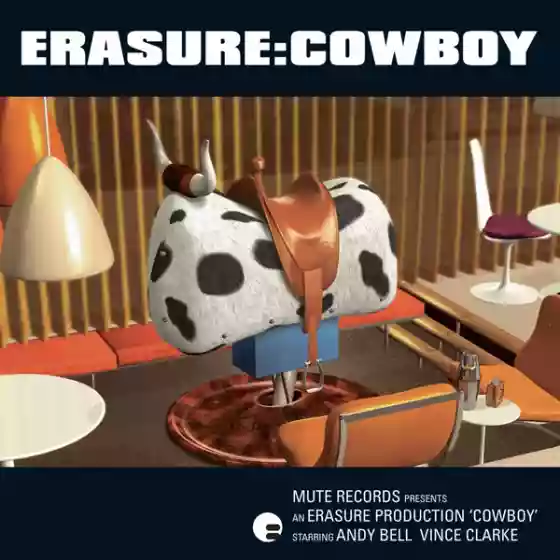
Two years after their artistic peak, Erasure returns to offer fresh, pleasant, and carefree synth-pop, and they do it with a truly well-crafted album: simple, straightforward, absolutely unpretentious, with decidedly inspired and catchy melodies, excellent and consistent quality, and a more streamlined sound compared to albums like "The Innocents" and "Wild!", in line with the times, though unmistakably personal. "Cowboy" conveys enthusiasm and joy of life in every single note, in lively and sparkling tracks like "Don't Say Your Love Is Killing Me", "Have Me Darling", and "Rain", as well as with calmer and more balanced midtempos that, contrary to what one might think, form the backbone of the album, particularly "Worlds On Fire", "In My Arms", "How Can I Say", and the pseudo-darkened "Treasure".
Two excellent ballads like "Boy" and "Love Affair", perfectly integrated into the context, complete an absolutely perfect album of its kind, a pleasant and entertaining listen that always manages to bring a smile. Simple and intelligent pop, and ultimately the involution, if we want to call it that, is clear and evident only in relation to "Erasure," an album that is somewhat in its own history, much less so with the previous record releases. In a way, "Cowboy" is almost a younger brother of "I Say, I Say, I Say," more carefree and informal but with the same unmistakable style; it is a great Erasure album with all the guarantees and certainties of the case, and that's enough to describe it effectively.
Loading comments slowly
Summary by Bot
Erasure's 'Cowboy' reflects a mature and elegant synth-pop style following their peak years. The album blends catchy, carefree tracks with more balanced midtempo and ballads. It showcases consistent quality and a personal, streamlined sound. Though less commercially explosive, 'Cowboy' remains a joyful and satisfying Erasure release appreciated by their solid fanbase.Tracklist Lyrics Videos
Erasure
Erasure are a British synth-pop duo formed in 1985 by Vince Clarke (formerly of Depeche Mode and Yazoo) and singer Andy Bell. They dominated late-’80s and early-’90s UK pop with four consecutive No.1 albums and a string of melodic, radio-ready singles. Their catalog spans bright hooks to expansive electronic ballads.08 Reviews
