
 •
Rating:
•
Rating:
THE REVIEW
It's hard to talk about Enrico Ruggeri without being mocked. Yet, it's worth it.
It's difficult because the character has had quite a few phases and often alienated the sympathies of those who follow singer-songwriters. I believe in his case, one can genuinely speak of schizophrenia. Maybe he's a genius, maybe a smartass, maybe both.
A singer not virtuosic but functional, in his career, he has dabbled with punk (among the first in Italy, certainly the first to create situational provocations in the McLaren style with some effectiveness), singer-songwriter music, Eastern European folklore, French chanson, glam, and more. In his lyrics, he has cited Wilde, Homer, Tolstoy, and Nietzsche. He's dared to translate (brilliantly) a song by Tom Waits ("Con la memoria/Foreign Affair") and write genuine national-popular atrocities like "Si può dare di più". He's given great songs to Berté ("Il mare d'inverno"), to Mannoia ("I dubbi dell'amore", to name just one that isn't the usual "Quello che le donne non dicono").
Even politically, the man takes odd positions, from decidedly right-wing beginnings to recent involvement with the "Nessuno tocchi Caino" association against the death penalty. Lateral trajectories are his bread and butter, and they've led him to write enjoyable storybooks like "La giostra" and "Piccoli mostri", participate as a presenter in questionable Voyager clones ("Mistero") and, finally, land as a judge on the X-Factor board just in time to be told by a thousand kids that he's not an important author like Morgan. A highly debatable statement, which Morgan himself might confirm, seeing as Ruggeri over more than twenty years has written memorable works that even Mr. Castoldi has declared admiration for. Clear-headed, cold, intelligent, never banal, not "sympathetic", often cynical and ironic, I believe he's one of the strangest figures in Italian music, usually easy to label. If I had to recommend an album to a newcomer to clear the bitter aftertaste of "Si può dare di più" and "Mistero", I'd certainly choose "Enrico VIII/Difesa Francese". The year is 1986 and Mr. Enrico is about to give up the white glasses that have become his trademark. But first, he releases what is perhaps his most elegant album: "Enrico VIII".
Enrico VIII
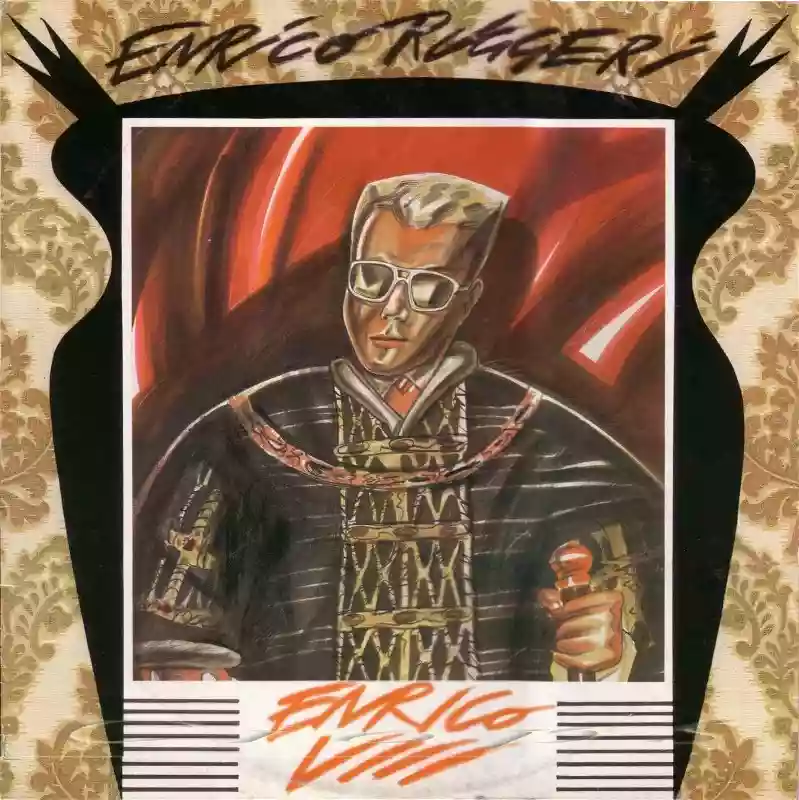
The cover, the only one he designed in his solo career, portrays Enrico disguised as King Henry VIII, celebrating the release of his eighth studio album. The opening is breathtaking: "Con la memoria" is a very delicate translation of a Tom Waits song and Enrico tackles a sacred monster with respect and care. The result is practically perfect. This is followed by "Non è più la sera", an ironic reflection on the end of adolescence and the arrival of adulthood. The sound is warm and the press at the time dared to make comparisons with Fossati and Paolo Conte. Ruggeri will deny everyone by choosing a more typically rock vein later, which I think is much less special. Rhythm and irony also shine in "Je t'aime", a delightful portrait of a man who, suffocated by his partner's attention, escapes using the most classic excuse. This album has no pauses, with the measured rock of "L’uomo che ami" responding to the swinging pace of "La bandiera", the intimacy of "Non finirà" contrasting with the carefree "La carta sotto".
The lyrics are thought out to the smallest detail, telling everyday stories without ever falling into clichés, often using metaphors tied to poker, chess, and sports. To finish, this album also contains one of the most beautiful songs in Italian music of all time: "Il portiere di notte". A nocturnal and inspired text, a melody that even Mina would challenge with a beautiful interpretation. Balancing between rock, swing, and hints of jazz, "Enrico VIII" is musically the most refined album of the Milanese singer-songwriter.
Difesa francese
An agile EP released after participating in Sanremo with "Rien ne va plus", a song full of smoky Parisian bistro atmospheres with an extraordinary lyric (it will win the critics' prize), "Difesa francese" owes its title to a chess move and features a handful of very diverse songs. "La medesima canzone" has a melodious rock feel and talks about madness with great sensitivity, "La prima sigaretta" is a poignant adolescent picture revisited through adult eyes, "Dalla vita in giù" talks sarcastically of a love affair over a Spanish-flavored base, "Gli uomini piccoli" narrates in a text I find extraordinary the devastating lives of those who never take a position that isn't convenient. The only misstep, in my view, is "Cuba", which over a fairly traditional rock base treads a fine line in describing the island caught between communism and tourism exploitation.
Ruggeri's writing is nevertheless at its peak, being fluid and natural, rivaling Italy's best authors. It's a pity it's the last time: from 1987 onwards, Enrico would continue a successful career and often deliver great "strikes" by writing other splendid songs (I think of "Il fantasista", "Gimondi e il cannibale", "I dubbi dell’amore", "Prima del temporale", "Trans") but he would never again deliver such complete and poetic works. In exchange, commercial success, which until now had been relative, would smile upon him with less distinctive but well-written and undoubtedly more immediate records like "Peter Pan" and "Il falco e il gabbiano". The spiteful claim that myopia and the iconic white glasses, much like Samson's hair, were partly responsible for his inspiration. I, however, believe that Ruggeri's desire to methodically release a record every year was his greatest limitation and eventually led him to publish works that were not entirely accomplished. However, he still remains, in my humble opinion, the most beautiful pen in Italian rock alongside Fausto Rossi, Emidio Clementi, and Giovanni Lindo Ferretti.
Loading comments slowly
Summary by Bot
This review explores Enrico Ruggeri’s 1986 album Enrico VIII, highlighting its elegant and refined sound blending rock, swing, and jazz. The album features detailed, metaphor-rich lyrics and includes a stunning cover of a Tom Waits song. The accompanying EP Difesa Francese is praised for its musical diversity and poetic quality. Despite later commercial success, Ruggeri never again matched the artistic completeness of this era. The reviewer regards Ruggeri as one of Italian rock’s finest songwriters.Tracklist Videos
01 Con la memoria (03:03)
02 Non è più la sera (03:51)
04 La bandiera (04:17)
05 Certe donne (03:41)
06 La medesima canzone (03:56)
07 Je t'aime (03:23)
08 Il portiere di notte (04:33)
09 Dalla vita in giù (03:42)
10 L'uomo che ami (04:30)
11 La carta sotto (03:41)
12 Cuba (04:17)
13 Gli uomini piccoli (03:50)
14 La partecipazione (04:33)
15 Non finirà (03:45)
Enrico Ruggeri
Italian singer-songwriter, leader of the punk/new-wave band Decibel before a long solo career; noted for songwriting, lyrical depth and stylistic shifts across punk, new-wave and chanson-influenced rock. Winner at the Sanremo Festival with "Mistero" (1993) and author of songs performed by other major Italian artists.28 Reviews
