
 •
Rating:
•
Rating:
THE REVIEW
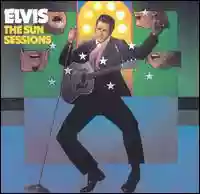
On March 22, 1976, RCA released "The Sun Sessions," an album containing almost all the tracks Elvis Presley recorded, between July 1954 and July 1955, at the "Sun Studios" of Sam Phillips in Memphis, Tennessee.
It was an exceptional sound document that, for the first time, organically brought together on a single record the recordings of the young Elvis.
It all began in 1954, more precisely on the evening of July 5....
"If I could find a white man who had the Negro sound and the Negro feel, I could make a billion dollars."
Sam Phillips was quite well-known in Memphis due to his recording studio, which offered everyone the chance, especially black artists, to record their tracks.
It goes without saying that in the still-racist postwar South, "friends of the Negro" were not well-regarded. Phillips, who had no prejudice against people of color, was a great enthusiast of rhythm and blues (which at the time was beginning to influence white folk) and aspired to bring black music out of the ghetto to make it acceptable to a wide white audience.
He really dreamed of creating musical integration as a way to help fight racial segregation.
In 1950, he founded the small "Sun Records," the only label at that time that produced only "rock'n'roll" records, because, as a pioneer in his genre, he understood the spirit of that music better than anyone else.
His constant search for young talent (he discovered and launched many artists, including Carl Perkins, Johnny Cash, Jerry Lee Lewis, Roy Orbison, B.B. King, Rufus Thomas) and his thirst for new sounds led him to codify "rockabilly," the classic kind, in fact an exciting blend of rhythm and blues and hillbilly (a now-obsolete term for American white folk music).
"One day, a young truck driver from Memphis happened to pass by the "Sun" recording studio and decided to record a disc to give to his mother for her birthday. The studio owner, Sam Phillips, was so impressed by his voice that he signed him immediately: thus a legend was born."
This is what the legend says, but as we know, legends are made to thrill the popular imagination.
In reality, young Presley had wanted to record a disc for some time because he was convinced, and rightly so, that he had something to say and possessed an original style.
Like Phillips, he was fascinated by black music (particularly Gospel), and like him, he had no prejudices, but when he finally had the courage to go to "Sun Studios" to record some tracks, he was rather disappointed by Phillips's lukewarm reaction.
In fact, it was seven or eight months before the producer, remembering that young man, considered the idea of contacting him again: upon listening to him again, he heard something in his singing style that inexplicably attracted him.
So he decided to call two musicians he knew well, guitarist Scotty Moore and bassist Bill Black, to see what would happen.
...on the evening of July 5, 1954, during a recording session, after hours of unfruitful attempts, Elvis suddenly began to play and sing, in a frenzied manner, an old blues by Arthur "Big Boy" Crudup, titled "That's All Right (Mama)," shaking as if bitten by a tarantula and instinctively followed by Moore and Black: at that point, Sam Phillips realized he had found his soulmate.
"That's All Right (Mama)" was interpreted with a truly unique style: the sharp and tight tones blended perfectly with the rhythm, the way of singing was fresh, exuberant, even brash.
All of it was highlighted by an emphasis never heard before and especially presented with an unusual confidence and flair for a white singer.
What was it, rhythm and blues? hillbilly? rock'n'roll? rockabilly? Pop? They didn't know, but it was something new: "The Sun Sessions" is one of the liveliest albums of rock and magically encapsulates the expectations of an era.
In these recordings, "The Hillbilly Cat" (as Presley was then called), gives his best.
His style, albeit raw, is incredibly versatile and manages to express all the energy and excitement of the postwar generation.
His vocal tone moves effortlessly from moments of intense drama to moments of relaxed calm.
Just listen to tracks like "Tryin' To Get To You," "Just Because," "Mystery Train" or the already mentioned "That's All Right (Mama)" to realize it.
Elvis and the band naturally mess up and transform classics like: "Blue Moon Of Kentucky" (a sluggish waltz by Bill Monroe, which is completely overturned here), "Baby Let's Play House" and "You're A Heartbreaker" (turned into powerful "rockabilly" performances), "Good Rockin' Tonight" (a classic rhythm and blues from 1947 which, when "treated" by the band, changes dramatically), or even "Milkcow Blues Boogie" with a slow start and acceleration led by Elvis's voice.
Even when performing rather conventional standards like "Blue Moon," "Harbor Lights" or "I Don't Care If the Sun Don't Shine," Presley manages to convey a certain originality.
The incredible rhythm section constituted by Bill Black's double bass and, especially, Scotty Moore's "fingerpicking" style guitar (one of the greatest rock'n'roll guitarists) does the rest.
The tenacity and intuition of Sam Phillips, the talent of Elvis Presley, and the spirit of Scotty Moore and Bill Black created true musical gems.
This is the Elvis Presley I prefer, along with the initial RCA period, before carelessly allowing himself to become a bad, and sometimes embarrassing, copy of himself.
But here there are still no "Colonel" Tom Parker, the millions of records sold, the glamorous covers, the Hollywood films, the idolizing crowds.
Here is a young man with enormous talent who is writing the history of rock.
P.S.: Thanks to Teenagelobotomy for pointing out the absence of this rock milestone among the over 28,000 reviews in the database.
Loading comments slowly
Summary by Bot
The Sun Sessions album compiles Elvis Presley's groundbreaking recordings from 1954-1955 at Sun Studios, showcasing his early rockabilly style. Producer Sam Phillips recognized Elvis' unique blend of rhythm and blues and hillbilly influences, helping launch rock'n'roll. The review praises the raw energy, versatility, and historic importance of these tracks, highlighting the contributions of guitarist Scotty Moore and bassist Bill Black. This era captures Elvis before commercial pressures shaped his later image.Tracklist Lyrics
02 Blue Moon of Kentucky (02:04)
03 Good Rockin' Tonight (02:12)
05 Milkcow Blues Boogie (02:36)
07 Baby, Let's Play House (02:15)
08 I'm Left, You're Right, She's Gone (02:36)
11 I Love You Because (02:42)
12 Blue Moon (02:38)
13 Tomorrow Night (03:00)
14 I'll Never Let You Go (Little Darlin') (02:23)
15 Just Because (02:33)
18 I Love You Because (take 2) (03:29)
20 Blue Moon of Kentucky (01:05)
22 I'm Left, You're Right, She's Gone (My Baby's Gone) (take 9) (02:41)
23 I'll Never Let You Go (Little Darlin') (01:05)
24 When It Rains, It Really Pours (04:03)
25 I Love You Because (take 3) (03:32)
26 I Love You Because (take 5) (03:26)
27 I'm Left, You're Right, She's Gone (My Baby's Gone) (take 7) (02:50)
28 I'm Left, You're Right, She's Gone (My Baby's Gone) (take 12) (02:38)
Elvis Presley
Elvis Presley (1935–1977) was an American singer and actor widely known as “the King of Rock and Roll,” rising to mass popularity in the 1950s and becoming a central figure in rock ’n’ roll’s mainstream breakthrough.12 Reviews
