
 •
Rating:
•
Rating:
THE REVIEW
"If it came to pass that they should ask
What could I tell them?
Would they criticize behind my back
Maybe I should let them
Oh if only then and only then
They would understand
They'd turn a full-blooded city boy
Into a full-blooded city man"
..If it happened that they asked me
What could I tell them?
They will criticize behind my back
Maybe I should let them
Oh if only and only after
They would understand that
They have turned a full-blooded city boy
Into a full-blooded city man...
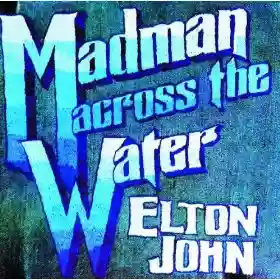
Probably Elton John with this LP titled "Madman Across The Water", dated 1971, gives birth to his absolute masterpiece, after the excellent "Elton John" and "Tumbleweed Connection", his previous works.
Surrounded by top-level session men (one above all, a very young Rick Wakeman), Elton describes the America of that period - and that of the past in the song "Indian Sunset", which talks about the destruction of the Iroquois tribe - with a few, decisive brushstrokes of paint. What makes it all so interesting and magical in this album is that the color and intensity with which the nine scenes that compose it are painted really manage to enchant the listener; among countless plays of light, sudden changes of tempo, perfect melodies and brilliant arrangements that inevitably, inexorably, transport into a sort of parallel universe.
At first listening, one might be puzzled, as the pieces may seem too intimate and dark, thanks to the dark arrangements of the immense Paul Buckmaster and the lyrics of Bernie Taupin, who through sometimes indecipherable metaphors leaves it to the intense and versatile voice of Elton more than ever the task of revealing, probably without realizing it, every little mystery; probably because only Taupin writes the lyrics (Elton would not be capable of it at all), but it is then the English pianist who transforms, with his melodic intuitions and his perfect harmonic constructions, every text written on paper into a completely independent creature. Rarely taking inspiration for autobiographical quotes, but very often to convey to the listener all his doubts, his uncertainties, his strokes of genius (the extraordinary melodic crescendo of "Levon" and "All The Nasties", the poignant and pianistic "Razor Face"); a certain taste for a decidedly personal rock ("Rotten Peaches"); Elton's visceral love for gospel, for the love ballad, for the blues, all peculiarities of his music, of his maniacal personality, of his inexhaustible creative vein up to his first "cocaine" record, that "Rock Of The Westies" of 1976, a watershed between two completely different eras.
The title track, perhaps the most heterogeneous song on the album, boasts a long instrumental part that almost obsessively repeats the piano and guitar chords of the intro, and its lyrics lend themselves to different interpretations: it is perhaps the toughest piece of the album. The track was originally intended to appear on the previous album, in a version with the great Mick Ronson on guitar, which was then officially presented to the public in the double "Rare Masters", in 1991.
The piece that closes the album, "Goodbye", piano and voice, has as its main theme the farewell, and it is decidedly evocative in the verses:
"I'm sorry I took your time
I am the poem that doesn't rhyme
Just turn back a page
I'll waste away, I'll waste away..."
The romantic "Tiny Dancer" was revived thanks to the soundtrack of "Almost Famous", in a memorable choral scene of this film that helped rediscover, especially to the new generations, the undisputable beauty of this LP which, in part, is a declaration of love from Elton to America, the country that launched him, "out of the blue", towards an unrepeatable career.
Loading comments slowly
Summary by Bot
Elton John's 1971 album 'Madman Across the Water' is hailed as his absolute masterpiece, blending intimate and dark lyrics with brilliant arrangements. Supported by musicians like Rick Wakeman and orchestrator Paul Buckmaster, the album paints vivid American scenes and emotional stories. Songs like 'Tiny Dancer' and 'Indian Sunset' showcase a mix of rock, gospel, and blues influences. The review highlights the album's depth, intensity, and lasting cultural significance.
Elton John
Reginald Kenneth Dwight, known as Elton John, is an English singer, pianist and composer who rose to prominence in the late 1960s and early 1970s. Longtime collaborator Bernie Taupin provided lyrics for much of his work. He is best known for piano-driven pop/rock songs and landmark 1970s albums; he was knighted and has had a prolific recording and performing career.54 Reviews
Other reviews
By Giuseppe13
If I had to choose a music album to take with me to the afterlife... I would choose an Elton album.
The singer apologizes for having stolen our time... leaves the stage with his head bowed, he, who for this Madman would deserve a standing ovation from 1971 until today.
