
 •
Rating:
•
Rating:
THE REVIEW
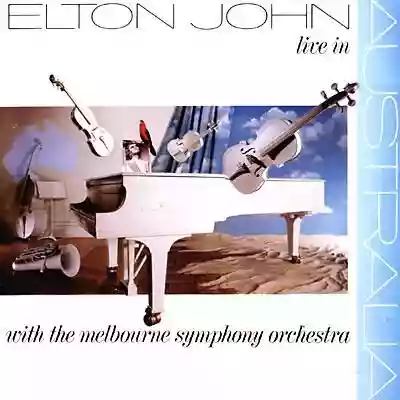
Two absolutely disastrous studio albums, a vocal cord surgery that could have permanently ended his career, increasingly worrying drug addiction issues, a marriage that sadly fell apart, and, as if that weren't enough, his beloved Watford FC getting relegated: the 1987 Reg Dwight has nothing left to lose. He's a boxer in the corner, a wounded fox, an artist for whom all seems lost, who immerses himself in the glory of his past to escape present difficulties. This perspective is essential to fully understand this live recorded in Sydney with the Melbourne Symphony Orchestra: the choice of songs seems absolutely tailor-made for such a period, every single note, every single word of Bernie Taupin's lyrics perfectly reflects the personal and human moment Elton John was experiencing at the time, thus giving life to a live performance of bitter and poignant beauty, undoubtedly the highest point reached by EJ in his troubled '80s.
Scrolling through the setlist, one of the first things that stands out, proving what was previously stated, is the presence of no less than six songs from EJ's darkest album, the eponymous one from 1970; first and foremost, "Sixty Years On": hoarse and tormented voice, enveloping orchestrations, a hypnotic and majestic melody and lyrics steeped in melancholy and resignation to immediately realize the atmosphere of this live performance, but also the wonderful and underrated "I Need You To Turn To," with its smooth medieval ballad cadence, "The King Must Die," presented in all its dark and theatrical drama, the sweet and melancholic "The Greatest Discovery" and obviously a "Your Song" that starts almost quietly to gain strength in an emotional climax of great intensity; these are the songs that shape the style of "Live In Australia"; the others follow suit, shape, and blend together to form a single discourse; "Sorry Seems To Be The Hardest Word," faithful to the original with an extra touch of desperation, "Tonight," which with Elton John's "new" voice loses its melodramatic side, becoming more direct, bitter, and almost aggressive in its sung parts, an unknown masterpiece like the pressing, lively, and unpredictable "Have Mercy On The Criminal," which speaks of a lonely man, hunted and on the run from the law, with his back against the wall just like the Elton John of that time, a monument to Music like "Madman Across The Water," here much clearer, more imposing and less nuanced than in the studio version; even "Tiny Dancer" loses part of its light and ethereal appeal to become rich with pathos and "Candle In The Wind," in an orchestral live performance, sheds its sumptuous arrangement to reveal itself in its most intimate and bitter essence; "Don't Let The Sun Go Down On Me," faithfully presented to the original, is therefore the most logical conclusion, the best, the only possible one for this wonderful and unrepeatable concept-live.
And so, if the albums "Ice On Fire" and "Leather Jackets" are the worst ever produced by the pianist from Pinner and the subsequent "Reg Strikes Back" and "Sleeping With The Past" are undoubtedly good but not memorable, "Live In Australia" is instead a unique work of art: the symphony orchestra is a wonderful co-star; Elton, his piano, and his new hoarse and raspy voice are the undisputed stars, holding the stage with unchanged class despite everything. EJ's more pop and carefree side is absolutely not contemplated, the more rock side, except for "Take Me To The Pilot" and the pyrotechnic "Burn Down The Mission" is almost absent; therefore it's not a live performance representative of his entire career and stylistic range but rather a splendid snapshot, a harmonic ensemble of songs, music, and words to capture a moment, and precisely because of this, it is unrepeatable.
Loading comments slowly
Summary by Bot
Elton John's 'Live in Australia' album captures a crucial and troubled period of his career in the late 1980s. With a hoarse voice and orchestral backing, the live set highlights deeply emotional and melancholic songs, revealing his personal struggles. The performance stands out as a unique, artistic peak in this era, shaped by carefully chosen tracks from his darker and more intense repertoire. It offers a poignant snapshot rather than a broad stylistic representation.Tracklist Lyrics Videos
Elton John
Reginald Kenneth Dwight, known as Elton John, is an English singer, pianist and composer who rose to prominence in the late 1960s and early 1970s. Longtime collaborator Bernie Taupin provided lyrics for much of his work. He is best known for piano-driven pop/rock songs and landmark 1970s albums; he was knighted and has had a prolific recording and performing career.54 Reviews
Other reviews
By metafisico
It is absolutely not true that those who sell millions of records and are stars cannot produce good music.
The album closes with 'Your Song,' the most beautiful pop and love song ever written.
