
 •
Rating:
•
Rating:
THE REVIEW
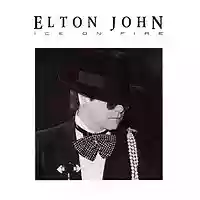
Heavily influenced by failed marriages, depressive crises, suicide attempts, and drug problems, the '80s were a turbulent time artistically for Elton John: starting with a good transitional album, "21 At 33" (1980), and continuing with a small masterpiece of eclecticism and sophistication like "The Fox" (1981), followed by the simpler but equally valid "Jump Up!" (1982), featuring songs like "Empty Garden," "All Quiet On The Western Front," "Blue Eyes," and "Legal Boys," to name a few, these years find a turning point with the return of Bernie Taupin as the sole lyricist and the reformation of the Elton John Band: the result, two albums like "Too Low For Zero" (1983) and "Breaking Hearts" (1984) rich in excellent insights and utterly forgettable songs. Another déjà-vu in 1985 with the return of producer Gus Dudgeon, and the situation precipitates definitively with "Ice On Fire," which, despite the great success of "Nikita," a true fig leaf, proves to be boring, insubstantial and pedantically aligned with the synth-pop and new wave trends of the time: the final result is a complete failure that transforms EJ from the enlightened Captain Fantastic to a modest follower devoid of ideas.
As I said before, "Nikita" is the only beautiful song on "Ice On Fire": as in the rest of the album, synthesizers dominate the scene, but in this case, there is a warm and flowing melody that, combined with Elton John's excellent performance and backing vocals by Davey Johnstone and George Michael, results in a great evergreen, yet it remains a small oasis in the barren desert of "Ice On Fire," where the only other episode that somewhat deviates from the general mediocrity is a rather plasticky song like the opener "This Town," with electronic beats and sax of blatantly '80s taste. Notably negative is the second single "Wrap Her Up," with an arrangement as pompous as it is crude, with George Michael's falsetto counterpoint making the whole thing even more irritating; total darkness also for the ballads, which do not go beyond the level of mere professional episodes ("Cry To Heaven", "Shoot Down The Moon" and especially "Too Young", where the presence of Roger Taylor and John Deacon is not enough to lift the fate of a repetitive and syrupy melody).
For the rest, "Ice On Fire" consists of cheerful songs that have aged terribly such as "Soul Glove", "Tell Me What The Papers Said" and "Candy By The Pound", which perfectly capture all the enormous limitations and flaws of this album: freshness and inspiration equal to zero and the choice to fully embrace a genre like synth-pop which, with all due respect, hasn't left an indelible mark on the history of music, besides being almost as alien to Elton John's style as the disco of "Victim Of Love". The deep crisis, both artistically and personally, would continue in the subsequent years, at least until "Reg Strikes Back" in 1988, which, despite still being distinctly '80s in sound, proves to be much more spirited, inspired, and convincing than "Ice On Fire," a true low point in the production of this sometimes misunderstood pop genius.
Loading comments slowly
Summary by Bot
Ice On Fire represents one of Elton John's lowest artistic points in the 1980s, heavily influenced by synth-pop trends. Despite the success of 'Nikita,' the album largely lacks inspiration and fails to leave a lasting impact. The review critiques the overuse of electronic elements and forgettable songs. It considers this album as a contrast to his more inspired works before and after.Tracklist Lyrics Videos
Elton John
Reginald Kenneth Dwight, known as Elton John, is an English singer, pianist and composer who rose to prominence in the late 1960s and early 1970s. Longtime collaborator Bernie Taupin provided lyrics for much of his work. He is best known for piano-driven pop/rock songs and landmark 1970s albums; he was knighted and has had a prolific recording and performing career.54 Reviews
