
 •
Rating:
•
Rating:
THE REVIEW
Often dismissed as a sentimental queen with a hair and glasses obsession, Elton John is actually one of the greatest artists to appear in the charts over the last 35 years.
Especially during his golden period, the first half of the ’70s, when he was producing an average of two albums a year and sending them both to the top of the charts worldwide, Sir Reginald Wright was one of the happiest realities of modern mainstream. The talent of this quirky genuinely British man lies in being, above all, a great interpreter, adaptable to any type of material. In fact, his main flaw is precisely being a pop passkey which, as such, has resulted in a rather impersonal vocal style, although it is hard to mistake: his famous vocalizations and youthful falsettos, for example, have become proverbial for their expressiveness and sensitivity to the lyrics.
The inseparable piano is another typical element of our drag queen's songs: carefree, sometimes played with gentleness, sometimes with the ferocity of an old-time rock'n'roller, terribly profound on evergreen ballads, evocative on simpler tracks but incredibly moving.
Accompanying Elton in his continuous recording adventures is almost always his trusted lyricist, his adolescent companion Bernie Taupin, a misogynistic and straightforward Sancho Panza yet full of imagination, who has always carried out his role as the local Mogol with great dignity.
After a dull and immature debut ("Empty Skies", 1969), the two will give a first remarkable taste of their qualities in “Elton John” (1970), the forerunner of an uninterrupted series of blockbusters (at least until the devastating flop of the double album “Blue Moves”, 1976). In just a few years, Elton John, with an excellent fixed band behind him (Dee Murray on bass, Davey Johnstone on guitars, Nigel Osson on drums) will set the world charts on fire with indefatigable prolificacy, releasing increasingly diverse albums, burdened with the ongoing challenge of improvement and astonishing an ever more enthusiastic audience. From the bitter "Madman Across The Water" (1971) to the journeys through American history in "Tumbleweed Connection" (1971), from the joys and pains of young Elton in "Honky Chateau" (1972) to the quirky '50s pastiche of "Don't Shoot Me, I'm Only The Piano Player" (1973).
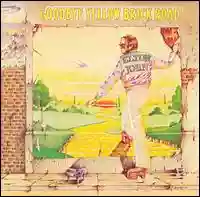
Amidst this real King Midas period, Reginald decided to outdo himself with the first double album of his career, the kaleidoscopic "Goodbye Yellow Brick Road".
Conceived as an open diary on the world of John & Taupin, a collection of feelings and memories, the concept increasingly becomes the sound collage of a musical story, the curriculum vitae of who these two rascals were, what they did, what they tried
. From the opening progressive suite in two parts of "Love Lies Bleeding/Funeral For A Friend" we are seated in the auditorium of an imposing show, where the aim is to try and please everyone. Thus, an effective primer is realized which, for another artist, would already be a ready-packaged greatest hits. From the touching tribute to Marilyn Monroe in "Candle In The Wind", to the wonderful "Bennie And The Jets", a perfectly on-point live story of a group of glam-rockers captivating local kids, from the autobiographical title track about the start of adulthood to the pure initiatory poetry of "This Song Has No Title" (legendary title), with Elton just piano and voice there to enchant us. As I was saying, there’s something for everyone, from the celebrations of prostitutes ("Dirty Little Girl") and living for the day (the parodic "Social Disease"), to the sapphic loves with a psychedelic vibe ("All The Girls Love Alice") followed by the infectious hard-rock of "Saturday Night’s Alright For Fighting".
If I chose to talk about this particular album, it is because it is surely representative of what Elton John is and, above all, was. "Goodbye Yellow Brick Road" is the perfect introduction to the genius and mediocrity of dear Sir, symbolizing (in a complementary way perhaps to Marc Bolan and a few others) what it was like to live in those years of novel-like excesses and uncontrolled creativity, where one could improvise as an experience-free rasta-man without shame ("Jamaica Jerk-Off"), just because one had been on an "inspiring" vacation in Kingston ("well, the Rolling Stones had already been there"
, he explained) or invent mutant r'n'r dances complete with circus-like tunes ("Your Sister Can’t Twist But She Can Rock'n'Roll“).
If you manage to appreciate the work, obviously scaling it down to a pleasant melodic toy, you might also reassess the legacy left by this funny and clumsy fallen prince of pop. And perhaps, skirting a sea of silly and inexplicable songs that litter an overly ample discography (like the master himself), you might stumble upon real jewels (practically almost the entire production '70-'75) to listen to and listen to again with esteem, few prejudices and a great deal of enjoyable passion.
Loading comments slowly
Summary by Bot
This review highlights Elton John's remarkable talent during his golden 1970s period, focusing on the iconic double album Goodbye Yellow Brick Road. It praises John's piano-driven style, his fruitful collaboration with lyricist Bernie Taupin, and the diverse, emotionally rich tracks that showcase his artistic range. The album is portrayed as a vibrant musical diary capturing the era's excess and creativity while remaining an essential masterpiece in rock history.Tracklist Lyrics Videos
Elton John
Reginald Kenneth Dwight, known as Elton John, is an English singer, pianist and composer who rose to prominence in the late 1960s and early 1970s. Longtime collaborator Bernie Taupin provided lyrics for much of his work. He is best known for piano-driven pop/rock songs and landmark 1970s albums; he was knighted and has had a prolific recording and performing career.54 Reviews
Other reviews
By Starblazer
"Good Elton also gives us some duds of the caliber of 'All The Girls Love Alice'... lowering my rating by a full two stars."
"Making quality pop music is one of the most difficult things in the world, perhaps even more challenging than writing songs like 'A Change Of Seasons'..."
