
 •
Rating:
•
Rating:
THE REVIEW
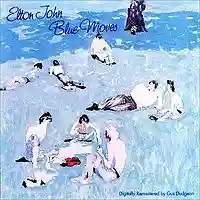
In Elton John's intentions, "Blue Moves" was supposed to be his last album (the blue hue of the cover, directly recalling that of the first album, "Empty Sky," is not incidental), or at least the last before a long break: that was not the case, but this record represents a crucial milestone in EJ's career: the end of the first collaboration with Bernie Taupin, Gus Dudgeon, and his historic band, and the definitive end of his golden era. Certainly, the good Elton wanted to go big for what was supposed to be his artistic testament, creating a colossal double album with a total duration of 85 minutes and mobilizing entire orchestras and gospel choirs: it's a lot, definitely too much for an album rich in great songs and refined melodies interspersed with tedious fillers that break the album's rhythm and make it decidedly arduous to listen to from start to finish.
The signature song of "Blue Moves" is undoubtedly "Sorry Seems To Be The Hardest Word", one of EJ's saddest and most poignant ballads, as well as one of the simplest songs on the album, not lingering or getting lost in convoluted arrangements but going straight to the heart; similar in attitude and equally fascinating is the dark and intimate "Tonight", a true pop-operatic masterpiece with Elton's piano conversing with the strings of the London Symphony Orchestra, painting a musical picture with romantic and mournful tones. The most successful experiment of "Blue Moves" is undoubtedly "One Horse Town", perhaps the most atypical and bizarre song ever recorded by EJ with its intriguing "symphonized" rock, while the other standout tracks on the album come from simpler and more immediate songs in Elton John's traditional style, like "Cage The Songbird", a song deliberately sparse in its arrangement and slightly psychedelic with lyrics that, without the romantic emphasis of "Candle In The Wind", reflect on the perverse mechanisms of fame in a poetic but almost raw tone, ballads like the dreamy "Chameleon" and the refined gospel "Where Is The Shoorah?". Also very interesting and enjoyable are the short instrumentals "Your Starter For", creating a sense of lightness in contrast to the pathos of "Tonight" and "Theme From A Non-Existent TV Series", pure entertainment in the form of a frenetic jingle.
These are the best moments of the album, which often and gladly gets lost in the quicksands of just decent songs ("Crazy Water", "Someone's Final Song", "If There's A God In Heaven") and pretentious fillers without head or tail like "Shoulder Holster", "Between 17 And 20" and "The Wide-Eyed And Laughing", hitting the lowest points with the boring instrumental "Out Of The Blue" and the commonplace "Boogie Pilgrim" and "Bite Your Lip", which together amount to about twenty minutes of hot air.
Ultimately, "Blue Moves" suffers from the same syndrome of overabundance as "Goodbye Yellow Brick Road," with more sonic pretense but decidedly less inspiration compared to 1973; undoubtedly, it was not the best time to overreach, especially in a moment of crisis, even on a personal level, like the one Elton John was going through at that time, and it's a shame because if it had been a single album meticulously cleaned of all fillers and unnecessary experimentation, my rating would surely have been four, maybe even five stars, because songs like "Tonight", "One Horse Town", "Sorry Seems To Be The Hardest Word" and "Cage The Songbird" demonstrate that a talent like Elton John’s can diminish, lose inspiration, experience stagnation but never completely fade away.
Loading comments slowly
Summary by Bot
Blue Moves was intended as Elton John’s farewell album before a break, embodying a crucial career milestone with rich orchestration and a double album format. While it features standout tracks like "Sorry Seems To Be The Hardest Word" and "Tonight," the album suffers from excessive length and uneven quality. Filler tracks disrupt listening flow, making the album feel overambitious and less inspired than earlier works. Despite its flaws, moments of brilliance confirm Elton John’s enduring talent.Tracklist Lyrics Videos
Elton John
Reginald Kenneth Dwight, known as Elton John, is an English singer, pianist and composer who rose to prominence in the late 1960s and early 1970s. Longtime collaborator Bernie Taupin provided lyrics for much of his work. He is best known for piano-driven pop/rock songs and landmark 1970s albums; he was knighted and has had a prolific recording and performing career.54 Reviews
