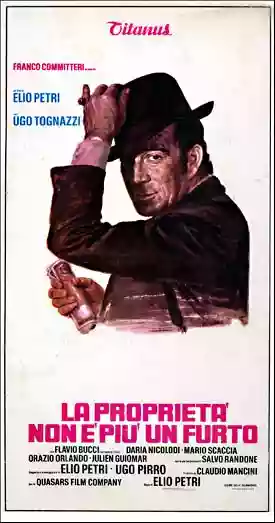

 •
Rating:
•
Rating:
THE REVIEW
I am no different from you […] we are equal in needs, unequal in their satisfaction […] selfishness is the fundamental sentiment of the Religion of property. (Ragionier Total – Flavio Bucci)
[…] he has, damned, he sure has, he owns us, he possesses us; he has shops, houses, cars, women, workers, and money in bags, in truckloads. (Total talking to his father about the butcher)
when I think […] of those starving people who passively accept their misfortune, respecting the law and defending property, then I suspect that in these have-nots madness prevails, idiocy hovers, which reassures me because it is on them that I enrich myself. (The butcher - Ugo Tognazzi)
[…] I am in many pieces, many pieces of a thing and live as if I were a vase full of holes.(Anita, the butcher's lover – Daria Nicolodi)
[…] arresting is wonderful. (Public security brigadier – Orazio Orlando)
Private property is theft. The title of the film (and the film itself) plays with this famous phrase by anarchist Pierre-Joseph Proudhon.
Man is a carnivorous animal. Sign that stands in the butcher shop.
This is the third chapter of a sort of “trilogy on neurosis”: neurosis of money in this film, which turns out in certain situations not to be entirely in focus, which makes it all the more interesting; the first half hour is dazzling, with a fast pace showing the characters, the events and the ideal-ideological framework that then develops in the continuation, where the vision suffers small setbacks and the mechanism flows less smoothly; the cause is precisely the massive amount that accumulates and stratifies starting from the simple initial ideas; the synthesis of property-non-property, possession-non-possession, the etymological-social modification of the concept of theft besides the denial of money as "absence of object" and bearer of disease (specifically a severe psychosomatic allergy) and consequently reflection on existing as a physical person in relation to the object with which one comes into contact.
It is all resolved following the principles of the grotesque, intermissions are entrusted to parentheses where the characters justify their actions.
At least two scenes are memorable: the robbery in the opening sequences with the butcher intent on defending the bank deposit, and the demonstration in the security device company, where the full grotesque and irreverent charge of the film is released.
Petri carries out a daring operation, pushes the narrative to the thresholds of theatrical aesthetics, accumulates, wedges into the absurd, risks going off track, but always remains fully within the original idea, the impossibility of having and being simultaneously: “I would like to have, but also to be, this is my illness” says Total about his situation.
Ultimately, it reflects on what Italy is post-economic boom; we are in the early seventies and on the verge of the 1973-1976 oil crisis, for a moment Italians are forced to stop and take a breath.
The butcher (a superb Ugo Tognazzi) exemplifies the new enriched Italian type: arrogant, ignorant, calculating; very similar to too many Italians we have the misfortune to encounter at all levels today in our country, people who are part of the ruling class and who perpetuate their mediocrity, arrogance, and greed from generation to generation.
Finally, special mention for the other actors: Salvo Randone in the role of Total's father, Mario Scaccia in the part of the thief Albertone "master of Total" and Gigi Proietti in the role of the thief Paco with his eulogy to thievery.
The film gives us that leaden atmosphere, very similar to what our future will be, but at a certain point, two giant portraits appear, one of Marx and the other of Mandrake; now I feel like shouting out: “Long live Marxism-Mandrakism!”.
Loading comments slowly
Summary by Bot
Elio Petri’s film 'La proprietà non è più un furto' delivers a daring and complex critique of property and societal neurosis through grotesque and theatrical storytelling. The film captures 1970s Italian social realities, highlighted by strong performances from Ugo Tognazzi and others. Though its narrative pace fluctuates, its ideological core remains compelling. Memorable scenes showcase the absurdity and greed permeating post-economic boom Italy. Overall, the review praises the film’s bold and reflective approach.
Elio Petri
Elio Petri was an Italian film director and screenwriter, widely associated with politically charged cinema of the 1960s–1970s. His films frequently use satire and grotesque tones to examine power, institutions, and social alienation.11 Reviews
