
 •
Rating:
•
Rating:
THE REVIEW
During the early years of the twentieth century, the Italian artist Luigi Russolo, a painter, inventor, and composer, a proponent of the futurist movement, patented after years of studies and theories the intonarumori, a complex musical instrument designed for the creation and modulation of noises in various forms and tones. These instruments, divided into categories depending on the type of noise produced (buzzers, crackers, sibilators, etc.), operated by levers and buttons, produced a sort of mathematical chaos, a powerful and atonal noise controlled by the musician himself.
In 1913, Russolo theorized the use of noise as a fundamental element in the music of the years to come, with the futurist manifesto "The Art of Noises," where an idea of music created by noises and dissonant sounds takes shape. From here to the first avant-garde compositions for various intonarumori machines, the step was short. Russolo's revolutionary ideas paved the way for new ways of understanding music and sound, going through the concrete music of the '40s, the experimental electronics of the '50s and '60s, up to less academic musical forms in the '70s and beyond.
In 1980 in West Berlin, a young Blixa Bargeld formed a band called Einstürzende Neubauten, a band that would bring to certain completion the avant-garde and brilliant ideas of Luigi Russolo on the music of the future and the use of noise in music. For some time now, the current of industrial music started by the British Throbbing Gristle merged noise and electronics in a wild way, but with Einstürzende Neubauten, they would reach levels of intensity and sonic fury unheard of.
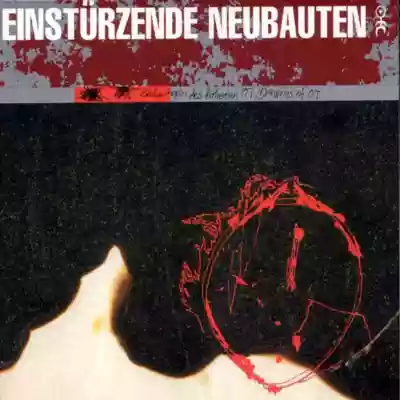
After the powerful debut of 1981 "Kollaps," an album that serves to show, like a manifesto, the innovative approach to industrial material by the Berlin band, Blixa and company come back a couple of years later with their wildest, most majestic and important work in their history. The "new collapsing buildings," armed with an instrumentation based on electronic instruments and various work tools, sheets of metal, pneumatic hammers, and grinders, create a terrifying and imposing work, "the drawings of the patient O.T.," the drawings of a schizophrenic patient of an asylum come to life in nightmare sound frescos, immersed in post-apocalyptic scenarios. If in the industrial music of the English formations of that era resonates a profound alienation from the present and the modern era, the German band goes beyond this approach. The world described by Blixa and company is neither in decline nor heading towards an end; the world described by Einstürzende is dead, buried under heaps of rubble, iron, tar, and radioactive clouds; the humanity that survived this holocaust can do nothing but try to survive, returning to a primitive stage, rediscovering its primordial instincts, its most natural instincts.
A cold sound, hard, torn by ingenious and malevolent sonic insights, sound abysses where every semblance of human life seems to have disappeared, but it's not: Blixa's screams are the only profoundly human element to emerge from the atonal chaos of every composition of this work. The band delineates a deadly fusion between the synthetic textures of the rhythmic advancement and the work of the non-musicians with work tools. The initial "Vanadium-I-Ching" stands as a symbolic piece of the work, among metallic and electronic percussive textures, persistent noises of sheets of metal struck by iron pipes, and Blixa's gasps declaiming words of terror. The tension brought to the extreme in "Die Genaue Zeit" and in the gloomy "Neun Arme" load a work devoted to the most complete sonic destruction and deconstruction with pathological obsessiveness. "Abfackeln!" stained as it is by a dark and primordial tribalism, stands out on noise drones as destabilizing as they are theatrical and monolithic. The sound of Einstürzende in this work is icy, majestic, and aseptically clean and defined; what these non-musicians manage to pull off is incredible, and listening to, among others, real sound nightmares like "Hospitalistische Kinder-Engel der Vernichtung" with a dramatic and horrific crescendo that starts from the mere sound of an iron pipe striking against a sheet of metal, and the song of a child playing, until diving into an ocean of derailing noises and piercing screams, or the avant-garde "Armenia" that among psychotic screams and giant electronic drones makes sad melodies entrusted to a string orchestra rise high, every piece represents something apocalyptic and primordial, violent and gloomy, ingenious and spontaneous... futurist.
Loading comments slowly
Summary by Bot
This review highlights Einstürzende Neubauten's album 'Zeichnungen Des Patienten O.T.' as a powerful, pioneering industrial work rooted in futurist noise concepts. The band uses unconventional instruments and sounds to craft bleak, apocalyptic soundscapes filled with raw intensity and emotional depth. The album is praised for blending metallic percussion, electronic textures, and primal screams into a unique and visionary musical statement.Tracklist Lyrics Videos
Einstürzende Neubauten
Einstürzende Neubauten are an experimental industrial music group formed in West Berlin in 1980, known for using scrap metal, tools, and custom-built instruments alongside conventional ones, and for evolving from early harsh noise toward more structured, atmospheric songwriting while retaining a strong percussive identity.23 Reviews
Other reviews
By Mr.Moustache
I boldly pronounce it with pride: art.
Every sound is recited with absurd theatricality, shaping generations of contemporary music.
