
 •
Rating:
•
Rating:
THE REVIEW
We are in 1981. While punk is slowly dying in London and people like Tod Ashley and Trent Raznor are still little more than kids, three young Berliners decide to create a conceptual art-house non-music, drawing inspiration from the Dadaist avant-garde of the late 1800s, noise music, modern experimental theater, and modern art, to musically achieve what the exponents of "Arte Povera" created in the 1960s for visual art. Their music was indeed based on the use of everyday objects, from teaspoons to jackhammers, including hoses, grinders, and anything they deemed necessary to reproduce the "cry of industrial civilization." What would emerge from their works was the ultimate expression of all industrial music.
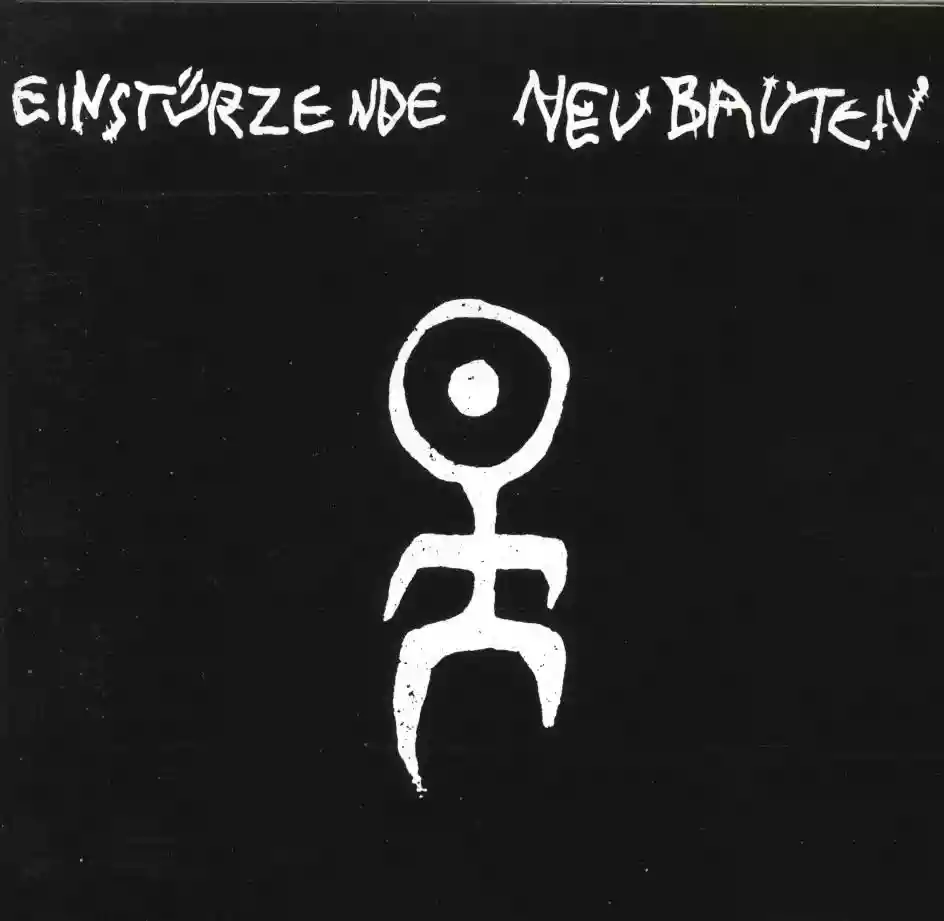
Having released two singles (Fur den Untergang and Dürstiges Tiger) and an extended plate (Kalte Sterne) that already hinted through their bloody cacophonous assaults what the group would become with this and the subsequent three full-length albums, after numerous lineup changes (which also served to elect guitarist/vocalist (singer would be reductive) Blixa Bargeld (born Christian Emmerich) as the leader), the Einstürzende Neubauten ("New Collapsing Buildings") present themselves with this Kollaps ("Collapse"), a manifesto of industrial avant-garde, one of the harshest and darkest records in the entire contemporary music scene.
Essentially, it consists of a handful of tracks (fourteen, to be precise) where the art of noise (as futurist Luigi Russolo called it in his time) almost reaches its zenith, I say almost because the two albums that will follow will be even more significant, thanks to the experience and maturation of the group. The power of the compositions, from a musical standpoint, is given by several factors: the (almost) total abandonment of melody to create architectures of pure noise, able to give a sense of claustrophobic realism to their works; the use of the voice no longer with precise vocal lines, not with "spoken" words but with a diction, a recitation of words, sometimes pushed to the extreme of screams, covering a large part of the possible sounds reproducible by human beings; and still the use of background noises obsessive, yet simultaneously dreamlike and delicate despite their blatant artificial nature (this invention owed to pioneers Throbbing Gristle).
Moving on to the lyrical aspect, we can say very little; not because Blixa's lyrics are insignificant, but because their extreme crypticism renders them open to many interpretations, none more correct than the other, but at most one more plausible, I therefore invite you, if you are interested, to search for his lyrics yourself (which can be found on the web even with Italian translation) and draw your conclusions.
The album opens with "Tanz Debil" ("Demented Dance"), a tribal war-preparatory dance, a rather violent track, paced by what could be a hydraulic press or some other large metallic object, utilizing rhythms from German underground techno; Blixa's vocalizations are a mix between the pleas for help of a man trapped among the rubble and the screams of a fighter urging his soldiers to battle. The track concludes with a crescendo of cacophonic orgy, with Blixa's screams further accentuated by the background use of what could be an industrial drainer and the inevitable grinder.
The noise of a jackhammer instead opens the second track, "Steh auf Berlin (Krieg In Den Stadten)" ("Rise Berlin (War In The Cities)"); this time Blixa's screams are those of a possessed person describing the rubble of a city destroyed, most likely by his own consumerist zeal. The rhythm is provided by what might be the noise of a chain, or perhaps the gears of a large machine; again, it is an extremely heavy blow, especially for those not accustomed to perceiving music in noise and even more so for those accustomed only to tonal music.
"Negativ Nein" ("Negative, No") is as calm as it is dark: the beginning is the sound of what could be numerous pendulum clocks or a makeshift drum kit, like wooden sticks hitting plastic, with a softly moving water in the background? then the voice arrives, never more mephistophelian; the screams seem stolen from "Frankie Teardrop" by Suicide, but they are even rougher and more violent? until the song ends with the terrifying final scream.
It is now the turn of "U-Haft Muzak", a dark instrumental dominated by muffled percussion with distant screams and a kind of electric noise and rare moments of grinding in the background; it is a sort of underworld version of "Maggot Brain" by Funkadelic, an "M. B." transported into the world of shadows.
The very short "Draussen ist feindlich" ("Out There is Hostile") is one of the most emotional tracks on the record, despite its brevity: the whispered voice, creating an intimate atmosphere, clashes with the noise of what could be a ram attempting to break down a door (this is what the track conveyed to me in hindsight, after reading the lyrics), with female voices reciting something incomprehensible and mocking as a counterpoint. Following in rapid succession is "Hören mit Schmerzen" ("Listening With Pain"), a veritable funeral march for a world that has gone too far to be saved. The measured cadence, characteristic of all funeral marches, recalls the steps of pallbearers carrying the casket, in this case, that of modern civilization. It is one of the most tragic moments of their production.
The following track is perhaps the one that maintains a clearer musicality: "Jet'm" opens with intertwining synth arabesques and tribal percussion, creating an air of unreal mysticism. It should be noted that this track is a sort of (brutalized) cover of "Je t'aime (Moi non plus)" by Serge Gainsbourg, made not to pay tribute but to ridicule.
And now the title track: "Kollaps" ("Collapse") opens with a martial stride in the vein of Killing Joke, slowly transforming into a wizardly ritual, a dance to favor the fall, an anthem of decay and destruction. From a traditional musical perspective, it is undoubtedly the most complete track, as it remains very anchored to the traditional song form, and in the voice (destroyed and anguished), remnants of traditional vocal lines can be found; this makes it a track easy to absorb, suitable even for listeners of more traditional music.
After the eight minutes of Kollaps, we arrive at "Sehnsucht" ("Burning Desire"), almost a piano ballad, where industrial reminiscences can only be glimpsed in the intermittent "beep". However, it is merely a coda to "Kollaps" itself.
"Vorm Krieg" ("War of Worms") is an interlude, during which the noises of radios or televisions can be heard.
The true new track is "Hirnsäge" ("Brain Saw"), a schizoid procession, yet another march of an endless war. We continue to notice a certain musicality in this track as well; it is also easy to consume. It is a simple trance dominated by a hypnotic guitar and oriental-style percussion, occasionally erupting into brief outbursts.
The finale is named "Abstieg und Zerfall", that is, "Decline & Decay"; we are faced with the most melancholic track of the release, the true funeral. What we hear is the sound of the wind among the ruins and the steel fragments being thrown onto the bleeding corpse of the Earth itself.
With "Helga", the last message, the last prayer before the final darkness, the curtain falls on one of the most important albums of the industrial scene, and on the corpse of modern civilization, which committed suicide through the machines it built itself.
Loading comments slowly
Summary by Bot
Kollaps, released in 1981 by Einstürzende Neubauten, is a pioneering industrial album defined by its innovative use of noise and everyday objects as instruments. The band's sound abandons traditional melody, emphasizing raw, claustrophobic industrial atmospheres. Vocalist Blixa Bargeld delivers haunting screams and cryptic lyrics, adding to the album's intensity and depth. Tracks vary from tribal rhythms to melancholic ballads, painting a vivid portrait of urban decay and modern collapse. This album remains a landmark in the industrial and avant-garde music scenes.Tracklist Lyrics Videos
Einstürzende Neubauten
Einstürzende Neubauten are an experimental industrial music group formed in West Berlin in 1980, known for using scrap metal, tools, and custom-built instruments alongside conventional ones, and for evolving from early harsh noise toward more structured, atmospheric songwriting while retaining a strong percussive identity.23 Reviews
Other reviews
By Mr.Moustache
Abandoning oneself to abrasive ruin. Practicing metaphysical-ultrasonic perversion.
Communicative reduction. Formless mimicry. Approximation. Irrationalization. Decadence. Collapse.
By lexus
"More than a record, Kollaps becomes a sort of expressionist painting, where the listener feels part of the brutal violence produced by the jackhammers."
"Within an industrial press, where everything is generated and recycled with surgical speed, feelings become only superficial stages of existence."
