
 •
Rating:
•
Rating:
THE REVIEW
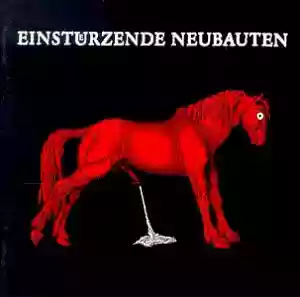
"Do not believe: that we could sign and perhaps even resign like those gnats that live for only one day only to make music everywhere and always to then return to this earth all swollen from the long time forgotten tracing circles ever smaller." Prologue If Art truly is the representation of one's Time and one's Space in History, I believe I can assert that the role of musical representation of the alienation of German industrial civilization in the 80s carried out by Neubauten's music concludes in 1983 with the release of "Halber Mensch", the highest point reached by the Berlin band. After that, Blixa Bargeld realized that the subversive power of his music needed to be redirected in some sense towards more orthodox channels, and so already from the subsequent "...Richterskala" the music assumes darker and heavier tones, with sounds in which the bass reigns supreme, and the singing increasingly glances towards melody, softening the sonic violence of the earlier works. This does not mean that from 1984 onwards they have nothing more to say, it only means their role in musical avant-garde ends there. Splendid albums will still follow, but that's another story. Blixa's voice is pure noise. It screeches more than any chainsaw or drill or metal crashing into other metal. It is capable of recounting pain in the first person, of casting small shards of suffering into the ears of those who listen to its rasp or its indifferent account ("Prologue"). Even if "Feurio" or "Haus der Luge" have the same well-paced advance, where the song format is now clearly recognizable, one cannot deny a certain charm to both compositions, and especially to the lyrics. For the first time, Blixa decides to leave traces for the listener, guiding them along the path of his ideas, and then suddenly abandoning them to their fate, leaving them lost and confused in the wasteland of their thoughts. Fire is the only engine of the world, it is the power at the base of life, it is the spark of the human race, discovered by humanity but rebelling against it, claiming an independent consciousness ("Marinus, it wasn’t you, but King Fire"). The cynicism and black humor of "Ein Stuhl in Der Holle", where a son cannot do anything but wish a spot in hell for the mother who has just exterminated the family with a poisoned pepper soup. The most profound and important element of Neubauten's poetry is their action on the boundary line between what is real and what is only the fruit of fantasy, in an ancestral world where rationality has not yet taken over primal instincts, in a house where floor by floor from the blind who believe what they see and the deaf who believe what they hear leads up to the architect full of ideas who in the end has nothing left but to shoot himself, to avoid admitting the failure of his project ("Haus der Luge"). Once the great dreams and great projects have failed, man can only find refuge in the love of someone able to sink inside him, who can read aloud his soul, someone with whom to confuse his own identity, so much so that he no longer knows who between the two is the beloved ("Fiat Lux"). Reason can only produce monsters, complicated labyrinths ("Hirnlego"), and every attempt to escape them only further complicates the condition of a man who only at the end of his path will be able to rediscover in the nakedness of a kiss ("Der Kuss") the completeness and meaning of his own existence. Perhaps Art is not always the representation of its own time, perhaps this album is just a fleeting glimpse at the series of events called History and the ridiculous figures moving within it that Blixa must have observed with indifference, maybe from a car window, on a cold Berlin night in 1989, waiting to see what lay hidden on the other side of that Wall...
Loading comments slowly
Summary by Bot
This review reflects on Einstürzende Neubauten's 'Haus Der Lüge' as a continuation of the band's evolution from raw avant-garde noise to darker, more melodic industrial music. It praises Blixa Bargeld's unique vocal delivery and poetic lyrics that explore themes of alienation, human struggle, and the boundaries between reality and fantasy. The album is recognized as both a compelling artistic statement and a deeply symbolic reflection on history and humanity. The review underscores the lasting charm and intellectual depth of the music and lyrics.Tracklist Lyrics Videos
Einstürzende Neubauten
Einstürzende Neubauten are an experimental industrial music group formed in West Berlin in 1980, known for using scrap metal, tools, and custom-built instruments alongside conventional ones, and for evolving from early harsh noise toward more structured, atmospheric songwriting while retaining a strong percussive identity.23 Reviews
Other reviews
By LittleBluebelle
Einstürzende perfectly embody the idea of Berlin: avant-garde, movement, creativity, fluidity, eclecticism.
Destroy harmony, and you will destroy the social structure.
