
 •
Rating:
•
Rating:
THE REVIEW
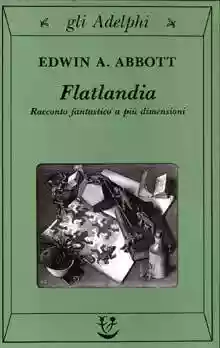
Edwin Abbott, a well-known author of English school textbooks of the late nineteenth century, did not think that the only note of merit attributed to him in our time would be this magnificent booklet. Even Einstein recognized its value as a precursor to the Fourth Dimension.
The book can simply be divided into two main parts: the first, where the protagonist (a Square, a lawyer and mathematician), talks about the world of « Flatland », or the plane. In it, only two dimensions exist, and therefore all the « human beings » as our angular character calls them, are geometric figures. There is a hierarchical Order and Laws that regulate life in this flat world: the Isosceles triangles are workers or soldiers, dangerous for their point and lack of intelligence (the wider the angles, the more developed the intelligence), the Equilateral triangles are the bourgeois, the Squares and subsequent regular Polygons are the aristocracy (in English « square » = « squire »), up to the Ecclesiastical class, the Circles, or figures whose sides can no longer be counted. The figure with the most power is the Supreme Circle, « to which ten thousand sides are always attributed as a courtesy ». The presentation of this world continues with Women, straight lines, with methods to recognize each other, since everything seen within a plane is nothing but a straight line, and all the other things that make you smile at the idea that there might be an analogy with your world.
The second part consists of the discovery of other Dimensions. First, the line, ruled by a King, then the Space of three Dimensions prophesied by a sphere, and finally the point, the zero dimensions. Becoming aware of the different dimensions, our hero surpasses his Teacher, the Sphere, hypothesizing a Fourth, a Fifth, innumerable dimensions! And here the boundary is crossed, we begin to talk about scientific and philosophical actuality.
Indeed, the square is incredulous when the Sphere enters his plane (but he knew no other places, so he conceived it as space). He cannot conceive another dimension, he does not see it. And these are the questions that I think every reader asks themselves: Does a Fourth Dimension exist? Perhaps we do not see it, but will there be someone to show it, even though, as the Square demonstrates, it is impossible to prove the existence of an additional dimension in a place that lacks it? Moreover, what will this Fourth Dimension be? These are the questions that have made the book famous. But in my opinion, there is more beneath this layer of science and philosophy.
The description of Flatland is meticulous, the result of a language that dates back to the late 1800s, and which the translator has well preserved. It is refined, cultured, in my opinion very square, perfect, it shows us Abbott's ability to explain, it would be understood even by «the least gifted of Spaceland's inhabitants». Such register projects us into a first part that seems like a manual of Flatland society, which reveals itself to the attentive reader as a transposition of English society. It's an irony not really hidden, let's say, a way to make you smile, but also to reflect. Abbott perfectly explains the Flat world.
In my opinion, this book allows the mind to open, to see things from another perspective, to become aware of one's prejudices, to aim towards the Fourth.
Loading comments slowly
Summary by Bot
Edwin A. Abbott's Flatland offers a unique blend of imaginative geometry and sharp social critique. The world, inhabited by geometric figures, unfolds a rigid hierarchy reflecting Victorian England. The protagonist's journey through dimensions sparks deep philosophical questions about perception and reality. The book is both an educational and thought-provoking read, with a language style that preserves its 19th-century roots.
Edwin A. Abbott
English author Edwin Abbott Abbott (1838–1926), best known for the 1884 novella Flatland and for educational texts.01 Reviews
