
 •
Rating:
•
Rating:
THE REVIEW
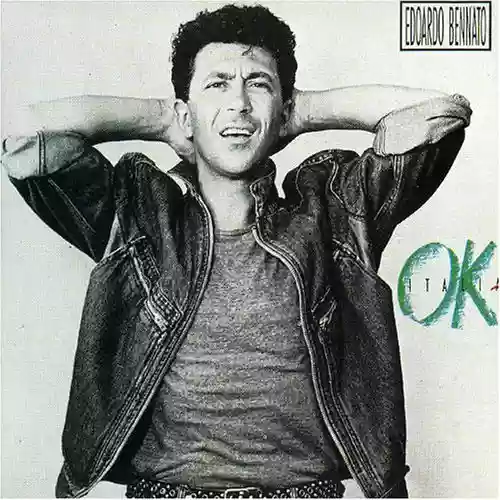
We are in the middle of the eighties, or rather, to be truthful, we are at the end of the eighties. It is 1987. In Italy, as in the rest of the world, there is the craze for "trash," crazy comedians, and Duran Duran. Edoardo Bennato releases 'OK Italia' and for some, it is the beginning of (his) end.
Yes, because, some divide the artistic life of the national Edo, much like the life of Christ divided history: Before and after Christ, Before and after "Sono solo canzonette," in Bennato's case. According to these people, in fact, the Neapolitan singer-songwriter died there, or perhaps, they would have preferred he had really died and not just artistically. That way, he would have become a legend. Too easy, everyone becomes legends after death; want someone, even your most bitter enemy, to speak well of you? Invite them to your funeral, but that's another story. Ok Italia, as we were saying.
The album opens with the title track of the album, which has a very catchy rhythm and lyrics that at first listen might seem trivial, but in reality, perfectly capture Italy of that period. The second track is "Mestieri che si inventano," a bona fide ballad, praising in fact, the so-called invented jobs, like that of the singer-songwriter. "Allora Chi" is another protest song against society of that time (which then resembles today's society terribly), very rock and with Bennato sounding more biting than ever. "Era una festa" perhaps represents the most useless track of the album. Legend has it that it was dedicated to his friend Francesco De Gregori and indeed, in the lyrics, a "Francesco" appears.
Continuing in the listening, we come to "La Città Obliqua," a very sweet ballad which, as can be easily deduced from the title, is a sort of homage-protest to the city of Naples. And here comes, "Tu Vuoi L'America". The latter is one of Bennato's most loved and debated songs, the "usual" someone claims that it represents the transition of the songwriter to the commercial genre (which will then culminate in the success of "Viva La Mamma"), someone else loves it to bits. I believe it is simply a beautiful love song and I believe that sometimes, treaties of philosophy are not necessary to talk about love. Closing the album, we find "Chi Beve-Chi Beve," another playful and sincere song about the city of Naples, and "La Televisione Che Felicità," in which Bennato, rails against the TV (and to think that reality shows didn't exist yet).
In short, for those who are Bennato's fans, I highly recommend getting this album, it's a must-have. For those who are not, I do not recommend it, because Bennato needs to be understood and therefore all his previous albums must be acquired first. As for those who hate it, I suggest listening to it again =)
Loading comments slowly
Summary by Bot
Edoardo Bennato's 1987 album OK Italia captures the spirit of Italy in the late 80s with catchy rhythms and thoughtful lyrics. The album blends protest songs, ballads, and social commentary, highlighting Bennato's distinctive style. While some critics saw this album as a turning point in his career, fans will find it essential. The review recommends the album especially to existing fans who understand Bennato’s roots.Tracklist Videos
Edoardo Bennato
Edoardo Bennato (Naples, 1946) is an Italian singer‑songwriter known for blending rock and blues with incisive satire and fairy‑tale concept albums. A charismatic live performer and early one‑man‑band on Italy’s big stages, he co‑wrote and performed the 1990 World Cup song “Un’estate italiana” with Gianna Nannini.43 Reviews
