
 •
Rating:
•
Rating:
THE REVIEW
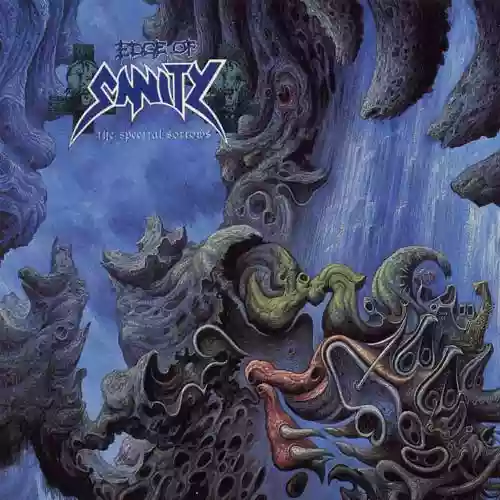
Introduced by what might be the best death metal album cover ever created, a work by the master Dan Seagrave, "The Spectral Sorrows" is the turning-point album for Edge of Sanity. Just as represented in the painting, the group has become a mutable entity, with an unclear nature, trying to cling here and there with different appendages and tentacles, in search of a new form and a new dimension.
Indeed, the two souls of the group, the more progressive one of Dan Swanö and the more traditionalist one of Andreas Axelsson, have started to diverge from each other, and the style of the group has irrevocably changed. Already by listening to the track that shares the album's name and serves as an introduction, it is clear that this record will not be an "Unorthodox Vol. 2", and the confirmation comes with the start of "Darkday", which picks up the main melody from the previous song to deliver the first blow to the neck of the listener hungry for Swedish-styled decay. Yet despite the distortion of the guitars being more explicit than a passport regarding the country of origin of the four musicians, and Swanö's voice remaining that of a grizzly ready to gut a rival bear to mate with the desired female, there is a sense of something different. The compositions indeed are contaminated by a very rock approach, for instance, the drummer never uses the double bass, and some songs, especially "Lost", if not for the distortion and the growl, could be songs suitable for a mainstream audience that certainly does not appreciate musical extremism. The desire for change is felt throughout the duration of the work; after all, it's 1993, and death metal was in need of physiological evolution, also finding space for hardcore contaminations ("Feedin' the Charlatan") and doom ("Across the Fields of Forever" with its splendid and distinctly old-school dark atmospheres). The choice that makes the work even more interesting is, in my opinion, not aligned with what is read in other reviews, to break the homogeneity of the tracklist twice further increasing the variety factor. The first time, one suddenly hears Swanö's clean voice attempting a cover ("Blood of My Enemies") of the champions of true epic and uncompromising metal, the beloved/hated and in any case debated Manowar, with a decidedly remarkable result; the second is the even more surprising "Sacrificed", a true tribute to the dark wave movement.
Perhaps purists may turn up their noses at certain solutions, but Edge of Sanity had the right vision, and the subsequent albums "Purgatory Afterglow" and especially "Crimson" will prove them right, as well as the success achieved by bands moving with the same open-mindedness (read: Opeth).
Loading comments slowly
Summary by Bot
The Spectral Sorrows marks a turning point for Edge of Sanity, showcasing their shift from traditional death metal to a more progressive and diverse sound. The album blends heavy distortion with melodic elements, incorporating rock, hardcore, and doom influences. Unique tracks like a Manowar cover and a dark wave tribute highlight the band's versatility. This record laid the groundwork for their future success and influenced similar artists like Opeth.Tracklist Lyrics Videos
Edge of Sanity
Edge of Sanity are a Swedish death metal band formed in 1989, led by Dan Swanö. Known for fusing progressive elements with Swedish death metal, they released the landmark one-track album Crimson (1996). After splitting in the late ’90s, Swanö revived the name in 2003 for Crimson II.05 Reviews
