
 •
Rating:
•
Rating:
THE REVIEW
Edward Raymond Cochran... October 3, 1938 Albert Lea (Minnesota - USA) - April 17, 1960 Chippenham (Wiltshire - UK)
Many years have passed since I, as a child, would go hide in the living room, carefully turn on the stereo, making sure no one could catch me, close the door, and magically find myself in a world that seemed to be mine... exclusively mine.
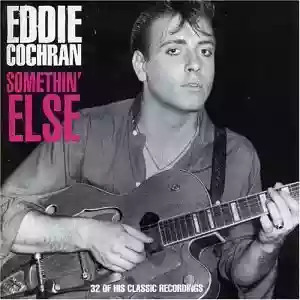
The speakers would start to transmit that splendid (listened to through today's eyes) crackle, causing a restless frenzy under my skin, a prelude to that surge of pure adrenaline that was about to arrive, each time magically with renewed energy. I will never forget the whirlwind of emotions that overwhelmed me when the bass started pulsing with "C'mon Everybody". I was caught by the convulsions of my crazed muscles and would completely surrender to that pagan vortex, feeling almost like I was inside a spinning washing machine. Other times, I would sink into the soft embrace of the couch cushions, and with the cover in hand, I would try to imagine Eddie's expressions as he sang "Summertime Blues" or "Somethin' Else", imagine his "moves," his movements... captivated by his slightly mischievous voice.
Eddie Cochran was one of the greatest rock 'n' roll performers (as well as one of my childhood heroes)... in less than five years as a songwriter, a practice not yet very common among the stars of the time, and performer, he codified the subgenre of rockabilly which over the course of a couple of decades contributed to the birth of garage rock at first and punk later... honored in between by seminal hard bands like Blue Cheer, sacred monsters like The Who (see and hear to believe) or pop icons like Olivia Newton John. Maybe he didn't have Elvis's appeal, Jerry Lee Lewis's fire, Little Richard's schizophrenia, or his best friend Buddy Holly's poetics; or maybe he just didn't need them, he played in a field all his own, having cut his teeth playing country with his cousin Hank (under the name Cochran Brothers) and the meeting with producer Jerry Capehart opened the doors of fame to Eddie, first in cinema and then in music, with a contract for Liberty Records.
In 1957, he took part in the first world tour of a rock 'n' roll show, remembered mainly for Little Richard's departure from the stage in Australia to embrace faith and religion. On February 3, 1959, a plane crash took the lives of Buddy Holly, Ritchie Valens, and Big Bopper, throwing Eddie into despair that led him into the recording studio for the heart-wrenching tribute that is "Three Stars", a piece written by DJ Tommy Dee... where his deep voice, broken by emotion and tears, can be heard multiple times. Liberty did not release it, judging the master as insufficient quality (another example of "corporate ignorance"). But at the beginning of 1960, he gathered around him the surviving Crickets of Buddy Holly and recorded the splendid "Three Steps To Heaven", a tribute to the art of his deceased friend with a performance that seems like a slap to the best Elvis. But the fate (sadly) prophetic, hidden in the title's lines, was lurking. Eddie, having finished the recording sessions, left for the United Kingdom (where he was a true superstar) to join his other great friend, Gene Vincent, on tour. On the evening of February 3, 1960, the taxi driver taking them to London's airport lost control and crashed into a roadside lamppost. The driver, Vincent, and Sharon Sheeley, Eddie's girlfriend (also co-author of many of his songs), came out unscathed, while he, gravely wounded in the head, passed away a few hours later at St. Martin’s Hospital in Bath.
In 1987, he was inducted into the Rock 'n' Roll Hall Of Fame, years later than the one I reserved for him among my deepest emotions... never stopping to thank my father for passing on his love for Elvis Presley, Jerry Lee Lewis, Little Richard, Chuck Berry, Bill Haley, and especially Edward Raymond Cochran; always pretending not to notice that I had put my clumsy hands on his precious and magical black flying plastic discs.
Loading comments slowly
Summary by Bot
This review reflects on Eddie Cochran's influential yet brief career, highlighting his pioneering role in rockabilly music and his emotional impact on the reviewer since childhood. It honors his lasting legacy, tragic death, and connections with other rock legends like Buddy Holly. The reviewer vividly shares personal memories tied to Cochran’s iconic songs and praises his unique style and contributions.Tracklist Lyrics
Eddie Cochran
American rock ’n’ roll and rockabilly singer, guitarist, and songwriter (born October 3, 1938, Albert Lea, Minnesota; died April 17, 1960, Bath, England). Known for Summertime Blues, C’mon Everybody, and Somethin’ Else; recorded for Liberty Records; inducted into the Rock and Roll Hall of Fame in 1987.02 Reviews
