 •
Rating:
•
Rating:
THE REVIEW
Uh-oh! It was pointed out to us that this review also appears (in whole or in part) in "100 Dischi Ideali Per Capire Il Rock" by Ezio Guiatamacchi
When, at the end of 1976, the sweet melodies of "Hotel California" began to play incessantly on radios around the world, no one was able to perceive what was hidden behind those seemingly calm songs, behind those perfect vocal harmonies, behind those romantically typical west guitar notes. It just seemed like the fabulous new work of the best American country-rock band. Only when you begin to pay more attention to the unsettling lyrics of the title track does something of what was hiding behind the new Eagles album emerge. What emerged was not very pleasant to see.
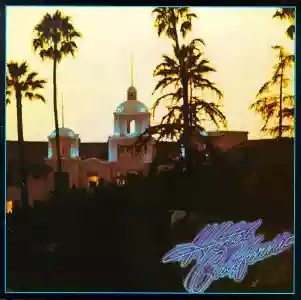
Twenty years from those days, when the story has been pieced together from interviews and biographies, it appears as a painful portrait of decay, envy, internal strife; in perfect rock style but very close to the specter of death. In fact, this is a story of drugs and rock 'n' roll. Of jealousy and envy. The other side of sunny California, where beautiful girls parade. Yet the images, starting from the cover, should have already made something clear: that majestic hotel in the light of an apparently tranquil sunset but reflected in those blue lights and impending shadows appears quite cold; the five members of the band inside, with those worn faces as if they had passed through the flames of hell; and finally that luxurious hall left behind, except for a figure in the distance sweeping the floor as if nothing had happened.
A little history, then: when the Eagles were about to enter the Record Plant Studios in Los Angeles in March 1976, they were the most popular band in the United States. The Eagles' career, short but dazzling, made country-rock the most successful formula in America. For this album, new paths had to be found anyway. The recordings took place in an atmosphere that was anything but serene. This episode alone is enough to understand it. One evening, while in the house he rented for that period, Meisner hears a knock on the door. It’s Don Felder and Joe Walsh with distraught faces. They said they were ruining everything. During those eight months in the studio, the five consumed industrial quantities of cocaine, testing both their physical and nervous systems. It is difficult to believe that a group of people who hate each other so much could have produced such a beautiful album; yet it happened.
All these feelings are evident, starting from the title track, the farewell to the dream of California, that of good vibrations and "peace & love". From the lyrics, it is understood that the dream has become a claustrophobic nightmare, the hotel that represents the successful California is a place full of dangers from which no one will ever leave. The splendid change of solos at the end between Felder's guitars and Walsh's fades everything into the mist of music. California is seen as a microcosm reflecting the rest of the world.
At the end of the recordings, Frey and Henley, despite everything, are satisfied with the result: in fact, they declared that from now on the Eagles were not just writing chart-topping songs. "Hotel California", consciously or not, is a concept album, also published just in time before the "Bicentennial" year and the related grand celebrations for the United States' two hundred years of existence, come to an end. A concept album where the lifestyle of the so-called "Southern California", that is, the world of stars and cinema, is bitterly denounced through the story of the "new kid in town" aspiring for success, eventually living a "life in the fast lane" only to end up locked in the fake paradise of Hotel California where he finally understands it has all been "wasted time".
These concepts are expressed in "New Kid In Town", "Life In The Fast Lane", "Wasted Time" and in the wonderful "Hotel California", the masterpiece song of the album, and also the most famous. In "The Last Resort" at the end, there is a lingering hope, that of resurrection. Henley and Frey surely may have tyrannized their companions, but you cannot say that the result proved them wrong: the only track composed by Randy Meisner, the nice "Try And Love Again", is an innocuous country-rock like the one belonging to the Eagles' past and has very little to do with the rest of the album, with the complex pianistic, vocal, and orchestral structure of magnificent tracks. Joe Walsh, on his side, signs the hard rock in "Life In The Fast Line" which announces the future of the Eagles, those of "The Long Run". The only contribution of the other member of the band, Don Felder, is "Victim Of Love", however, composed together with Frey and Henley.
To this day, this album has sold more than ten million copies. But the Hotel California is already closing its doors, and for those who lingered inside, there is no more hope. The winds of punk are already blowing fiercely around its building, and now it is no longer the time to "dream of California".The journey is over.
Loading comments slowly
Summary by Bot
This review explores the famous Eagles album Hotel California, revealing its dark and unsettling themes beneath the smooth melodies. It highlights the band's internal strife, drug abuse, and the bitter portrayal of the Californian dream. Despite the turmoil, the album stands as a masterpiece blending complex musical and lyrical elements. The review also contextualizes the album as a concept work reflecting America in the mid-1970s.Tracklist Lyrics Videos
Eagles
Eagles were an American rock band formed in Los Angeles in 1971, known for country-rock roots, polished West Coast rock, and prominent vocal harmonies. They achieved massive commercial success in the 1970s, broke up in 1980, and reunited in 1994, later releasing Long Road Out of Eden.16 Reviews
Other reviews
By Grasshopper
"For all six and a half minutes of 'Hotel California'... we are immersed in the haze of a warm Californian sunset."
"An album steadily declining, but since 'highs and lows even out,' decent overall."
