 •
Rating:
•
Rating: THE REVIEW
When Glenn Frey (guitar) and Don Henley (drums) called Bernie Leadon (guitar and mandolin) and Randy Meisner (bass), they certainly did not imagine they were giving life to the most important country-rock band of all time and more generally to one of the pillars of rock.
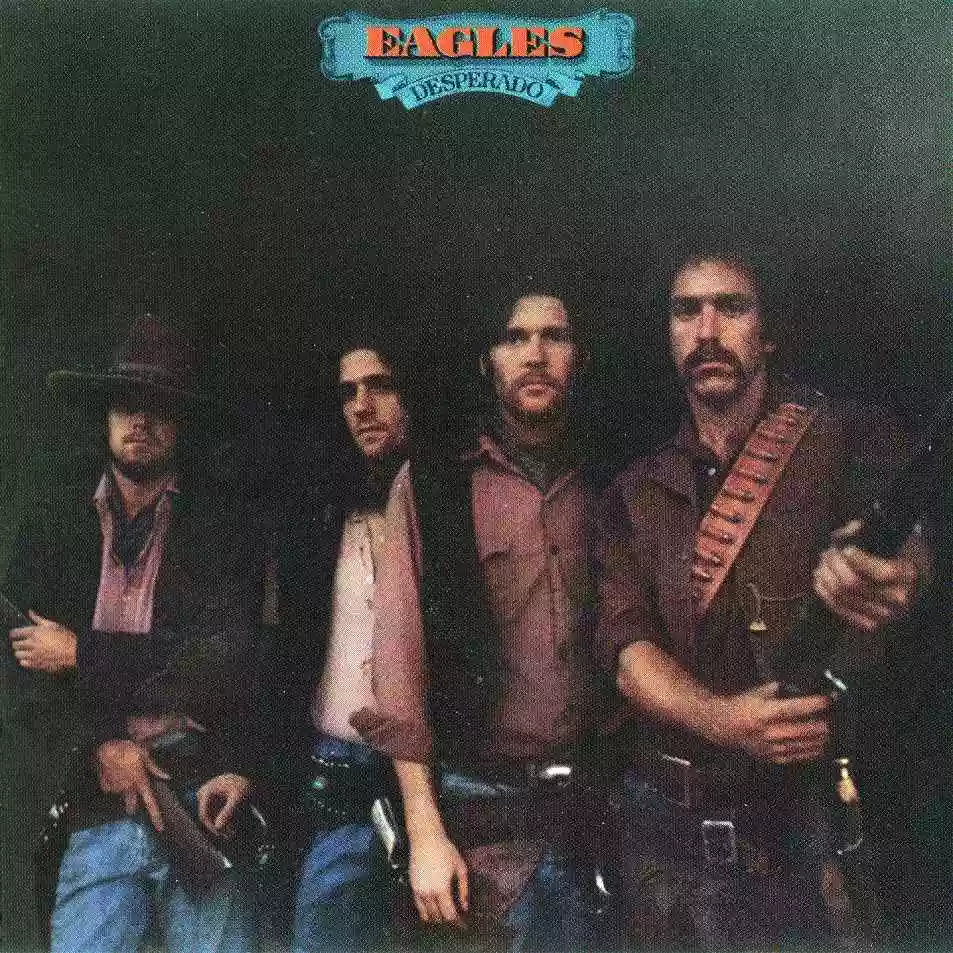
After their debut with the self-titled album, a "classic" country-rock work, close to some of Jackson Browne's works (who, among other things, collaborates with the group), the four released this "Desperado": it is 1973. The album, which is a concept, takes us into the theme of the record from the cover. We find ourselves in the midst of a western "epic," the lyrics tell us about bandits, melancholy sunsets, cowboys, and women. There's a greater sense of the old west than in many bluegrass or otherwise "pure" USA folk albums. The atmospheres are evocative, the dust, the horses, the scent of the wood of a saloon, or an old Martin D28 seem to come out of the record.
The first track, "Doolin-Dalton," encapsulates all these characteristics: beautiful sounding acoustic guitars, a melancholy harmonica in the distance, exceptional harmonies that blend well with electric guitars and drums. The voices alternate, Don Henley showcases the potential of his splendid timbre. "Twenty One," the next track, has the classic "locomotive" beat, thanks to a drumming style but especially a great banjo work by Barnie Leadon, which gives a full rhythmic texture to the piece. As always, everything is enriched by the harmonies. After the harder and still well-played rock of "Out Of Control," we move to "Tequila Sunrise," among the most beautiful songs of the Eagles' entire career. The guitar rhythm (almost a beguine) creates a "Mexican-flavored" atmosphere, the steel guitar embellishments are very elegant, as are all the vocal parts, an atmosphere of relaxed melancholy. It is then followed by another Eagles masterpiece, "Desperado." A wistful ballad, entrusted to Henley's voice (the author of the song), with piano and orchestra in the foreground, a classic that over the years will be reinterpreted by many, without ever reaching the beauty of the original version. "Certain Kind Of Fool" balances between country-rock and true rock, with a fine electric guitar solo (but we are still far from Hotel California and the solos of Joe Walsh, who will join the group later).
The forty-eight seconds of banjo of "Doolin-Dalton" serve as a prelude to "Outlaw Man," a rock track that ties to a certain late-sixties American country-rock tradition. Again, "borderline" atmospheres (here meant as the imaginary frontier between the U.S. and Mexico) with "Saturday Night": slow rhythms, very prominent and well-arranged harmonies, mandolin characterizing the piece. "Bitter Creek," a slow, pleasant, and well-arranged piece, is one of the few that can recall some things by C.S.N&Y. We are at the end, but just as the album started well, it concludes equally well, with "Doolin Dalton - Desperado (reprise)." It is practically a summary of the two songs, but enriched by great banjo and electric guitar work in the first one, with a beautiful "musical bridge" entrusted to Henley's voice that leads us to a more choral and full version of "Desperado." A beautiful, atypical medley that lives independently closes this album, which, although it is fully an expression of a genre certainly not in fashion today, if listened to today, will still offer emotions and a taste of old west adventure.
Loading comments slowly
Summary by Bot
The Eagles' 1973 album Desperado is a landmark in country-rock, with powerful storytelling inspired by the Old West. Featuring standout songs like "Tequila Sunrise" and "Desperado," the album is praised for its evocative atmospheres, intricate harmonies, and blend of acoustic and electric instrumentation. This concept album delivers timeless emotion and a distinctive western vibe that remains fresh even today.Tracklist Lyrics Videos
Eagles
Eagles were an American rock band formed in Los Angeles in 1971, known for country-rock roots, polished West Coast rock, and prominent vocal harmonies. They achieved massive commercial success in the 1970s, broke up in 1980, and reunited in 1994, later releasing Long Road Out of Eden.16 Reviews
Other reviews
By stevesirovai
The Eagles are undoubtedly the best Folk group of all time for me.
'Desperado' should be listened to calmly by calm people like the Eagles.
By hellraiser
"'Desperado' is a beautiful and well-played album, where the perfectionist mania of the Henley-Frey duo is noticeable."
"One of the best moments of the work is the following 'Desperado,' a song of hope where the protagonist is a man wounded by past love experiences and who fears loving again."
