 •
Rating:
•
Rating:
THE REVIEW
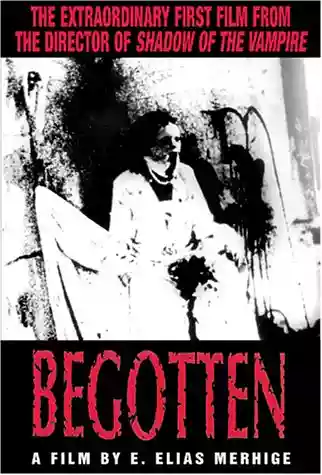
Before shooting the cult film "l'ombra del vampiro," which hopefully needs no introduction, Elias Merhige released this film in 1991 that is considered a landmark in weird cinematography, a film that perhaps has its highest point in the initial part of the footage. In the first scene, the camera makes its way into a dilapidated house where a person, who would later be "GOD," is in the throes of an epileptic seizure, holding a razor in hand, their face covered by a strange mask. Still gripped by the crisis, they begin to disembowel themselves until they die, from which Mother Nature will be generated in the form of a beautiful woman, also wearing a mask on her face, but who will remain with her head turned toward the sky for almost the entire duration of the film. Mother Nature approaches the now lifeless body of "GOD," and by masturbating the corpse, she will fertilize herself and bring forth a son. The black and white footage, along with the lack of audio replaced by strange sounds on loop, does nothing but transport the viewer into a hallucinated and timeless dimension. The son, an incredible boy, is seen writhing on the ground in strange epileptic attacks, then roaming with a rope around his neck, like a leash pulled by Mother Nature. This all unfolds in an environment that seems to be a rocky mountain, where men are represented by strange figures, with odd cloaks and certainly do not promise anything good at first glance.
I've already told you too much, and I don't want to spoil the ending by revealing the entire plot, even though, upon first viewing, it's not clear who the characters are. Only at the end, through the credits, does the director reveal the protagonists. ENJOY THE VIEWING.
Loading comments slowly
Summary by Bot
Begotten is a landmark experimental film by E. Elias Merhige, known for its hypnotic and surreal black-and-white visuals. The film’s cryptic narrative uses symbolism and disturbing imagery to immerse viewers in a timeless, hallucinatory experience. While challenging to interpret, its artistic style and atmosphere make it a cult classic. The review highlights the film’s opening as particularly powerful and encourages viewers to experience the film without spoilers.
E. Elias Merhige
American film director known for the experimental horror film Begotten (1991) and the later film Shadow of the Vampire (2000).02 Reviews
Other reviews
By GustavoTanz
"A permanent anguish prevails, generated in part by the effective repetition of sounds and bird voices by composer Evan Albam."
"Some have seen something blasphemous in Begotten. It is not so. This is a film that makes one think, in every field."
