
 •
Rating:
•
Rating:
THE REVIEW
The '69 haunts me. Lately, I can't stop reviewing albums released in that year, and they're all masterpieces. The '69 may represent many things (!), but musically, a few events come to mind: Woodstock, the death of folk as a pure genre and cultural movement, etc.
Yet this album has nothing to do with the aforementioned events.
Dusty doesn’t play any instruments, doesn’t compose or write songs, doesn’t participate in any socio-political movement... Dusty is voice, not "the" voice like Frank Sinatra, but pain, joy, despair, sensuality, loneliness, power, melancholy in the form of voice.
Dusty was, but for those who continue to listen to her, she is and will always remain THE INTERPRETER; and yet she always reached a sort of visceral empathy with the songs she sang that the same songwriters who gave her their compositions were terrified by her interpretation (see Burt Bacharach, Carole King, Janis Ian, and many others, all expressed the same fear of not being able to sing that song anymore because Dusty had already performed it!). Any song she sang became hers.
Dusty is a myth, an idol, the last great white soul/pop diva, as she has been defined. Elton John, Paul McCartney, Annie Lennox, Cher, Bruce Springsteen, Elvis Costello, Alison Moyet, Sinead O’Connor, Pet Shop Boys, Oasis, and many others adored her.
Mmmmmm Dusty and soul... it reminds me of a series of episodes that culminated in this album "Dusty In Memphis". Dusty, even before the Beatles arrived in America, had launched the British Invasion in the early '60s with the sunny "I Only Want To Be With You". Back then, there was no music video, and radio was the major promotional vehicle for a single... All Americans believed she was black!
Dusty who duets with Martha and the Vandellas (all-black girl band, famous at the time for a series of hits including the standout "Dancing in the Street" under Phil Spector's banner) and who didn’t want to sing in front of an all-white audience in South Africa or who introduced the English to the great Philly sound during her BBC shows.
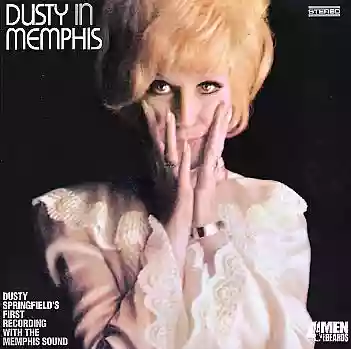
And finally Dusty in Memphis.
Dusty packs her bags and puppets and in '69 moves from London to the USA. Dusty and the capital of soul/blues. Her voice is a black voice, yet it cannot be whiter and more angelic than this. Dusty has always been a tribulation made into a person, a constant inner chaos. This miasma has always transferred to the recording studio: unbelievably perfectionist, insecure, and sometimes unmanageable, yet as soon as she opens her mouth, everything becomes heavenly.
"Dusty In Memphis" is an album perfect in every way, it is squaring a circle, the vastness in its impossibility. Dusty sang, recorded, arranged, and repeated it syllable by syllable (look, it's true... read interviews with anyone who had the (mis)fortune of entering the studio with her, and they'll tell you she would start singing and re-recording the songs syllable by syllable!).
Dusty who wanted to record an album like Aretha Franklin.
Dusty had an immense baggage behind her: from ballads like the worldwide hit "You Don’t Have To Say You Love Me" (an adaptation of the Italian "Io Che Non Vivo Più Di Un’Ora Senza Te"), to the super seductive "The Look Of Love" by Bacharach, and to suddenly switch to soul was considered at the time a suicide.
But Dusty in Memphis has no genre... and it’s indeed a suicide, but like those tragic acts that have their own inner power then become mythical... it's the result of a long and troubled labor that could only culminate in one of the masterpieces of any century (included in the list of the 100 greatest albums of all time by Rolling Stone), a superhuman and troubled effort by dozens of human beings who sweated, got angry, cried, overwhelmed by nervousness and happiness, and created an emotion called "Dusty in Memphis".
Very high-ranking producers from Atlantic (Jerry Wexler, Tom Dowd, and Arif Mardin) have woven, sewn, adorned, sculpted, and painted what not even perfection could have ever dreamed of creating; musicians among the best on the scene in Memphis at the time would never again be able to pick up their instrument the same way after this experience.
Listen to the harmony with which the orchestra and especially the strings intertwine with Dusty's voice, they chase each other, one cushions the other, none seeks to dominate like in previous records where the magnificence of the orchestra contrasted with the expressive power of Dusty's voice that didn’t take much to surpass it. But no, Dusty has changed and begins to use a modulation that from this moment on will mark the rest of her discography: sweet, gentle, sometimes whispered to reach towards the end of the song a ferocious emotional crescendo that leaves the listener naked in front of that explosion of emotion like only those words or phrases where Dusty, with just her voice, manages to place her entire soul.
Listen for example to "I Don’t Want To Hear It Anymore" when she pronounces "...and the walls are muuuuch tooooooo thin...", Jesus Christ and the 300 apostles!!! No one, and I would bet my hand on it, could ever have charged that phrase with such emotions; or the beginning of "Windmill Of Your Mind" (at the time the soundtrack of the film with Steve McQueen "The Thomas Crown Affair" and recently it was reused for another film - sorry but I can’t remember the title... something with Pluto) where she starts with "Round like a circle in a spiral/like a wheel within a wheel..." sublime!
Bacharach ("In The Land Of Make Believe"), Carole King ("So Much Love", "Don't Forget About Me", "No Easy Way Down" and "I Can't Make It Alone"), Randy Newman ("I Don’t Want To Hear It Anymore" and "Just One Smile") and many other songwriters are present in this album... but above all, the song that will always be remembered will be the now famous "Son of a Preacher Man" with that famous opening bass line (originally rejected by Aretha at the time, and brought to success by Dusty - number 10 on the Billboard chart) and reincarnated with new life in 1995 thanks to Quentin Tarantino who made it one of the standout tracks of the Pulp Fiction soundtrack.
Look, such miracles happen only once in a lifetime, that alchemy between Dusty and the musicians, Dusty and the backup singers (the so-called Sweet Inspirations, among which is Whitney Houston's mother), Dusty and the orchestra (no, you will never hear those strings again), Dusty and the lyrics (simple yet direct as the facts of life where feelings, emotions, and fears reign supreme).
The frenzy of those sessions that gave birth to such divinity brought to life many other compositions that ended up in the remastered versions of this album (I highly recommend the RHINO Warner Deluxe Edition, a digipack that offers over 14 bonus tracks resulting from those sessions, including standout "You've Got A Friend" by King and "I Found My Way" which will definitely be the song I’ll have played at my funeral... or rather, they will play, and also a splendid booklet!).
Simply amazing but tremendously incomparable.
Inimitable and immeasurable.
After almost 40 years, this peak has never been reached.
P.S. Once again, I apologize, I know my tendency to write lengthy reviews is inversely proportional to my desire to shorten them!
Loading comments slowly
Summary by Bot
Dusty Springfield's 1969 album Dusty In Memphis is celebrated as a flawless soul masterpiece that transcends genre boundaries. Known for her distinct vocal delivery full of emotion and vulnerability, Dusty transforms each song into a personal statement. The album's production, musicianship, and song choices contributed to a legendary recording experience that remains influential. Highlights include iconic tracks like 'Son of a Preacher Man' and collaborations with top songwriters and producers of the era. This album is a timeless blend of soul, pop, and emotion.Tracklist Lyrics Videos
01 Just a Little Lovin' (02:18)
02 So Much Love (03:29)
10 No Easy Way Down (03:09)
12 Son of a Preacher Man (mono) (02:29)
13 Just a Little Lovin' (mono) (02:18)
14 Don't Forget About Me (mono) (02:50)
15 Breakfast in Bed (mono) (02:56)
16 I Don't Want To Hear It Anymore (mono) (03:10)
17 The Windmills of Your Mind (mono) (03:52)
18 In the Land of Make Believe (mono) (02:31)
19 So Much Love (mono) (03:32)
Dusty Springfield
English singer and defining voice of 1960s pop and blue‑eyed soul. Known for hits like I Only Want to Be With You, You Don’t Have to Say You Love Me, The Look of Love, and Son of a Preacher Man, and for a late‑80s resurgence via Pet Shop Boys leading to Reputation. Died in 1999.03 Reviews
