
 •
Rating:
•
Rating:
THE REVIEW
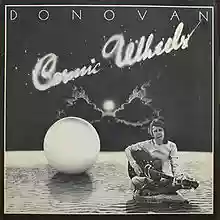
"Cosmic Wheels" from 1973: Donovan's evolution proceeds swiftly and smoothly, and this album is an important and obligatory milestone; its predecessor, "Open Road" from 1970, did not garner particular enthusiasm despite its overall excellent quality. Then there was the "childlike" parenthesis of "HMS Donovan," but a prompt return to "mainstream" music was urgently needed: after all, time passes inexorably, and the fame that Donovan had deservedly acquired during the '60s was beginning to wobble perilously. Thus, the Scottish artist recalls his trusted producer Mickie Most and releases what was meant to be the album of the great comeback; confirming this, "Cosmic Wheels" flirts with glam rock, which was at its peak at the time, much like "Open Road." However, whereas in the 1970 album, it was perfectly blended with Donovan's folk/psychedelic trademark, here it is predominant and central.
"Cosmic Wheels" is a distinctly electric but not aggressive album: the guitars outline sly and suggestive melodies, the arrangements are meticulously crafted and original, and the album as a whole is imbued with a remarkable expressive elegance: the songs that best express these themes are the biting "Wild Witch Lady" and a captivating "The Music Maker" where a vaguely oriental atmosphere marries a powerful and almost danceable groove; the use of synthesizers and backing vocals is simply perfect. This album expresses its full potential in the first three episodes: "Cosmic Wheels", rich with spatial suggestions dear to David Bowie, starts like a ballad but transforms into an elegant and evocative midtempo, enriched by sumptuous and imposing orchestrations, "Sleep" sounds wonderfully glam: the singing turns into a piercing falsetto, a saturated and full-bodied guitar and a plush bass outline a feline and sensual rhythm, where a saxophone makes an appearance, being widely present in the more subdued and wonderful "Earth Sign Man", a piece, as the English would say, absolutely flawless, which progresses gracefully in an atmosphere with jazzy undertones, stylish and sensual, the perfect backdrop for a warm dandy night.
After this high-level glam concentration that ends with the opening track of side B of the original vinyl, namely "The Music Maker", the album's tones relax, causing, however, a certain loss of identity and stylistic cohesion for an album that had been impeccable up to this point. Nevertheless, there's "I Like You", a very sweet and whispered ballad, enriched with childlike voices alternating with accelerations well-supported by orchestral arrangements, forming a blend of exquisite and ingenious refinement, "The Intergalactic Laxative" is a hilarious acoustic nursery rhyme, amusing and commendable for its irony, a good divertissement, while the pop-folk of "Only The Blues", though pleasant in itself, is decidedly detached from the context, as is the concluding and rather lackluster "Appearances".
Unfortunately, "Cosmic Wheels" will not succeed in bringing Donovan's name back to prominence: following this initial attempt to recapture the general public, there will be others in the subsequent years, equally excellent and equally unsuccessful commercially. He will try everything, shedding the glam rock persona and consistently offering original, well-crafted, and organic albums, all products of an intelligent and thoughtful artist who leaves nothing to chance, but all in vain: the ostracism towards Donovan will continue unabated, ultimately managing to marginalize him completely and render him an almost invisible ghost; we are talking about a genius, one of the greatest melody creators in contemporary music; artists far less talented than he will take that place in the sun that was his, and this is profoundly unjust: Philip Donovan Leitch deserves a total and complete rehabilitation and reevaluation for everything he has produced in his long and prolific career and not just in his early years.
Loading comments slowly
Summary by Bot
Donovan's 1973 album Cosmic Wheels marks a significant evolution into glam rock with meticulously crafted arrangements and electric melodies. The album strongly showcases Donovan's creativity and elegance, especially in its first half. Despite its artistic strength, Cosmic Wheels failed to restore Donovan's commercial prominence. The review highlights Donovan's ongoing struggle for recognition despite his undeniable genius and contribution to music.Tracklist Lyrics Videos
Donovan
Donovan (born Philip Donovan Leitch) is a Scottish singer-songwriter who rose to prominence in the 1960s, moving from acoustic folk into psychedelic pop and related styles. Reviews frequently describe him as an underrated peer of the era, often compared to Bob Dylan, with a reputation for strong melodies, poetic imagery, and stylistic flexibility across decades.24 Reviews
