
 •
Rating:
•
Rating:
THE REVIEW
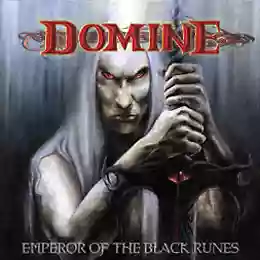
Why review an album by Domine, an Italian band active for two decades now, and in particular this “Emperor Of The Black Runes”? Already from the title “Emperor of the Black Runes”, it might seem that Domine is just another power band without personality and similar to many others. Indeed, they have many characteristics that could lead one to think so, the cover for example (it depicts Elric with his sword Stormbringer); the lyrics, mainly focused on knights, enchanted forests, swords, and warriors, themes now too common and stale.
The structure of the album, which begins with an intro that flows into a very fast second track followed by gallops, slower tracks, long and articulated compositions, more driven tracks, and finally the last ballad. So why choose Domine? First of all, they manage to move every listener; their direct style, their pure metal, all the musicians, who in this album manage to show their immense technique and creativity, the strong, intense, and sharp voice of Morby, manage to create an original, singular, and wonderful sound. Even the production, although at times it may seem too octaved, manages to enhance the band's sound and make it even more direct.
As tradition dictates, the album starts with a majestic intro (“Overture Mortale”), an excellent rearrangement of an aria from Mozart's Don Giovanni, which prepares our ears for epic and powerful atmospheres. No sooner than two minutes later, the guitars break in with a very aggressive riff. “Battle Gods” is a very fast and engaging track, supported by a dazzling double bass.
Two screams from Morby, whom I can confidently call the best singer on the Italian scene, make way for a wonderful gallop “Arioch, The Chaos Star”, a track dedicated to Arioch, the star of cosmic chaos. The chorus is beautiful and Morby is brilliant, delighting us with a sharp and glorious singing that fully reflects Arioch's hatred and malevolence.
Now, it's time for “The Aquilonia Suite”, a suite divided into six parts, which takes melody from the soundtrack of the excellent film “Conan the Barbarian” superbly rearranged by an incredibly inspired Enrico Paoli. The performance by the whole group is superb as well, from Stefano's drumming which firmly supports the piece with very combative rhythms to the excellent keyboard parts by Iacono, and of course, Morby’s vocal interpretation. A slow glorious beginning takes us to the distant northern lands, suddenly the rhythm changes, and uninterruptedly follow rising and vehement verses, excellent instrumentalizations, and a chorus bordering on the epic and the lyrical; clearly audible are the self-praises in the majestic choirs chanting “Ave Domine! Ave Domine”.
A great piano line followed by an arpeggio from Enrico immediately creates a fanciful and chivalrous atmosphere. “The Prince In The Scarlet Robe” starts as a ballad, then becomes more epic and heroic in the chorus and more imposing in the verses, supported by an organ and a very direct guitar (as throughout the entire CD). The instrumental part is very beautiful, creative, and imaginative.
With “Icarus Ascending” the Tuscan band certainly delivers a good performance, with exceptional vocal parts that culminate in a memorable chorus, striving like Icarus to remain high in the sky.
“The song of the swords” begins with the sound of a drawn sword, then it's Enrico Paoli's turn, perhaps the sharpest blade of all, gifting us an indelible, wonderful riff and solo (during the song you can discern the clash of the two swords Stormbringer and Mournblade). Very sharp, therefore very suitable as always, is Morby’s voice.
“The Sun of The New Season” is a very articulated and complex track, featuring Morby singing with Leanan Sidhe from Beholder. Two voices so different yet so perfect together, the first sharp, flexible, and pointed, the second sweeter and more enchanting. The suite indeed has very particular dreamy, magical atmospheres and truly refined and ambitious instrumental ideas.
It is followed by “True Believer”, an anthem, a very direct, strong, and emotional track, unstoppable. Introduced once again by Morby's (beautiful) high notes, it is a very driven and symphonic piece and will surely become a new flagship song for Domine.
The last track is called “The Forest Of Light”, an acoustic ballad, perhaps not up to the average of the album, but it closes the album in a very elegant and accurate manner, with Morby demonstrating to be very versatile.
With this “Emperor Of The Black Runes” Domine has achieved a perfect stylistic-artistic balance and has managed to create (as in their other albums) a determined and frontal sound, as well as very personal. It's a difficult, aggressive, and dark album, which will hardly be appreciated at first listen. It's a masterpiece, a blend of majesty, power, and symphony.
I like the Domine because they are not afraid to express themselves and are aware of the maturity they've reached after many years, they are not afraid to propose articulated, complex tracks, rich in nuances and even somewhat ambitious. They are far from the trends, yet manage to be evocative and magniloquent.
In essence, in this “Emperor of the Black Runes” you can find everything, passion, creativity, genius, technique, maturity, imagination, grit, power, courage... In short, Domine's music contains everything that makes Metal a unique and wonderful expressive form.
“Ave Domine! Ave Domine!”
Loading comments slowly
Summary by Bot
Domine's 'Emperor Of The Black Runes' transcends typical power metal clichés through exceptional musicianship, mature songwriting, and a perfect balance of majesty and aggression. The album features epic storytelling, dynamic compositions, and Morby's sharp vocal delivery. Highlights include the multi-part 'The Aquilonia Suite' and the emotional anthem 'True Believer.' This complex and ambitious album rewards attentive listening and stands as a masterpiece in the genre.Tracklist Videos
01 Overture Mortale (01:09)
02 Battle Gods (Of the Universe) (04:57)
03 Arioch the Chaos Star (05:05)
04 The Aquilonia Suite (10:59)
05 The Prince in the Scarlet Robe (06:51)
06 Icarus Ascending (06:27)
07 The Song of the Swords (05:39)
08 The Sun of the New Season (08:41)
10 The Forest of Light (03:24)
11 Alstar the King (04:51)
Domine
Domine is an Italian power/epic metal band from Florence, formed in 1983. Debuting in 1997 with Champion Eternal, they’re known for fantasy-driven lyrics inspired by Michael Moorcock’s Elric saga and for dramatic, suite-like compositions across albums such as Dragonlord, Stormbringer Ruler, and Emperor of the Black Runes.04 Reviews
