
 •
Rating:
•
Rating:
THE REVIEW
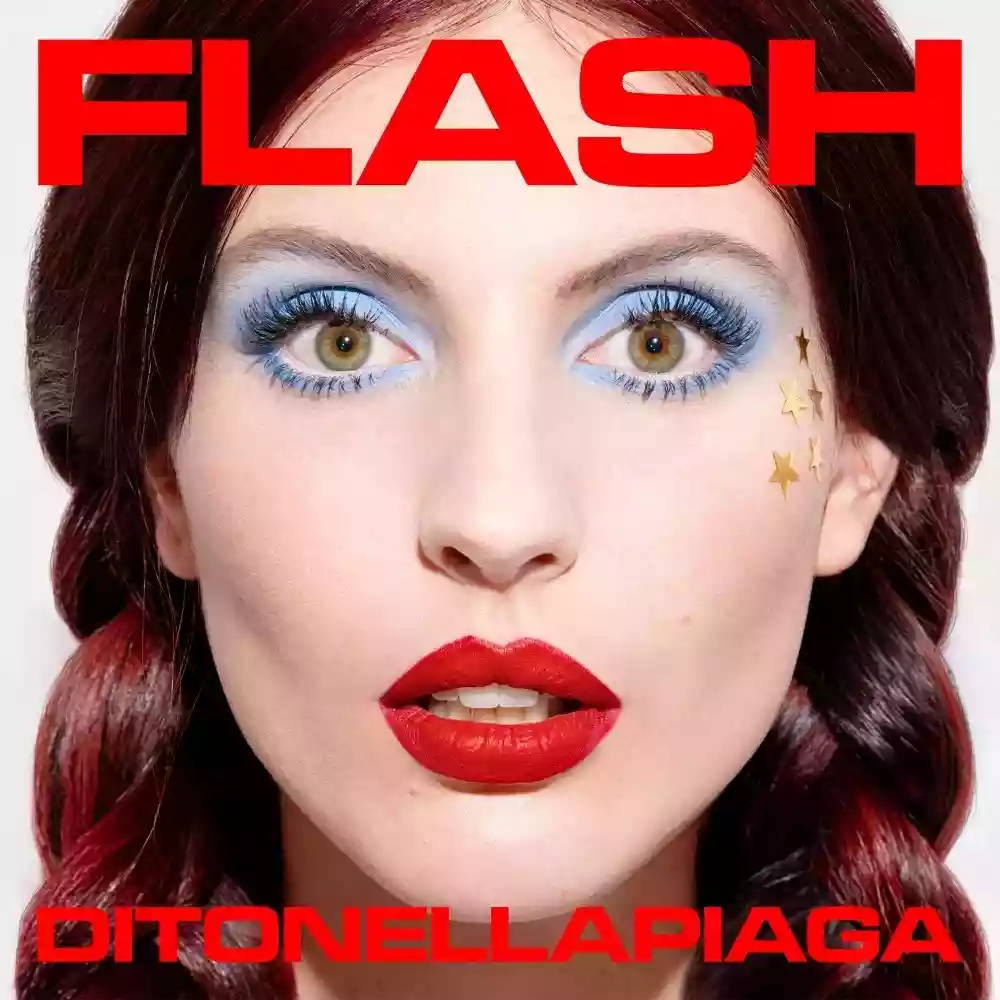
The classic “earthenware pot” between two iron pots: this is perhaps the best way to describe Ditonellapiaga/Margherita’s second work, released exactly two years after the excellent debut album “Camouflage” and her outstanding first appearance at Sanremo in 2022 with the celebrated “Chimica”.
That the brilliant Margherita undoubtedly represents, beyond subjective tastes, a true Artist with a capital A—poliedric, versatile, unpredictable, and able to move skillfully from an uncompromising ElectroPop repertoire to a decidedly more Soul/Jazz style (Amy Winehouse docet)—is, in my opinion, an established fact. Even so, in this “Flash”, the more songwriting-oriented side definitely takes precedence over the more theatrical aspect (although this is still fairly present in some tracks).
The record opens with “Ti Dirò”, a track dominated by Rock guitars skillfully blended with a well-conceived electronic base, with the singer-songwriter’s signature warm timbre doing its usual good work, even faintly recalling, at times, some early Radiohead compositions in a few brief passages.
The rest of the album tries to offer, with mixed results, “dishes” of all kinds: for example, the “featuring” with the (former) Coma_Cose on “DNA” is a classic case of “vorrei ma non posso,” where everything flows more or less pleasantly, but without that “creative spark” that could have made the song a bit more than a borderline pass.
The best results, instead, come with the two ballads “Fossi Come Te” and above all “Come Prima”, in collaboration with the excellent Fulminacci: both are highly intimate and perfectly illustrate Ditonellapiaga’s other side; that is, young woman Margherita torn by conflicting emotions about love for someone she imagines—or, more metaphorically, for herself, with a touch of nostalgia mixed with bitterness, leaving the listener with a sense of empathy and even emotion for the protagonist herself.
There is also space, as mentioned, for some high-quality, irreverent Pop/Dance tracks, such as “È Tutto Vero”, with lyrics that are decidedly...political from the very first verses: “Dici che ho il cuore più neutrale della Svizzera / La mia vagina è liberale e fa politica”, making it one of the high points of the album.
“Mary” is another excellent Pop/Dance track, with lyrics written by six hands with Veronica Lucchesi and Dario Mangiaracina from La Rappresentante di Lista, narrating with tenderness yet explosive energy the story of an imaginary girl named Mary who, at just 16, discovers the pleasures of the famed “first time” with someone who literally makes her soar up to “celestial orbits and clouds,” to paraphrase a line from the song.
The collaboration with Gaia on “Una” is nice but nothing more, offering a kind of semi-electronic Bossa Nova that is pleasant, though vocally both artists seem a little below par.
“Tu Con Me Hai Chiuso”, on the other hand, is a very radio-friendly track that flows smoothly like the waters of the Tiber she portrays in the lyrics, but it too doesn’t really leave a mark.
“Non Resisto” and “Pazza Di Me”, closing the album, are both firmly in the ElectroPop vein, though unfortunately rather bland: the first, despite the “feat” with Whitemary, one of the most in-demand electronic artists of the moment, adds nor detracts much from the album as a whole; the second, on the other hand, sees Margherita/Ditonellapiaga experimenting for the first time in her discography with autotune, with results that are, however, questionable and which, in particular, do not do justice to the brilliant “vocal texture” she possesses.
The final result is certainly a good or even very good record in some moments and, therefore, not one to be discarded; however, it is counterbalanced by other moments where the singer-songwriter from Rome’s Prati district seems to be undergoing a certain crisis of both personal and artistic identity. But it was precisely from this moment of “impasse” that the recent “Miss Italia” was born—and the rest, as they say, is history, especially at this year’s Sanremo.
Loading comments slowly
Summary by Bot
Ditonellapiaga's 'Flash' receives a middling review, landing at 3 out of 5. The album displays creative energy, but isn't universally impressive. Some tracks stand out, while others might not leave a lasting impact. Listeners may appreciate the modern pop approach, though it may not appeal to everyone.
Ditonellapiaga
Ditonellapiaga is the stage name of Rome-born singer-songwriter Margherita Carducci (1997). Active since 2019, she debuted with the EP Morsi (2021), released her first album Camouflage (2022), and performed “Chimica” with Donatella Rettore at Sanremo 2022. Her second album Flash arrived in 2024, followed by Miss Italia.03 Reviews
