
 •
Rating:
•
Rating:
THE REVIEW
The Dire Straits were a fire of strong and luminous intensity that burned out in a very short time, a perennial meteor that filled the airwaves for half a decade by climbing new charts every year; the band had an almost vertical rise considering their journey from obscurity to the colossal Brothers In Arms tour in just seven years, from 1978 to 1985.
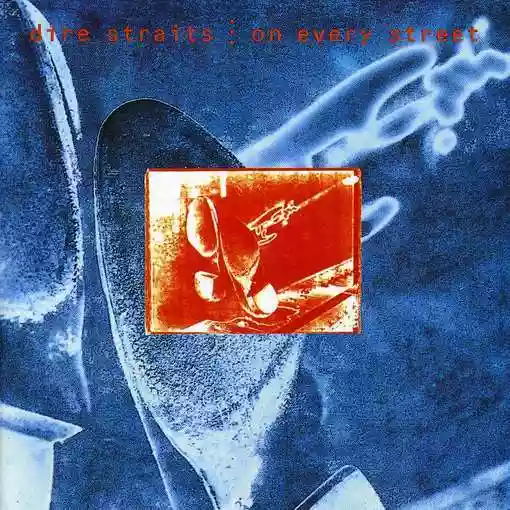
After this period of uninterrupted lights and covers, Mark Knopfler and company decided to call it quits. Thus, they returned to obscurity, with the second half of the 80s offering fans only a compilation, "Money For Nothing," containing a semi-new piece (a live version of "Portobello Belle," completely different from the studio version) and a concert in honor of Mandela held together with Eric Clapton. Meanwhile, Mark Knopfler dabbled in various alternative projects, such as soundtracks, records recorded with others (Chet Atkins and the Notthing Hillbillies group), and concerts with the aforementioned Clapton. But at the start of the new decade, the market's call became pressing, leading to the birth of "On Every Street", the sixth studio album from the revived Dire Straits.
The tour that followed gifted audiences a Mark Knopfler now with silver hair, at the peak of his technique, but somewhat lacking in sentiment. "On Every Street" doesn't fully satisfy those who waited six long years for a new album; the quality of the recordings is always excellent, but what's missing are the indelible tracks, those that make you sigh with emotion, which were usually a staple in a Dire Straits record. The album has going for it the fact that it is the most varied, in terms of presented musical genres, in the group's entire discography, confirming that Knopfler is now a master whose skill reveals itself in various forms.
"Calling Elvis" has the task of presenting the reborn Dire Straits to the public, a sort of "sorry for the delay," as well as "were you looking for us?". The audience responds more out of nostalgia than the beauty of the piece itself, which indeed, while being a good return to the scene, perfectly encapsulates the album's soul, that is, "nice, but nothing exceptional." The title track already convinces more, with a newfound Knopfler singing accompanied only by the piano before unleashing into a touching, compelling instrumental coda.
Following are the insubstantial "When it comes to you" and "Fade to black", while "The bug" is a fun rockabilly that will also find space during the ensuing tour. More fascinating is "You and your friend", where those solos are found capable of touching the heart, so missed since 1985 when those now listening to this album had not yet started to have gray hair and danced to "Walk of life" in the disco. "Heavy fuel", the second single from the album, revisits some of the "Money for nothing" style without sounding like self-celebration. Pleasant.
"Iron hand" has that country style that will characterize part of Knopfler's future solo discography, while the sweet "Ticket to heaven" adds a romantic tone to the album, further expanding the range of presented genres. "My parties" is one of the album's most successful tracks, a lively brass accompaniment colors this song with a nocturnal and vivid atmosphere, with Knopfler's voice maintaining its calm line, followed by all the instruments. "Planet of New Orleans" is another interesting episode, here the Dire Straits play with jazz, producing a piece that Sade would have liked.
"How long", finally, bids farewell to all those who followed the Dire Straits and waited so long; it does so in pure Mark Knopfler style, that is, shy and calm, as when, at the end of a concert, he raises his arm to wave goodbye with a simple gesture and a smile, wishing everyone goodnight before retreating.
Loading comments slowly
Summary by Bot
On Every Street is Dire Straits’ much-anticipated comeback album after a six-year hiatus, showcasing Mark Knopfler’s mastery across diverse genres. While the recordings are technically excellent, the album lacks the emotionally unforgettable tracks fans expected. Songs like "Calling Elvis" and "Heavy Fuel" highlight the band’s return with nostalgia, but the overall impact feels moderate. It remains a varied and skillful addition to the band's discography, marking a mature yet restrained phase in their career.
Other reviews
By claudio carpentieri
"One of the most challenging tasks of an album is to succeed in making the listener’s mind wander through their own thoughts, memories, even dreams."
"Mark Knopfler’s determination not to make 'On Every Street' a carbon copy of 'Brothers In Arms' certainly finds confirmation in listening to the album."
By Knopfler76
The purity of the guitar compensates (almost everything).
The more it ages, the more it becomes lovable.
By Knopfler76
The purity of the guitar compensates for nearly everything.
Calling Elvis, like a good Barolo. The older it gets, the more it is loved.
By marcoliam
An album that never ages annually, renews itself, shows no signs of weariness, simple rock 'n' roll with undisputed class.
"My Parties" elevates Dire Straits to perhaps the best band on the planet, blending jazz blues with surreal yet brilliant lyrics.
