
 •
Rating:
•
Rating:
THE REVIEW
Burt Bacharach and Rod Stewart, Fonzie and Richie Cunningham, Dionne Warwick and Gladys Knight, Stevie Wonder and Elton John: this song involves them all, at times in similar ways and at times differently. Ready?
Here we go!: Burt Bacharach, the late great American composer, in 1982 worked together with his collaborators on a portion of the soundtrack for the first major movie directed by Ron Howard, who played Richie Cunningham in the TV sitcom “Happy Days”. The film is titled “Night Shift”, and among its stars is none other than his idol Fonzie from “Happy Days”, that is, actor Henry Winkler. The two, at that time, were still involved in the famous TV series, which would end just a couple of years later.
One of the songs composed by Bacharach for the occasion, the subject of this review, was entrusted to the voice of Rod Stewart, who sang it in his own unmistakable style. The track is important within the film, as it closes the movie with its end credits still rolling while the song plays. The corresponding movie scene is very evocative, with the incredible nighttime skyline of New York shot from a helicopter… If you like, there's even something sinister about it, with the camera lingering for a long time on the enormous Twin Towers, symbols then of America’s commercial opulence, now of the cruel deaths of so many innocents and a warning of what arrogant and expansionist foreign policies of a great nation can bring.
Stewart's version of the song remained somewhat overlooked, without great success, not even making it onto the tracklists of his solo albums from that era. However, some time later, the great soul singer Dionne Warwick finally made peace with maestro Bacharach, whose music she had been the favored interpreter of during the seventies. They had split over some disagreement, but in 1985 they reconnected, seizing the opportunity to relive the glories of yet another ode to friendship, which so far had remained only as film music, with lyrics that are nothing extraordinary but set to music of a very high class.
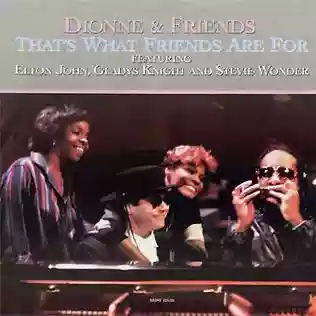
The pretext for this revival was one of the many fundraising initiatives for AIDS research, the plague of the past century. Warwick, or those around her, put together an impressive vocal quartet, consisting of her fellow African-American ex-Gladys Knight & the Pips, and the world superstars Elton John and Stevie Wonder. Quite the lineup.
The song, as is typical of Bacharach, enjoys harmonic richness and a refined, exquisite chord progression, with a profusion of unresolved fourths, minor and major sevenths, modulations out of key and sudden returns. Jazz-inflected touches, you could say, assets of that freedom and creativity in harmonizing American rhythm & blues, and so very elegant.
The four performers throw themselves in with passion, sparked by their physical closeness and mutual respect. Wonder’s chromatic harmonica introduces the track; then hostess Dionne takes the lead, handling the entire first verse and its chorus. Then, for the third verse, the peerless, blind virtuoso from Michigan comes in, at first breathing through his harmonica and then continuing with his noble voice. Getting better and better.
With the angelic vocalists having taken their turn, now come those with temperament: the verse is wrapped up by Elton, then not yet forty, and—impressive to say—in the midst of those certified soul singers, he comes across as the class dunce, despite his marvelous voice and attitude, both spiced with sincere love for star-spangled rhythm & blues. It's evident when Wonder takes over again for the second chorus… his delivery is unmatched for brightness, tone, understated attitude, perfection.
It's time for the passionate Gladys Knight, whose timbre is maybe a tad less fantastic (so to speak…) than those before her, but she’s got character to spare. She performs the chorus in full again, pushes harder than anyone, and she makes true history with a spirited vibrato at 3’07”: she nails a high C7 in “forever…” that practically brings down the saints, in columns.
The Englishman of the group insists once more for an intense, final chorus, but when the melody soars and gets tough for a man, Warwick returns to finish off his phrase, backed by Wonder, who joins her for the gentle finale of hums and chromatic whispers.
Great stuff, this by the four then-fortysomethings (from Stevie’s 35 to Dionne’s 44, with Elton at 38 and Gladys at 41). Over time the song has become an “adult” classic, like so many others by Bacharach; even criticized by some, like mystery writer Manzini who presents it as a Christmas earworm in one of his novels.
Rhythm & blues isn’t exactly my favorite genre and feel-good platitudes give me hives. But music doesn’t care about genres, context, intentions, clever or less-clever causes and messages, and when it’s good—great—music, it worms its way into your brain and finds a comfy spot to settle in for life. That’s the case, for me, with this record from forty years ago.
Loading comments slowly
Summary by Bot
The review praises Dionne Warwick’s ‘That’s What Friends Are For’ for its heartfelt message of friendship, standout collaborations, and enduring appeal. The reviewer highlights the album’s masterful soul and pop production, iconic guest artists, and timeless relevance. The work is commended for bringing together superstars and spreading an uplifting spirit. The overall verdict is highly positive and appreciative.
Dionne Warwick
American singer and enduring interpreter of the Burt Bacharach–Hal David songbook. Rose to fame in the 1960s with hits like Walk On By, I Say a Little Prayer, and Do You Know the Way to San Jose. Later topped charts with the 1985 charity single That’s What Friends Are For. Cousin of Whitney Houston.01 Reviews
