
 •
Rating:
•
Rating:
THE REVIEW
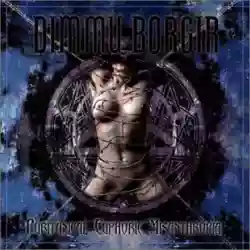
Cold, icy, destructive, direct, decadent. These are just a few descriptions, and much more, that fit the new Dimmu Borgir of 2000, after the release of the excellent Spiritual Black Dimensions. They return with an even more complete and mature album: Puritanical Euphoric Misanthropia, a mix of melody, aggression, and emotions that will surely appeal to anyone who already loves the Norwegian band.
With two line-up changes, the group gains instrumentalists of absolute relevance and highly inspired; foremost among them is the human engine Nick Barker, ex Cradle of Filth, one of the fastest and most precise drummers in the extreme scene, and the new guitarist Galder, leader of Old Man’s Child. The new work by Dimmu Borgir distinctly departs from the first albums, mainly thanks to truly well-done production. The sound of the Norwegian combo is further enriched by the excellent choice to play together with the Gothenburg orchestra, thus creating real masterpieces of pure melody.
The orchestra is indeed the ace up the sleeve of this full-length, and it can be admired in all its majesty especially in the suggestive and emotional intro “Fear and Wonder,” which seems to have come out of a horror film like F.F. Coppola's Dracula, in “Perfection or Vanity,” and in many other songs like the very fast “Indoctrination,” “Sympozium,” melodic and aggressive at the same time, and “Hybrid Stigmata,” an evocative song with a compelling chorus. Nevertheless, Dimmu Borgir keeps in mind their typically black metal origins and delights our ears with tracks oscillating between death, thrash, and, why not?, industrial, while always being well integrated with the typical keyboard parts, a trademark of Dimmu Borgir. Hence, in all their devastating power, “Blessings Upon The Throne Of Tyranny” and “Kings Of The Carnival Creation” emerge, two of the most beautiful songs on the album, the first with a clear death influence, the second with a black origin, showcasing Barker's excellent drumming. On the other hand, “The Maelstrom Mephisto” and “Architecture Of A Genocidal Nature” lean much more towards thrash, with a hallucinatory Shagrath singing over a piece of frenzied bass and keyboard.
Lastly, “Puritania”: the “strangest” song of the bunch. Industrial sounds accompany an almost constant double bass and sharp guitars. Purists need not fear: although it is an experimental track, it does not alter the group’s sound, and the black atmosphere remains intact. It is worth noting, however, that in this album, bassist Vortex sings less than in Spiritual Black Dimensions, and some songs can become tiring over time.
Dimmu Borgir thus delivers another absolutely new and personal work, which will certainly influence the upcoming releases of the Norwegian combo. Mandatory for fans, but also for those looking to approach one of the most important bands in symphonic black metal for the first time.
Loading comments slowly
Summary by Bot
The review praises Dimmu Borgir's 2001 album 'Puritanical Euphoric Misanthropia' as a mature and complete work combining melody, aggression, and emotion. It highlights the impact of new band members and the successful use of orchestral elements. Key tracks are analyzed, emphasizing the band's ability to blend black metal roots with orchestral and experimental sounds. Despite some minor critiques, the album is recommended for fans and newcomers to symphonic black metal.
Dimmu Borgir
Dimmu Borgir is a Norwegian symphonic black metal band known for combining extreme metal with prominent keyboards, choirs, and orchestral arrangements.23 Reviews
Other reviews
By CUNTGRINDER
"It's a symphonic brutal black that would frighten even the most violent Cannibal Corpse."
"Dimmu Borgir is one of my favorite black bands, not only because they are the only decent ones in Symphonic Black but also due to the beautiful rhythm section by Barker."
